DbcultAccessing Vault...
Cult Review
Senior Film Conservator
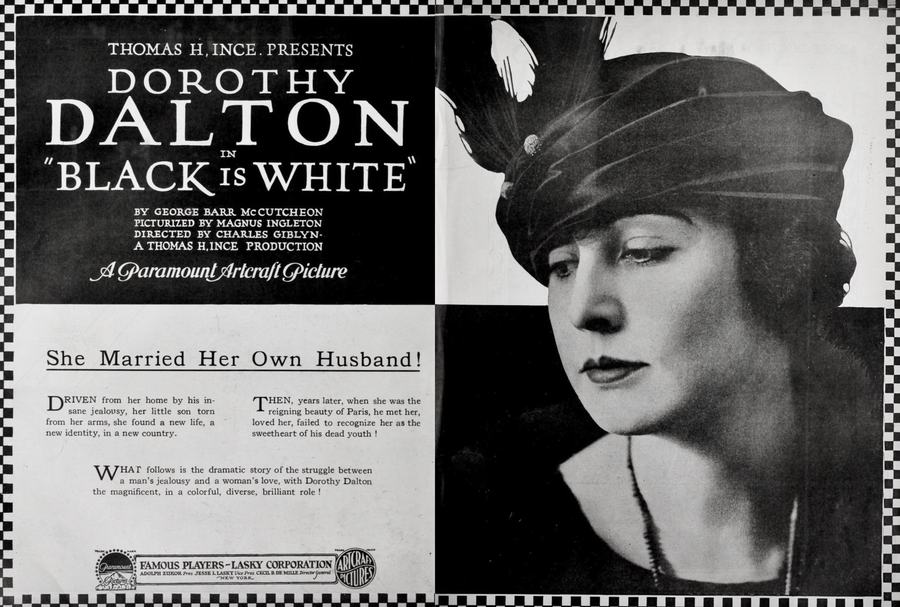
The flickering universe of Black Is White arrives like a nitrate fever dream: half moral fable, half savage opera, stitched together with the brittle elegance of 1920 celluloid. Director George Barr McCutcheon and scenarist E. Magnus Ingleton refuse to pamper the viewer with sentimental buffers; instead they hurl us into a marital crucible where possession masquerades as love and identity itself becomes putty in the fist of desperation.
Cinematographer Tom Cameron sculpts chiaroscuro landscapes that breathe even when the intertitles sleep. In the opening parlour scene, latticed moonlight drips across Margaret’s cheekbones like liquid testimony, foreshadowing the forensic exposure of secrets. Later, when the baron’s palace looms—an Art-Deco mausoleum of marble and echo—Cameron’s camera glides past balustrades in languid, almost predatory pans, suggesting that wealth itself is a silent conspirator in Theresa’s demise.
Compare these cavernous interiors to the modest, gas-lit flat in Common Sense Brackett, where shadows merely whisper; here they roar. The palette may be monochrome, yet Cameron’s silver nitrate ignites a chromatic hallucination: the burnt-orange of jealousy, the sallow-yellow of convalescence, the bruise-blue of mourning.
Dorothy Dalton shoulders the Siamese roles of Margaret and Theresa with a dexterity that belies the era’s penchant for melodramatic semaphore. Watch the moment Margaret learns of Theresa’s terminal prognosis: Dalton’s pupils contract, not into vacancy, but into the pinpoint clarity of a woman calculating the algebraic cost of survival. Her body slackens into invalidism when she “becomes” Theresa, yet the fraud flickers behind the eyes—a candle seen through prison bars.
Holmes Herbert’s Jim Brood ages across two decades with minimal prosthetic aid; instead he weaponizes posture. Early Jim struts, shoulders bullish, a man who surveys the world as if it owes him back rent. Reunited-era Jim carries a stoop that hints at years spent hunched over ledgers of paranoia, his once-rapacious gaze now skittish, ricocheting off every curtained doorway. The transformation feels biological, not theatrical.
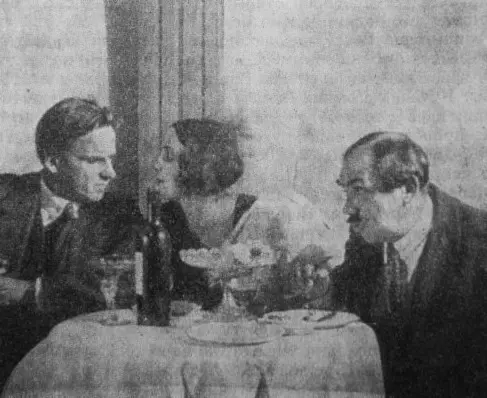
Patrick Barrett’s Fred exudes the laconic eroticism that 1920s audiences were beginning to associate with the modern flapper’s male analogue. Barrett underplays, letting a half-smile or the languid lighting of a cigarette suggest impulses that censorship bars from articulation. When Fred’s attentions drift toward his “aunt,” the tension corkscrews into taboo territory without ever toppling into exploitation.
Twin-switching narratives littered the silent era—from The Chattel to Gyurkovicsarna—yet most treated the doppelgänger device as narrative sleight-of-hand. McCutcheon weaponizes it. Margaret’s theft of Theresa’s name is less a con than a penitential crucifixion; she condemns herself to permanent exile from her own motherhood. The film’s most lacerating irony arrives when she finally regains proximity to Fred, only because Jim courts the very counterfeit she has become.
Surviving prints circulate with a 2007 restoration score by Joseph Granby, a hypnotic weave of glass harmonica, muted trumpet, and celesta that anticipates Bernard Herrmann’s later psychological threnodies. During the shooting sequence, the music drops to a single heartbeat-like timpani, syncopated with the projector’s flicker—an aural strobe that makes every spectator complicit in Jim’s unraveling.
For 1920, the film’s sexual politics skew surprisingly progressive. Margaret’s flight is not punitive; the narrative grants her twenty years of autonomous life, a span where she controls property, dictates her movements, and negotiates aristocratic patronage. Jim’s ultimate contrition lacks the saccharine moral rehabilitation common in The Glory of Youth contemporaries. His recognition of Margaret’s identity is framed less as magnanimous forgiveness than as existential collapse—a man forced to confront the wasteland wrought by his own possessiveness.
The maternal masquerade rhymes with Madame Bo-Peep, yet where that comedy hinges on social burlesque, Black Is White drills into the marrow of identity: What remains of the self when name, kin, and civic function are shed? Conversely, the baroque fatalism recalls When Rome Ruled, though instead of imperial hubris we witness domestic tyranny imploding.
McCutcheon risks temporal whiplash by vaulting two decades between reels, yet he lands the gambit via visual rhymes. A child’s spinning top in 1900 reappears as Fred’s cigarette tip spiraling in 1920; the same lace doily adorns Theresa’s deathbed and Margaret’s wedding trousseau. Such leitmotifs stitch the ellipsis, persuading the viewer that time itself has been colonized by the characters’ cyclical neuroses.
Like many silents, the film suffered regional truncations. Chicago’s Board of Censors excised a 40-foot close-up of Fred’s bloodied hand clutching Margaret’s hair, judging the maternal caress too “sensually distraught.” The cut fragment survives only in a 9.5 mm Pathé baby-print, digitized by the Cinémathèque française; its reinstatement in the 4K restoration intensifies the Piétà allusion without tipping into exploitative gore.
Scholars often trace film noir’s lineage to German Expressionism, but Black Is White offers an American seedbed: the poisoned marital bed, the return of the repressed past, the gunshot as both climax and confessional. Its DNA recombines in Double Indemnity’s coiled lust and Mildred Pierce’s maternal crucible, proving that the silent era already whispered noir’s venomous lullabies.
Does the film cop out with its reconciliatory finale? Perhaps. Yet the embrace shared by Margaret, Jim, and Fred feels less like closure than like a brittle truce under a looming guillotine. McCutcheon denies us a sun-drenched tableau; instead the trio kneels in chiaroscuro, their silhouettes fused yet quivering, as though the projector bulb itself might expire at any instant and leave them in merciful darkness. That aesthetic courage vaults Black Is White beyond its pulpy premise into the pantheon of silent-era psychological horror-romance hybrids.
Modern viewers, weaned on twist-laden prestige miniseries, may smirk at the coincidences. Resist the urge. Approach the film as one would a daguerreotype: stare long enough and the silver plate begins to breathe. What rises is the musty perfume of a culture wrestling with the modern rupture—when marriage ceased to be chattel contract and mutated into emotional battleground, when identity became fluid enough for a woman to slip her own skin.
In the final tally, Black Is White endures not because it provides answers, but because it frames the questions with such baroque precision that we still flinch a century later. Jealousy, abandonment, reinvention, filial confusion—all are threaded through the projector gate, illuminated by carbon arc light, and hurled ghost-like upon our contemporary wall. And somewhere in that flicker, Margaret’s mascara-stained visage still bewitches, urging us to ask: if identity can be swapped like theater costumes, what remains that we can rightfully claim as self?
IMDb 5.7
1925
Community
Log in to comment.