DbcultAccessing Vault...
Cult Review
Senior Film Conservator
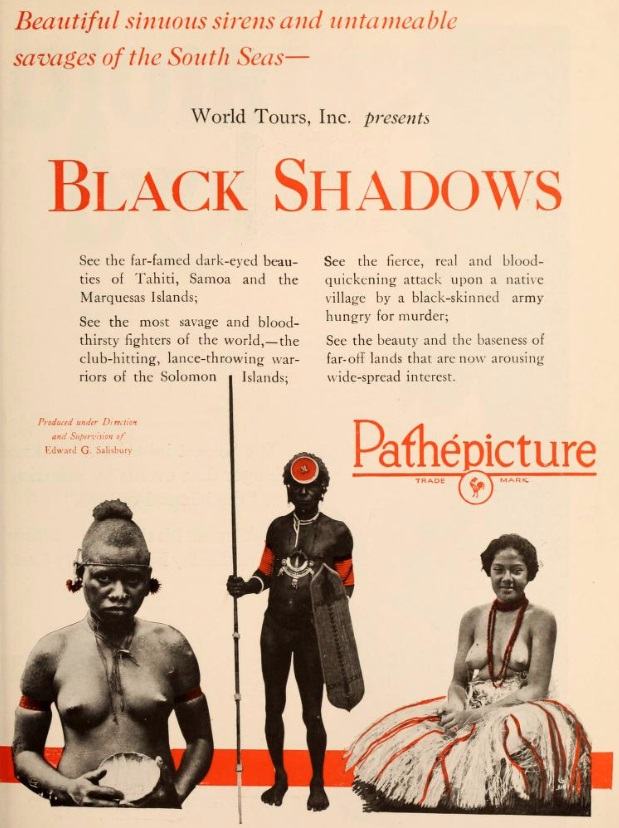
To watch Black Shadows in the twenty-first century is to engage in a profound act of temporal and cultural excavation. Released in 1923, this silent travelogue, helmed by the intrepid Edward A. Salisbury, stands as a monumental artifact of the ethnographic gaze. While modern audiences might initially recoil at the colonial undertones inherent in its title, the film itself offers a complexity that transcends mere exploitation. It is a work of startling visual ambition, capturing a world that was, even then, rapidly receding into the shadows of global modernization. Unlike the structured domesticity of Let Katie Do It, Salisbury’s work abandons the comfort of the parlor for the unpredictability of the archipelago.
The narrative arc—if one can call the meandering path of an expedition a narrative—begins with an almost religious reverence for the landscape. The Marquesas are presented not as mere geography, but as a dreamscape. Here, the cinematography achieves a level of poetic density rarely seen in the era's non-fiction works. The play of light across the volcanic crags and the dense, verdant canopies creates a chiaroscuro effect that justifies the film’s title. It is a visual language that feels more akin to the somber, atmospheric weight of Stormfågeln than the typical sun-drenched postcards of the period.
Edward A. Salisbury was not merely a filmmaker; he was an explorer with a penchant for the spectacular. In Black Shadows, he balances the role of the objective observer with that of the showman. When the expedition reaches the Solomon Islands, the tone shifts from the pastoral to the primal. The depiction of headhunters and cannibals is handled with a mixture of clinical curiosity and sensationalist dread. It is here that the film mirrors the propagandistic intensity of My Four Years in Germany, though its enemy is not a political entity but a perceived 'savagery' that the Western mind sought both to fear and to document.
The war dances in Fiji are captured with a kinetic energy that defies the static limitations of early 1920s equipment. Salisbury manages to frame these rituals with a respect for their internal logic, even as the intertitles suggest a hierarchy of civilization. This tension makes the film a fascinating companion piece to Martyrs of the Alamo; both films are obsessed with the boundaries between 'us' and 'them', though Black Shadows finds its conflict in the physical distance of the South Seas rather than the historical friction of the frontier.
One of the most poignant sequences in the film is the pilgrimage to the grave of Robert Louis Stevenson on Mount Vaea in Samoa. This moment serves as a spiritual anchor for the entire expedition. In the midst of documenting 'primitive' customs, Salisbury pauses to honor a titan of Western literature who found his final peace among the very people the film seeks to categorize. The juxtaposition is striking. It reminds the viewer that the Pacific was not just a laboratory for ethnographers, but a sanctuary for those fleeing the rigid structures of European society—structures perhaps best exemplified by the social dramas of Paid in Full.
The volcanic activity captured on film provides a literal and metaphorical heat. The bubbling lava and sulfuric plumes serve as a reminder of the volatile earth upon which these cultures exist. There is a sense of existential fragility here that one might find in the high-stakes political turmoil of Zhizn i smert leytenanta Shmidta. Both films, in their own disparate ways, deal with the forces of nature—human and geological—that threaten to overwhelm the individual.
To truly appreciate Black Shadows, one must look at what it is not. It lacks the whimsical artifice of Artless Artie or the pedagogical rigidity of Oh, Teacher!. Instead, it possesses a raw, unscripted quality that feels startlingly modern. While the film was certainly edited to appeal to a specific Western curiosity, the raw footage of the Solomon Islanders possesses a dignity that refuses to be fully subverted by the editorial hand. In this way, it achieves a level of 'truth' that even the most earnest war documentaries, like Allies' Official War Review, No. 27, often struggle to maintain due to their inherent bias.
Furthermore, the film’s exploration of gender and native life offers a sharp contrast to the era's fictional portrayals. Where The Little Yank uses femininity as a tool for narrative sentimentality, Black Shadows observes the women of the South Seas within the context of labor, ritual, and community. There is no attempt to 'Hollywood-ize' their existence, even if the camera lingers with a voyeuristic intensity that would be questioned today.
Technically, the film is a triumph over environment. Transporting heavy cameras and volatile nitrate film through the humidity and salt spray of the Pacific was a Herculean task. The clarity of the images—restored versions show a surprising depth of field—speaks to Salisbury’s skill. He wasn't just capturing movement; he was composing frames. Some of the wider shots of the Samoan coastline have the majestic sweep of a historical epic like Ave Caesar!, yet they are grounded in a tangible, salt-crusted reality.
The pacing of the film is also noteworthy. It avoids the frantic cutting of contemporary comedies like Niniche, opting instead for a contemplative rhythm that allows the viewer to absorb the details of the costumes, the architecture of the huts, and the expressions of the people. This slow-burn approach builds a sense of immersion that is almost hypnotic. It demands a level of attention similar to the stage-to-screen transitions of David Garrick, where the nuance of performance (or in this case, the nuance of existence) is paramount.
In the final analysis, Black Shadows is a film of contradictions. It is a document of discovery that is also a document of intrusion. It celebrates the beauty of the South Seas while simultaneously framing its inhabitants as 'others' to be studied. Yet, its value as a historical record is peerless. It provides a visual link to a world that has been irrevocably altered by the very forces of 'progress' that the film’s existence represents. When compared to the existential searching of Hope, Salisbury’s film seems to suggest that the answer to our questions lies not within the soul, but in the vast, unexplored corners of the map.
Whether one views it as a masterpiece of early documentary or a problematic relic of colonial history, Black Shadows cannot be ignored. It is as haunting and elusive as the title suggests. It invites us to look into the past, not to find answers, but to see the questions that were being asked a century ago. Does the camera capture reality, or does it create a new one? Much like the spiritual inquiries in Do the Dead Talk?, Black Shadows leaves us wondering what remains of the people and places once the camera stops rolling and the shadows finally claim the screen.
Salisbury’s journey was more than a travelogue; it was a confrontation with the limits of Western understanding. By the time the final frame flickers out, we are left with a sense of profound loss—not for the film itself, but for the untamed world it briefly held in its silver-nitrate grasp. It is a essential viewing for any serious student of cinema, offering a raw, unfiltered look at the power of the moving image to preserve, to distort, and to immortalize.
Review by the Cinematographic Chronicler.
IMDb —
1922
Community
Log in to comment.