DbcultAccessing Vault...
Cult Review
Senior Film Conservator
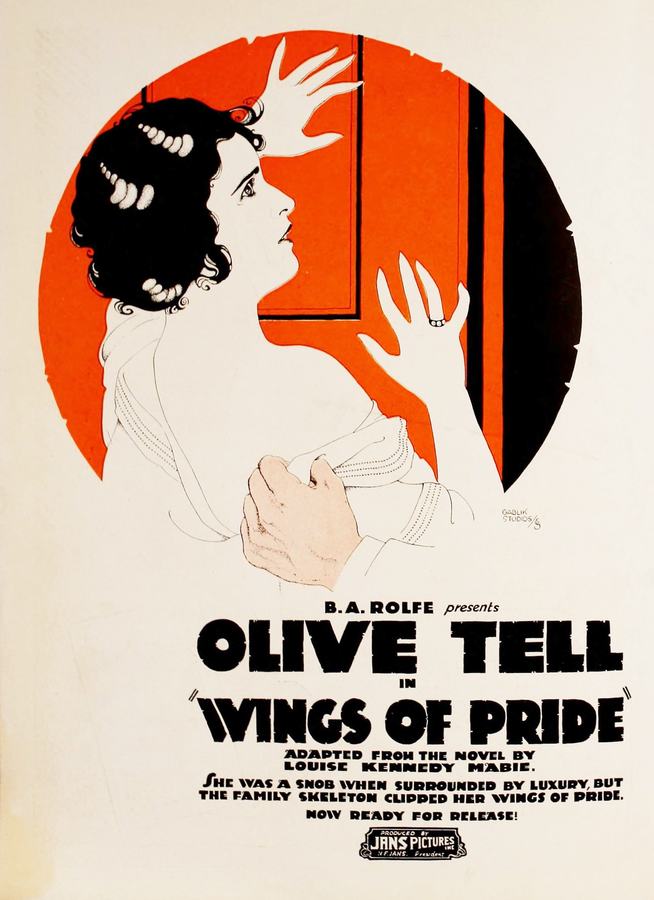
The first time we see Olive Muir she is a cathedral of entitlement, lacework rising like Gothic spires around her throat, eyes two cobalt stained-glass windows admitting no light inward. Director John B. O’Brien lets the camera linger until the glamour itself becomes a character—one that will soon be flayed alive.
Silent-era audiences, drunk on The American Beauty’s parade of orchid-festooned debutantes, thought they knew the recipe: take one platinum heiress, season with a sprig of harmless class anxiety, bake until the wedding bells ring. Wings of Pride tosses that recipe into the ashcan, douses it with moonshine, and strikes a match.
Louise Kennedy Mabie’s scenario weaponizes melodrama the way a surgeon wields a scalpel—no gesture wasted, every incision exposing raw sinew of social pretense. When Olive learns her blood is not bluer than heaven but browner than beer, her collapse is not the usual fainting spell; it is a seismic fracture shot in chiaroscuro, the chandelier above her shivering like a guilty verdict. Olive Tell plays the moment with mouth agape, not in silent-mime shock but in the existential gasp of someone whose entire past has been swapped for a counterfeit.
Cut to the rattling train carving westward through ink-black night. Cinematographer Denton Vane straps the camera to the cowcatcher—an effect later cribbed by The Square Deal—so the audience hurtles head-first into Olive’s exile. Each sleeper tie that whizzes past feels like a social rung dropping away.
The film’s second act relocates us to a frontier outpost that reeks of sagebrush and political graft—think The Captive’s desert austerity but with a populist pulse. Kavanaugh (a serpentine Edwards Davis) rules from a saloon cum courthouse, his pocket-watch chain looped like a hangman’s noose across his girth. He wants Olive as arm candy and her father’s vote in the same breath; the transactional leer anticipates every workplace-power-abuse drama a century later.
Enter Kent Ordway—John D. Walsh gives him the stoic magnetism of a young Lincoln, all elbows and ideals. Their friendship grows not through bouquets but through law books passed across splintered tables, a meeting of minds so quietly radical that a 1920 audience might have thought it science fiction. Watch the way Olive’s gloved finger hesitates over a statute citation; the quiver is erotic, intellectual, existential—three syllables of selfhood at last escaping the society page.
The siege on Ordway’s cabin—lit by guttering oil lamps that smear shadows across plank walls—plays like a Rembrandt dragged through gunpowder. Prentice, sober for the first reel, sacrifices himself to save the man his daughter now loves. O’Brien choreographs the brawl with barrels overturning, children of Babel shouting, and a bullet that enters a Bible on the mantel and exits through Revelations. The moment is baptism by blood, the old reprobate’s corpse sealing Olive’s deliverance from both paternal shame and social determinism.
Back East, the Muir townhouse looks refrigerated, every marble bust sniffing at the prairie dust on Olive’s hem. The film’s most subversive stroke arrives when she confronts Alice and Dick—no hair-pulling, no champagne-tossing. Instead, Olive removes her engagement ring, places it in Alice’s palm, and closes the girl’s fingers over it like a benediction. In that hush you can hear the corset of 19th-century plotting rip open; compare it with the infantilized rivalries of Dimples and you’ll see why censors in Chicago trimmed this scene, fearing copycat renunciations.
Though monochromatic, the tinting strategy speaks volumes. New York sequences shimmer in icy blue, suggesting refrigerated hearts; the prairie glows amber, as if the film itself has caught jaundice from the whiskey-soaked air. During Prentice’s death, the screen floods with crimson—hand-tinted frame by frame—until the image seems submerged in a chalice of communion wine. These chromatic choices prefigure the expressionist jolts of The Lash of Destiny and deserve an entire dissertation the academy has yet to write.
Olive Tell’s face is a palimpsest: layer arrogance, scrape it away, reveal raw shame, then tentative hope. Watch her eyes in the final close-up—shot in medium format, a luxury for 1920—pupils dilated like someone staring into the mouth of a new continent. Walsh counters with a minimalist magnetism; he barely lifts an eyebrow yet you feel the moral tectonic plates shifting beneath his boots. Together they achieve what few silent couples managed: erotic tension without histrionic clutching.
Edwards Davis chews scenery but with surgical precision; every villainous grin is bracketed by micro-tremors of self-loathing, hinting that Kavanaugh, too, is shackled to the very machine he operates. It’s a complexity miles away from the mustache-twirling caricatures populating Mesék az írógépröl.
Mabie and Clark lace the intertitles with aphorisms that bruise: ‘Pedigrees rot faster than potatoes.’ ‘A ballot in the wrong fist is a bullet in the right one.’ Such lines, far from the florid platitudes of Miss Meri, function like paper-cut incisions—small, swift, memorable. They also smuggle progressive talking points into entertainment the way smugglers once slipped contraband through Prohibition checkpoints.
The cut from the prairie shootout to Olive’s gloved hand knocking on the Muirs’ polished door is so abrupt it feels like a slap. That ellipsis—compressing a transcontinental journey into a heartbeat—mirrors the way trauma collapses time. Modern viewers raised on The Man Who Would Not Die’s rapid montage will still find this transition startlingly fresh.
Because it refuses to tether redemption to romance alone. Olive’s arc completes not when Ordway confesses love but when she forgives herself for the decades of condescension she cannot un-speak. The closing iris shot tightens on her smiling through tears—an image that dissolves into the film’s sole superimposition: a pair of wings sketched against the dawn. Not angel wings; they look cut from newspaper, a reminder that identity is printed daily, mutable, open to revision.
A comic-relief stablehand (Ida Pardee) belongs in another picture—imagine dropping a pie-fight reel into Ibsen. And the 78-minute existing print, cobbled from two archives, suffers a missing reel that forces viewers to surmise how Olive extracts her father’s contrition. Yet even that lacuna works inadvertently, compelling us to imagine the groveling that words couldn’t capture.
Wings of Pride is a phoenix rising from the ash heap of silents presumed lost. It anticipates the feminist swagger of 1970s New Hollywood, the class-conscious noir of 1940s Warner Bros, and the ethical ambiguities of golden-age Japan. Most silents ask you to read their intertitles; this one asks you to read your own complicity in caste, in the stories we inherit like hand-me-down corsets. Stream it if you can—though currently only 16mm circles project it in repertory houses. Bring friends; bring enemies; bring the smug certainty that silent movies are quaint. Then watch this film peel that certainty off like old varnish, revealing the raw, pulsating grain of what cinema can still become.
IMDb 6
1936
Community
Log in to comment.