DbcultAccessing Vault...
Cult Review
Senior Film Conservator
A Symphony of Contraband and Heartbeats
If Josef von Sternberg had inhaled the same ether as Proust and then decided to shoot a crime melodrama on a freighter bucking through a midnight typhoon, the resulting fever dream might resemble Blackbirds—a 1920 curiosity that has slipped through the cracks of canonical silence like liquefied onyx. The film’s very title is a misdirection: blackbirds as in the smuggler’s code for crates of rifles, blackbirds as in the bruises blooming under clavicles after a clandestine embrace, blackbirds as in the jazz-age omen of doom that chirps in syncopation with a snare drum. The plot, deceptively linear, loops upon itself like a Möbius strip lacquered in Chanel No. 5 and gun oil.
Leonie Sobatsky, incarnated by Mabel Bert with the feral languor of a panther napping on velvet, first appears reflected in a porthole: the image wavers, half-submerged, as though the Atlantic itself hesitates to carry her. She boards the SS Erewhon under the guise of a bereaved opera patron escorting a sealed casket—inside which nestles not a corpse but a constellation of emeralds rough-cut in Colombian mines. Her swagger is calibrated to the millimeter: every heel-click on the deck syncs with the ship’s chronometer, every exhale of Egyptian cigarette smoke forms a sigil dissolving into brine. William “Stage” Boyd’s Nevil Trask, all angular cheekbones and sketchbook, counters her theatrical precision with a seeming improvisation. He doodles her silhouette in charcoal, then tears the page, letting the scraps flutter overboard like black confetti. The camera—stubbornly static by today’s standards—lingers on those scraps until they resemble a funeral for images not yet committed to memory.
What elevates the drama above its pulpy premise is the film’s commitment to sensory contradiction. Love scenes are staged in meat lockers, the lovers’ breath vaporizing between them like contraband spirits; action sequences unfurl in boudoirs awash in peacock feathers and spilled perfume. The screenplay, attributed to Harry James Smith and Clara Beranger, brandishes epigrams that curl like cigarette smoke: “Loyalty is just a brand of lipstick that smears when the night grows humid.” In one bravura iris-shot, Leonie’s pupils dilate until the screen itself appears to be swallowed by a black hole; the next frame reveals Trask’s badge lying on her bedside table, its nickel surface reflecting her eye—an ouroboros of surveillance and seduction.
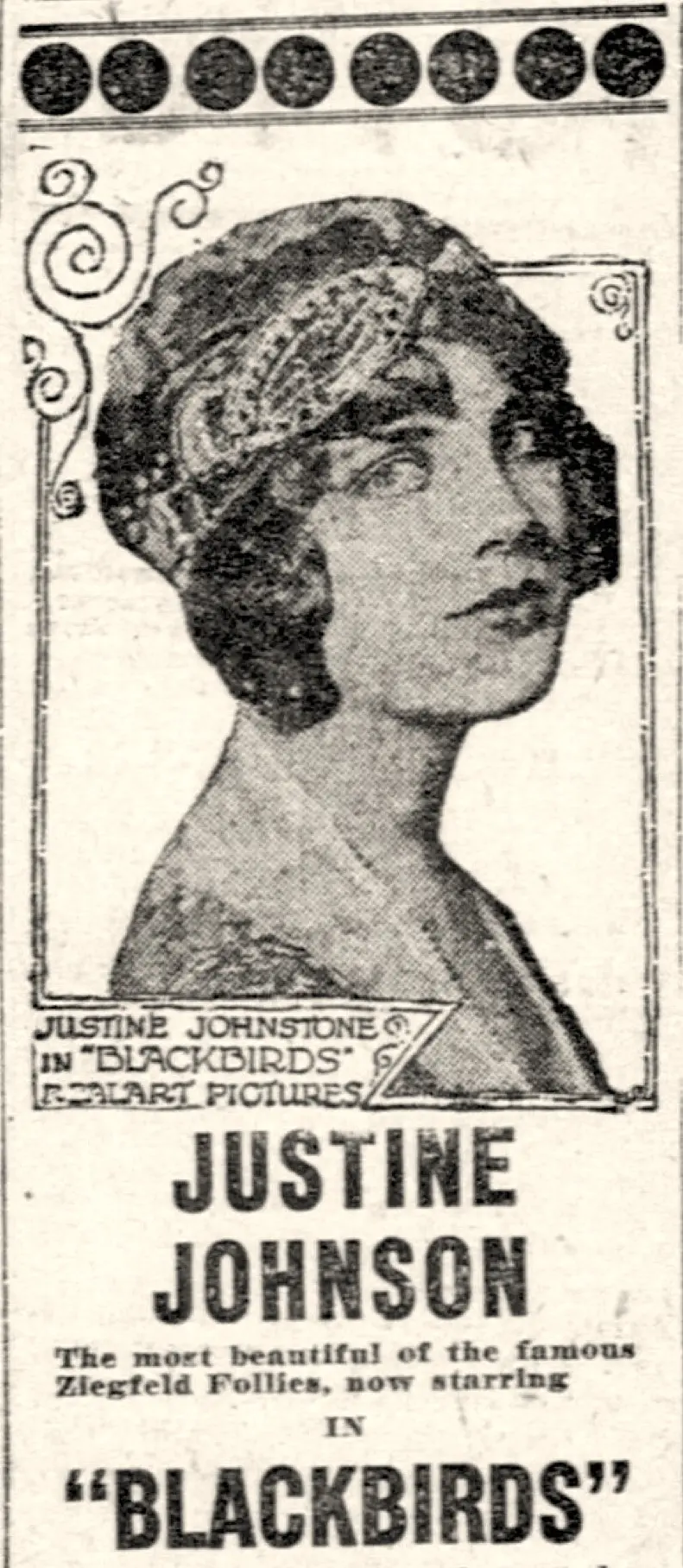
Critics weaned on Zagadochnyy mir’s kaleidoscopic mysticism or the flapper fatalism of The Chorus Girl’s Romance might fault Blackbirds for its narrative austerity—there are no dream ballets, no expressionist skylines tilted at vertiginous angles. Yet austerity here is strategy, not limitation. Director (and erstwhile stage maestro) Charles K. Gerrard opts for chiaroscuro minimalism: hallways reduced to slanted rhombuses of light, faces half-eclipsed by shadow as though the universe itself conspired to hide its double agents. The effect is Hitchcockian before Hitchcock, a cinema of negative space where what is withheld feels more erotic than what is revealed.
Musically, the original score—performed live in palatial moviehouses—was a mongrel of habanera rhythms and funeral-march brass, reportedly prompting Variety to quip that “every note smuggles itself across the footlights.” Sadly, no recordings survive; modern restorations substitute a commissioned suite that flirts with noir saxophonia, yet the dissonance between 1920 sensibilities and post-Miles Davis coolness injects a welcome anachronism, as though the orchestra itself were undercover.
Performances oscillate between heightened mime and proto-method naturalism. Mabel Bert negotiates that tightrope with feline poise: her Leonie never begs for sympathy, yet when she unhooks a diamond necklace in close-up—each facet catching the projector beam like a miniature supernova—her lower lip trembles a millimeter, betraying the terror of a woman who has weaponized beauty so thoroughly she no longer recognizes her own face beneath the lacquer. Boyd, saddled with the moralistic foil, sidesteps Victorian starch by playing Trask as a man erotically undone by his own espionage; his pupils mirror Leonie’s, twin black moons caught in mutual orbit. In supporting corridors, Marie Shotwell’s gin-soaked countess dispenses fatalistic bon mots with Tallulah-esque drawl, while Walter Walker’s customs inspector exudes the weary rectitude of a Tiresias who already knows every bribe will bounce.
Comparative contextualization illuminates Blackbirds’ idiosyncratic pulse. Where The Flames of Chance hinges on roulette-table fatalism and A Heart in Pawn wallows in masochistic martyrdom, this film locates peril within mutuality: the moment both masks slip, the lovers do not retreat into moral homilies but accelerate, hand-in-hand, toward the abyss. Their downfall lacks tragic grandeur; it feels closer to entropy, like pearls scattered across a nightclub floor—glittering, irreclaimable, rolling underfoot to trip the next pair of dancers.
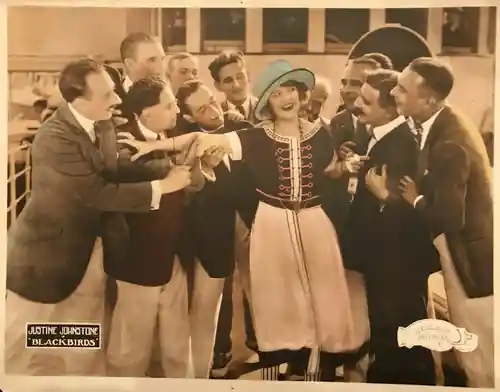
Cinematographer Alex Saskins—later eclipsed by the meteoric rise of Lee Garmes—composes frames that anticipate von Sternberg’s optical fetishism. Note the shot where Leonie’s cigarette tip glows inside a darkened stateroom while, through a porthole behind her, dawn blooms: the warm ember and cold sunrise occupy the same visual plane, a dialectic of desire and exposure. Saskins also experiments with under-cranking during a chase through Marseille fish market, the flicker imparting a staccato urgency that predates the Neue Sachlichkeit street footage of the late twenties.
Gender politics, inevitably, invite contemporary scrutiny. Leonie commands an international syndicate, yet her authority is predicated on allure—an ambiguity the film neither celebrates nor condemns. One could argue that the narrative punishes her autonomy by scripting love as the kink in her armor; conversely, Trask’s emotional surrender undermines institutional patriarchy, leaving both genders ship-wrecked. The final tableau—passengers waving from the departing liner—offers no triumphant resolution, only a horizon that devours names, passports, and perhaps the very notion of moral bookkeeping.
Archival history proves as murky as the plot. Prints circulated in Europe under the alternate title Les Oiseaux Noirs, occasionally truncated by censorship boards queasy over narcotics references. A nitrate dupe was rumored lost in the 1965 MGM vault fire, yet a 9-reel carbon print surfaced in a disused Jesuit monastery outside Lyon in 1987, complete with French intertitles scrawled in purple ink—apparently hand-colored by some cinema-smitten novice. The 2022 4K restoration by Eye Filmmuseum grafts those French cards onto an English master, producing a bilingual ghost-text where meanings shimmer and diverge like overlapping transparencies.
For the cine-curious, Blackbirds offers a portal into an era when the thriller still carried the perfume of melodrama, when smugglers quoted Rimbaud and G-men sketched portraits between gunfights. It is not a pristine museum artifact but a bruised pearl—its imperfections the very fissures through which its illicit luster leaks. Watch it not for propulsive plot machinery, but for the moment Leonie trails her gloved finger along Trask’s sketch of her face, smudging the charcoal until identity itself liquefies—a fleeting, flicker-born testament to the criminal ecstasy of being seen.
Recommendation: pair with a rye old-fashioned, the lights dimmed so low your pupils dilate like Leonie’s, and the volume cranked until the saxophone seems to emanate from the walls. Let the film smuggle you, one frame at a time, into the black-feathered night that predated neon—an empire of shadows where every kiss leaves a chalk outline and every diamond carries the blood of someone’s last illusion.
IMDb 7.1
1933
Community
Log in to comment.