DbcultAccessing Vault...
Cult Review
Senior Film Conservator
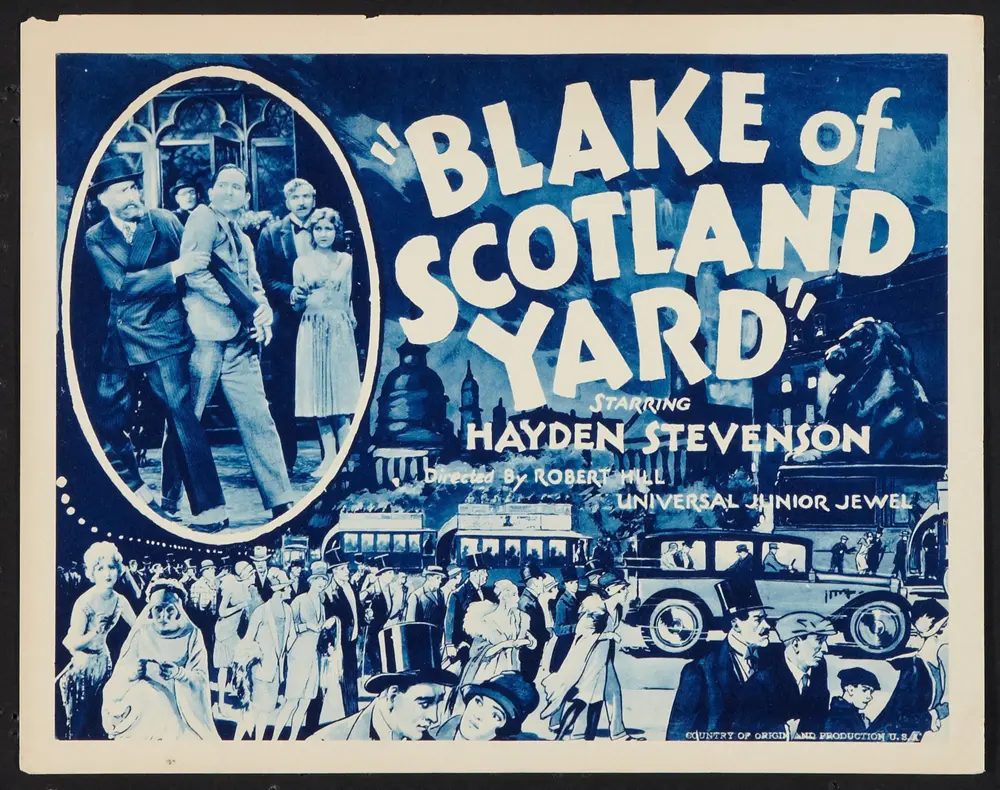
Is Blake of Scotland Yard worth watching today? Short answer: yes, but with significant caveats. This serial is a fascinating relic for specific audiences, but it actively repels others. It exists as a time capsule, offering a window into early cinematic storytelling and the nascent days of the action-adventure serial.
This film is undeniably for the ardent film historian, the dedicated serial enthusiast, or anyone with a deep curiosity for how popular entertainment functioned almost a century ago. It is not for viewers seeking modern pacing, sophisticated narrative complexity, or high production values. If you demand immediate gratification or polished contemporary filmmaking, you will find this an arduous watch.
Let’s get straight to it:
At its heart, Blake of Scotland Yard is a masterclass in persistent pursuit, a narrative spine that would underpin countless thrillers for decades to come. The plot, as expected for a serial of its vintage, isn't about nuanced character arcs or moral ambiguities; it's a straightforward, almost primal battle of wits between the unwavering Inspector Blake and a shadowy, often ludicrously inventive, criminal mastermind. The antagonist, a figure of theatrical villainy, presents a series of increasingly elaborate schemes, each designed to test Blake's resolve and deductive prowess.
The strength of this episodic structure lies in its inherent momentum. Each chapter, often clocking in at around 20-30 minutes, is a self-contained mini-drama, culminating in a genuinely perilous situation for our hero. This creates a compelling, if somewhat repetitive, rhythm. You’re not watching for intricate twists, but for the sheer spectacle of Blake escaping yet another impossible trap, whether it’s a collapsing building or a devious gas attack. The writers, Robert F. Hill and William Lord Wright, understood the assignment: deliver thrills, and deliver them fast.
However, this relentless pursuit of thrills comes at a cost. The narrative often sacrifices logical consistency for dramatic impact. Plot holes are less 'holes' and more 'caverns,' gaping chasms that require a generous suspension of disbelief. Characters appear and disappear with little explanation, and motivations can shift with the convenience of the plot. For instance, a villain’s elaborate death ray might be introduced in one chapter only to be inexplicably abandoned in the next for a more conventional car chase. It's a charming kind of narrative chaos, but chaos nonetheless.
The pacing, while brisk within each episode, feels jarring when viewed as a whole. The abrupt cliffhangers, designed to compel weekly attendance, can feel frustrating when consumed in a single sitting. It’s less a flowing river and more a series of distinct, energetic splashes. This isn't necessarily a flaw, but a characteristic of the form, requiring a different viewing mindset. It's a style that modern cinema has largely abandoned, often for good reason, but occasionally to its detriment in terms of pure, unadulterated pulp fun.
“The real star isn't Blake, but the sheer audacity of the production for its time, attempting such scale on a shoestring budget. It's a testament to the era's ingenuity, even when it often falters.”
The acting in Blake of Scotland Yard is, predictably, a product of its time. The theatricality that dominated early sound cinema is on full display, with broad gestures, exaggerated facial expressions, and often declamatory line readings. Subtlety was not a common virtue, and for many, this will be the biggest hurdle to overcome.
George Burton, in the titular role of Inspector Blake, embodies the stoic, unwavering hero. His performance is less about internal struggle and more about projecting an image of unshakeable competence. He's the audience's anchor, a steadfast presence amidst the swirling chaos. While not a performance of immense depth, it serves the serial's purpose admirably, providing a reliable figure to root for. His intensity, though sometimes bordering on stiffness, is effective in conveying Blake's dedication.
Hayden Stevenson, Walter Brennan, and the rest of the ensemble cast fill out the various roles of henchmen, damsels, and supporting officers. Walter Brennan, even in these early stages of his career, occasionally hints at the distinctive character actor he would become, though his performance here is largely constrained by the serial's demands for archetypes rather than fully fleshed-out individuals. His presence, however brief, lends a certain gravitas, a hint of the talent that would later earn him multiple Academy Awards.
The villains, in particular, often lean into pure caricature. They snarl, they gloat, they cackle. This isn't a flaw; it's a feature of the genre. The audience isn't meant to empathize with them but to revel in their delicious wickedness. Monte Montague, for example, often plays the brutish henchman with a physicality that is both menacing and, at times, comically over-the-top. These performances, while not aiming for realism, are crucial in establishing the clear moral boundaries necessary for a serial of this nature. They are less 'acting' and more 'embodying a function within the narrative machine.'
Robert F. Hill, as director, delivers a functional rather than artistically ambitious piece. The direction is straightforward, prioritizing clarity and narrative propulsion over visual flair. The camera is largely static, serving to capture the action rather than interpret it. This isn't to say there aren't moments of effective staging; the tight framing of a tense confrontation or the wide shot of a vehicle chase often serves its purpose well. However, those seeking the visual poetry of a Murnau or the dynamic compositions of a later-era director will be disappointed.
Cinematography, too, adheres to the practical demands of serial production. Lighting is generally flat, designed to ensure visibility rather than create mood or atmosphere. There are few deep shadows or artful compositions. The focus is on getting the shot, capturing the action, and moving on to the next setup. This utilitarian approach is understandable given the rapid production schedules and limited budgets typical of serials. For example, a scene set in a supposed 'secret laboratory' might feature rudimentary props and stark, uninspired lighting, relying more on the dialogue and the concept to convey its fantastical nature than on visual immersion.
Despite these limitations, there's a certain raw energy that permeates the film. The practical effects, while often charmingly crude by today's standards, demonstrate ingenuity. Explosions might be obvious miniatures, and stunts might be clearly performed by doubles, but the commitment to delivering spectacle, however modest, shines through. It’s a testament to the grit and determination of early filmmakers, often inventing techniques on the fly. The lack of pretension is, in its own way, refreshing. This isn't trying to be high art; it's trying to entertain, and often, it succeeds on that basic level.
The pacing of Blake of Scotland Yard is a double-edged sword. Each individual chapter is designed for maximum impact, racing through its plot beats to arrive at a dramatic cliffhanger. This creates an immediate, exciting rhythm that keeps you engaged for the duration of a single episode. The constant threat, the rapid succession of peril and escape, is the engine that drives the serial forward.
However, when viewed as a complete narrative, the cumulative effect can be one of exhaustion. The repetition of the 'hero in peril, hero escapes' cycle, while thrilling in isolation, can become predictable over many hours. There’s little room for quiet reflection or character development; the plot must always be moving. This means that while some chapters feel incredibly dynamic, others can feel like filler, simply setting up the next dramatic beat without adding substantial value to the overarching story.
The tone is consistently melodramatic, bordering on camp for modern sensibilities. Villains are dastardly, heroes are noble, and stakes are always life-or-death. There's little room for irony or subtlety. This earnestness is part of its charm. It fully commits to its pulp aesthetic without apology. The film doesn't wink at the audience; it demands their full, uncritical surrender to its fantastical world. For instance, a scene where Blake is trapped in a room filling with poison gas might be played with such heightened drama, complete with bulging eyes and frantic hand gestures, that it elicits a chuckle today, but in its original context, it was pure, unadulterated suspense.
This unwavering commitment to its tone is, in my opinion, one of its strengths. It never tries to be something it's not. It understands its audience and delivers exactly what they expect from a serial: escapism, adventure, and a clear distinction between good and evil. It's a brutal simplicity, but an effective one for the genre.
This film is absolutely for: film historians, fans of early cinema, enthusiasts of detective serials, and anyone interested in the evolution of genre storytelling. If you appreciate the raw, pioneering spirit of early filmmaking and can forgive technical shortcomings for the sake of historical context, you will find value here. It's also a great watch for those who enjoy the pure, unadulterated escapism of pulp fiction.
This film is definitively not for: viewers accustomed to modern pacing, complex narratives, and subtle performances. If you struggle with dated special effects, overt melodrama, or the episodic nature of serials, you will likely find this a tedious experience. It requires a specific kind of patience and an appreciation for cinematic antiquity.
Its uniqueness lies in its unvarnished representation of a bygone era of entertainment. It’s a direct ancestor to modern action franchises, a blueprint for the hero’s journey that still resonates. The sheer volume of peril Blake faces, and the ingenuity (however improbable) of the villain's schemes, is a testament to the creative energy of the time.
The story is engaging in its episodic segments. Each cliffhanger is designed to hook you. However, the overarching narrative, when viewed in its entirety, can feel repetitive due to the nature of serial storytelling. It's more about the journey through many perils than a single, tightly woven plot.
Blake of Scotland Yard is not a film for everyone, nor does it pretend to be. It is a historical artifact first, a compelling story second. It works. But it’s flawed. Its true value lies not in its ability to compete with modern blockbusters, but in its power to transport you to a different era of filmmaking, an era where ingenuity often compensated for limited resources, and pure, unadulterated adventure was king.
If you approach it with an open mind, a sense of historical curiosity, and a genuine affection for the foundational tropes of the action-adventure genre, you will find a surprisingly engaging, if occasionally clunky, experience. It’s a testament to the enduring appeal of a determined hero facing down an impossible foe. For a deeper dive into early cinematic thrills, you might also consider classics like The Mysterious Mr. Tiller or The Collegians, which offer different facets of serial storytelling. Ultimately, Blake of Scotland Yard is a window into a bygone era of cinematic ambition, and for the right audience, that alone makes it worth the watch. It’s a fascinating, if sometimes frustrating, piece of film history that deserves to be seen, even if not universally loved.
IMDb —
1920
Community
Log in to comment.