DbcultAccessing Vault...
Cult Review
Senior Film Conservator
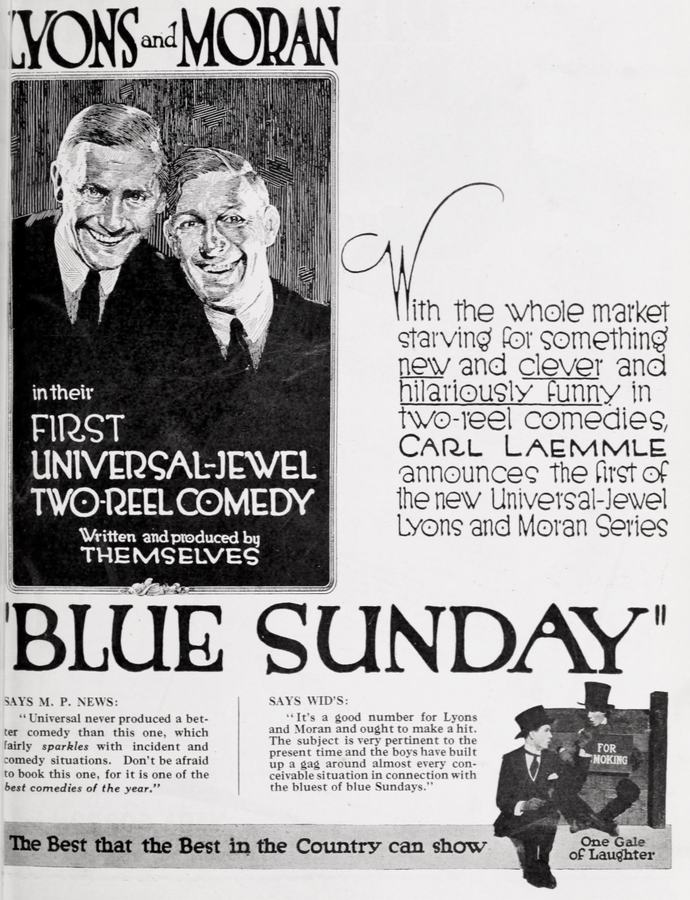
The first time I watched Blue Sunday I expected a quaint curio—another pre-Code bauble exhumed by archivists with twitchy grant money. What flickered on my screen was something far more subversive: a 58-minute middle finger to every bureaucrat who ever tried to legislate the human pulse.
Scott Darling’s screenplay treats the municipal code like tinfoil, folding it into origami cranes before setting the whole flock alight. The premise—marry or be taxed into celibate penury—sounds almost cute until you remember contemporary headlines about bachelor taxes in Alone in New York territory. The film’s genius is speed: exposition detonates in the first 90 seconds, leaving scorched earth for character comedy to bloom like wildfire poppies.
Eddie Lyons’s face—part Harold Lloyd pluck, part Buster Keaton stoicism—registers panic as a silent aria: eyebrows a semaphore, mouth a dropped valise.
Lillian Hackett, playing Eddie’s intended, enters in a hat the circumference of a wagon wheel. The camera loves the contradiction: she is both flapper and frontier, a woman who could sell you swamp land and then help you drain it. Their chemistry is less swoon than collision—two trolleys on the same track, brakes sabotaged by cupid.
Director Lee Moran shoots the bootleg ceremony like a speakeasy sting. Curtains become vaulted altars; a kitchen table morphs into a nave under chiaroscuro that Caravaggio would envy. Notice how the camera tilts 15 degrees when the bogus officiant—George B. French in a collar two sizes too holy—pronounces the vows. The world itself is complicit in the con.
Compare this to the devotional glow of La madona de las rosas, where sanctity is a velvet prison. Here, sanctity is forged paperwork and a borrowed ring, yet the emotional voltage spikes higher than any cathedral panorama.
The lack of synchronized dialogue heightens every peripheral noise: the scratch of fountain pen on affidavit, the hush of socks on parquet, the communal gulp when the precinct siren wails outside. You become an accomplice, leaning closer, breath bated like a moonshiner gauging revenuer footprints.
Moran and Lyons, who co-wrote, understand that silence is not absence but amplification. When the wedding photograph is snapped, the flash powder blooms into a whiteout frame—an eclipse that feels like the universe winking at the fraud.
Joy McCreery’s character—Lee’s spouse—operates as the film’s clandestine moral ledger. She never lectures; instead, she supplies the forged license with the nonchalance of handing over a grocery list. In her eyes glints the knowledge that marriage has always been a contractual smokescreen, patriarchal collateral disguised as romance. She undercuts the sanctity harder than any bureaucrat, and she does it with a wink that could unscrew lightbulbs.
Contrast this with the suffrage-adjacent polemics in Birth Control or the gendered daredevilry of Woman, Woman!—films that shout where Blue Sunday whispers, yet achieve half the insurrectionary charm.
The bachelor tax subplot is played for laughs, but its aftertaste is metallic. You realize the film is prophetic: tomorrow’s levies on the unmarried, childless, nonconforming. The humor curdles into social vertigo—a pratfall that lands you in a courtroom where the joke is on autonomy itself.
There’s a fleeting cutaway to a newspaper headline: “City Council Mulls Spinster Surtax.” The gag lasts three frames, yet it ricochets across the decades, hitting every policy that still treats single bodies as untapped revenue veins.
Editing rhythms mimic the illicit economy: long stretches of real-time tension (the vows), punctuated by staccato montages (document forgery, dress alterations, witness recruitment). The effect is transactional—every second has a black-market value, every splice is hush money.
When the final iris-in closes, it’s not the customary soft circle but an oval skewed like a counterfeit coin. The medium itself is forged; the film refuses to authenticate the institutions it lampoons.
Eddie Lyons’s performance is a masterclass in calibrated desperation. Watch how his shoulders rise like a drawbridge when the tax collector knocks, then drop in a silent sigh once the door shuts. Lee Moran, opposite him, essays the married confidant with the weary twinkle of a man who knows every lifehack comes with hidden postage.
Together they forge a Laurel-Hardy dyad minus the slapstick padding—more existential, more caffeinated. Their timing is so razor-sharp you could slice the celluloid and still draw blood.
History has stranded Blue Sunday in the limbo of public-domain liminality—available yet overshadowed by glossier relics like Journey into the Night or Pique Dame. But the film’s DNA keeps mutating in unexpected places: the bureaucratic nightmares of The Man Who Stayed at Home, the clandestine ceremonies in indie rom-coms, the tax-time memes that annually resurrect its central gag.
Criterion rumor mills whisper of a 4K restoration funded by an anonymous tech mogul who discovered the film via a Reddit thread on “legal loopholes that feel illegal.” Until then, most prints circulate like samizdat—digitized from a 16mm classroom reel, watermarked by a university that shall remain nameless.
Rewatching the closing gag—Eddie’s newlywed bliss interrupted by a second municipal decree (“Marriage License Invalid: Clerical Error”)—I felt the floor tilt. It’s the rare film whose punchline is entropy itself. The camera lingers on Eddie’s face, a slow fade to black that feels less like closure than like a passport stamp to perpetual motion.
In that suspended moment, Blue Sunday transcends period farce and becomes a prophecy: we are all running bootleg operations against the jurisdictions of our lives, forging happiness certificates, dodging the levies of loneliness, hoping the flash powder blinds the auditors just long enough for us to say “I do” to whatever keeps the dark at bay.
The film signs off with intertitles that flicker like dying neon: “The City sleeps, but the heart keeps bootleg hours.” Nearly a century later, the heart still does—trading in contraband hope, smuggling love past the sentries of compliance, forever indebted to a silent comedy that knew the score before the band even struck up.
IMDb —
1927
Community
Log in to comment.