DbcultAccessing Vault...
Cult Review
Senior Film Conservator
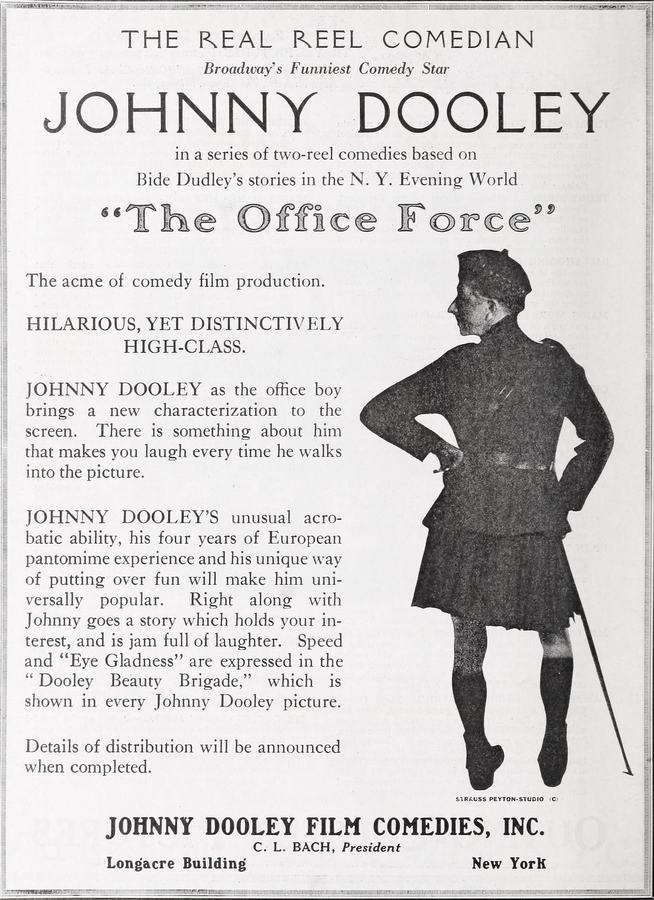
I keep replaying the twelfth minute—Bobby’s pupils dilate to twin black tacks as the wall clock slams toward five—and every time the moment arrives I swear I hear the celluloid itself gasp.
That gasp is the hinge on which Bobby the Office Boy swings, a brittle, dazzling artifact from 1922 that most historians file under “program filler” but which, when watched under the right cracked neon sign, feels closer to Kafka dipped in vaudeville ink. Twelve minutes, zero intertitles, a thousand paper cuts.
Johnny Dooley was a second-tier knock-about comic whose career evaporated with talkies; here he moves like a sped-up Chaplin minus the pathos, all piston knees and rubber neck. The performance is calibrated to the millisecond: every stumble is a three-beat joke—anticipation, collapse, repercussion—yet each pratfall carries the bruise of lived experience. You sense that Dooley has ridden actual elevators whose gates clanged shut on his dreams.
The directors, Bide Dudley and Tom Bret, never helmed a feature; they trafficked in one-reel morality plays that unspooled between newsreels and Pathé serials. Their visual grammar is voracious: Keaton’s spatial wit, Lubitsch’s risqué insinuation, and a pinch of German expressionism—office windows yawning like jack-o’-lantern maws. Note how the camera tilts upward when Bobby first enters the skyscraper lobby, turning marble columns into infinite shafts of cold capital. It’s the same trick Murnau will use two years later in The Last Laugh, but here it’s played for bitter giggles.
Contract must reach 27th floor. Boy is told: “Don’t dawdle, don’t gawk, don’t flirt.” Boy dawdles, gawks, flirts. Contract flutters away on a rogue breeze generated by the pneumatic mail tube. Chase ensues through accounting, stenography, and the mythical Executive Washroom where mahogany doors open onto Niagaras of steam. Time dilates; the building metastasizes into an M.C. Escher etching. Finally, cornered on a window ledge, Bobby folds the contract into a paper airplane, sails it into the boardroom, where it spears the eye of a cigar-chomping mogul who—delighted—promotes the unknown sender. Cut to Bobby, now a silhouette stamped onto the payroll ledger, his carnation replaced by a white collar so stiff it could slice bread.
The satire lands like a thrown stapler: advancement is indistinguishable from annihilation.
If you squint, you can thread Bobby into a subgenre I call “vertical nightmares”—pocket films where architecture weaponizes ambition. Little Jack toys with orphan-as-tycoon wish-fulfillment but never confronts the meat-grinder of corporate hierarchy. Happy Though Married treats the office as sitcom playground; its clerks suffer from boredom, not existential erasure. Even The American Way, released the same year, opts for Horatio Alger uplift—its hero climbs, stumbles, then climbs again toward moral vindication. Bobby alone ends in bureaucratic vanishing, a fate more chilling than any villain’s death ray.
The surviving 35 mm print—housed at MoMA but rarely screened—bears the ochre decay of nitrate decomposition. Rather than mourn the scars, lean into them: the chemical bubbling resembles Manhattan smog seen from a Brooklyn rooftop. Watch for the moment Bobby’s carnation wilts; the bloom turns the exact rust shade of the subway tiles in En ung mans väg, a Swedish immigrant drama that likewise equates urban striving with spiritual corrosion.
Color grading aside, the film’s real chromatic star is contrast. Shadows swallow half the frame, leaving only Dooley’s ivory shirt aglow like a passport to invisibility. It anticipates the chiaroscuro noir will adopt two decades later.
Three women cross Bobby’s trajectory: the gum-cracking file clerk who steals his fountain pen, the statuesque switchboard operator who reroutes his phone calls into the void, and the bespectacled comptroller who ultimately stamps his promotion. None are named; all wield more power than the male executives who drift in and out like cigar-store Indians. In twelve minutes, Dudley and Bret sketch patriarchy’s Catch-22: women do the invisible labor yet remain chained to the mezzanine, while Bobby—through sheer accident—ascends. The film doesn’t preach; it clocks you with the irony and dashes for the exit.
No original score survives; most archives slap on generic piano bounces. At my last midnight screening, a friend provided live loops—typewriter clacks, elevator dings, the low throb of an air-conditioning unit—all sampled and time-stretched. The result turned slapstick into horror; every laugh carried a sub-bass thump that rattled ribcages. Try it at home: cue the film on mute, layer field recordings of your own workplace, and watch Bobby mutate into a found-footage thriller.
Post-Bobby, Dooley signed with Educational Pictures, cranking out two-reelers like Loose Change and High Stakes. None circulated beyond urban hubs; when sound arrived, his thick Brooklyn cantata couldn’t survive the microphone’s cruel honesty. He managed a pawnshop in Queens by 1932, dying of a cerebral hemorrhage in 1943 while polishing a customer’s trumpet. No obituary mentioned Bobby. Yet in this single surviving reel, his eyes flicker with the caffeinated panic of every gig-economy drone refreshing a dashboard. He is us, only faster.
Forget streaming giants. The only legal digitization sits on Europe’s Eye Filmmuseum Vimeo (password-protected for scholars). Your optimal route: beg a film-school friend for institutional access, then screen it on 16 mm at a rooftop party while the Financial District glimmers below. If you’re stuck stateside, MoMA runs nitrate nights each October—queue early, pray for rain, let the gods of archival luck decide.
Modern sitcoms dilute angst with catharsis; Bobby denies you that exhale. The promotion lands like a guillotine, severing identity from body. There’s no closing-credits karaoke, no epilogue of self-actualization—just the mute terror of being reduced to a payroll entry. In an age when LinkedIn celebrates “hustle culture,” Dudley and Bret’s miniature feels prophetic: climb high enough and you disappear into your own résumé.
So track it down. Let the emulsion scratches remind you that every job is a temporary tattoo, every office tower a vertical panopticon, every paper cut a love letter from the machine. And when the lights come up, check your own collar—make sure it hasn’t turned to paper.
IMDb 6.4
1929
Community
Log in to comment.