DbcultAccessing Vault...
Cult Review
Senior Film Conservator
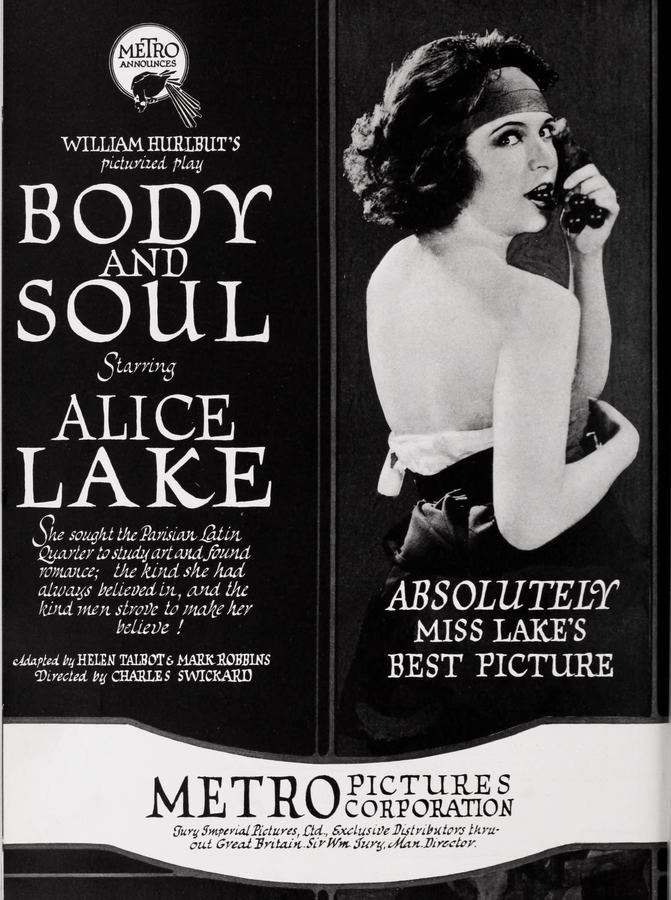
Paris, 1919. Montparnasse exhales opium and turpentine; a lone skylight spills mercury moonshine across cracked floorboards while Claire Martin—pigtail-braided daughter of Peoria Presbyterians—climbs a wobbly trestle to varnish a cathedral-sized canvas. One misstep, a dull crack, and the atelier tilts into delirium. What clambers out of the coma is no ingénue but a velvet-lipped revenant hungry for every taboo the Left Bank can vend.
Viewed today, Body and Soul (1920) plays like a proto-noir fever dream stitched from Gauguin yell, Toulouse-Lautrec crimson, and the metallic tang of surgical gauze. Director Charles Maigne, shackled by censorship edicts thicker than Notre-Dame’s missal, nevertheless smuggles in a psycho-sexist thesis: identity is not fixed but painted in wet layers, each cranial trauma a reckless varnish that dissolves what came before. The conceit is pulp, yet the execution—bathed in Arthur Edeson’s chiaroscuro lensing—elevates penny-dreadful ingredients into celluloid sacrament.
Silent cinema trafficked in doubles—The Trap’s snow-lost siblings, The Woman Michael Married’s marital masquerades—but few pushed the stunt as literally as Claire’s Jekyll/Hitchcock switch. Alice Lake’s performance hinges on micro-gestures: pre-concussion Claire sketches with her wrist arched like a cathedral buttress; post-blow Claire drags the charcoal as though signing a pornographic pact. The transition occurs without iris-mask gimmickry—only a smash-cut from spilled gesso to a grin that could slice Camembert.
Cine-philes hunting progressive gender politics will gag on the film’s regressive moral algebra: promiscuity equals brain lesion, virtue equals cranial re-reset. Yet the text is slipperier than its sermon. Houghton’s predatory studio, draped in Persian shawls and reeking of benzoin, is a cathedral of consensual voyeurism; Claire’s reclaimed innocence arrives through yet another male-mediated assault. The film indicts the very chastity narrative it pretends to champion, leaving the spectator complicit in every lecherous gaze.
Scott Houghton’s unfinished canvas—thighs parted beneath diaphanous gauze—functions as both MacGuffin and mug-shot. When first unveiled, the camera lingers on the wet pigment; beads of linseed glisten like sweat, the oils still breathing. Critics of Lime Kiln Club Field Day praised its racially nuanced portraiture, but Body and Soul weaponizes the same act: to paint is to possess, to exhibit is to prostitute. The film’s most electric cut occurs when Claire, repulsed by her own lubricious image, slashes the canvas; the rupture is accompanied by a single intertitle—white letters on black reading simply, “I cancel the flesh.”
Once Claire’s original persona surfaces, the script hustles her aboard a steamer bound for New York, scrubbing the slate as neatly as a Restoration comedy. Fifth-Ave parlors, rose-etched china, genteel fiancé—Howard Kent embodies every Gatsby-era safety rail. But the repression leaks: in a ballroom tracking shot, chandeliers fracture into prism shards superimposed over her face, hinting that memory festers beneath the permafrost. The device predates Hitchcock’s psychoanalytic flourishes by decades, proving that silent melodrama could weaponize subjectivity long before voice-over spelled out trauma.
The Plaza showdown stages memory as extortion. Houghton corners Claire beside a marble nymph, whispering, “Your sins are archived in vermilion.” It’s a curator’s threat: he will curate her past, frame it, hang it in the gallery of gossip. The nephew’s stabbing—off-screen but geyser-splatter implied—reads as avant-garde punctuation: a full-stop that silences the blackmail and condemns Claire to a guilt more corrosive than any court verdict.
Alice Lake, oft-dismissed as aParamount pretty face, here earns her place beside The Tiger Woman’s prowling Lillian Lorraine. Her pre-accident Claire moves with balletic hesitancy, wrists folded like parchment; her libertine iteration slinks, shoulders undulating as though boneless. The shift is so pronounced one suspects trick photography—yet archival footage confirms a single actress. Charles Kent (no relation to Howard) essays Houghton with oleaginous charm, part Raffles, part rent-boy, his eyes never fully closing even during smiles. W.E. Lawrence’s Howard Kent is vanilla on purpose: the bland horizon against which Claire’s Technicolor sins blanch blindingly bright.
Art director William Cameron Menzies—years before Gone With the Wind—imbues the Paris garret with carnivalesque clutter: harlequin masks dangle beside opium pipes, a stuffed raven perches on a crucifix. Once the tale relocates to Manhattan, symmetry reigns; ivory curtains billow like Protestant conscience. The tonal whiplash visualizes the moral binary, yet both spaces feel hermetically theatrical, as though every prop waits to be auctioned in the morning.
Arthur Edeson’s camera drinks in chiaroscuro: candlelight carves Alice Lake’s cheekbones until they resemble mahogany cameos. During the climactic stabbing, he undercranks for three frames—an almost subliminal shudder that injects expressionist frenzy into what might have been polite melodrama. Compare this to the static tableaux of What Am I Bid?; Body and Soul vibrates with proto-dynamism.
William Hurlbut’s intertitles oscillate between purple scripture and telegram-brief brutality. One card reads: “She tasted the apple—its core was crawling with maggots.” Another simply states: “Blood confirms the covenant.” The ecclesiastical cadence foreshadows the Hays Office crucifixion soon to descend on Hollywood; even then, studios sensed the censor’s breath on their napes.
Modern viewers, marinated in Dolby Atmos, may smirk at organ-only accompaniment. Yet the surviving score cue—scrawled on onionskin and preserved at MoMA—dictates a leitmotif: ascending whole-notes for Claire’s virtue, minor-second dissonance for Houghton’s brush. Restored screenings using this guide reveal a sonic ghost haunting the images, a reminder that even “silent” cinema was never mute.
State boards excised nearly 800 ft of footage—roughly 11 minutes— including a close-up of the portrait’s nipple-shadow and an intertitle referencing “the slime of Montparnasse.” The surviving print, cobbled from Czech and Danish archives, restores much but not all; jump-cuts betray absences. What remains plays like a fever dream with pages torn out—arguably improving the narrative’s disorientation.
Set Body and Soul beside The Bottle Imp’s Polynesian moralism or Juan sin ropa’s proletarian martyrdom and you locate a curious 1920 continuum: sin exported, virtue repatriated. Claire’s transatlantic round-trip maps America’s fantasy of European decadence followed by home-spun absolution, a trope still peddled by every YA novel where backpackers “find themselves” in hostels.
The film ends on a freeze-frame of Claire’s gloved hand accepting Kent’s ring—an effect achieved by optically repeating the same frame for three seconds, a proto-GIF that anticipates Instagram’s engagement metrics. It’s a banal closure, yet the image blurs as if printed on wet silk; the projector lamp, dimming, hints that memory itself is celluloid, prone to vinegar rot and emulsion fade.
Should you track down a 16 mm print in some Maine attic, beware: the nitrate stinks of almonds and camphor, a perfume Claire herself might have worn during her Left Bank nights. Thread it through a hand-crank viewer and you’ll feel the sprockets bite, as though the film itself resists resurrection. Yet that resistance is the final, inadvertent truth of Body and Soul: some selves, once painted, never dry; they smear across decades, staining every projector beam with crimson that refuses to fade to black.
Verdict: A lurid, lyrical amnesia-thriller that weaponizes pigment and patriarchy, Body and Soul survives as both moralizing relic and subversive fever dream—worth every archival hour spent squinting through its emulsion scars.
IMDb —
1924
Community
Log in to comment.