DbcultAccessing Vault...
Cult Review
Senior Film Conservator
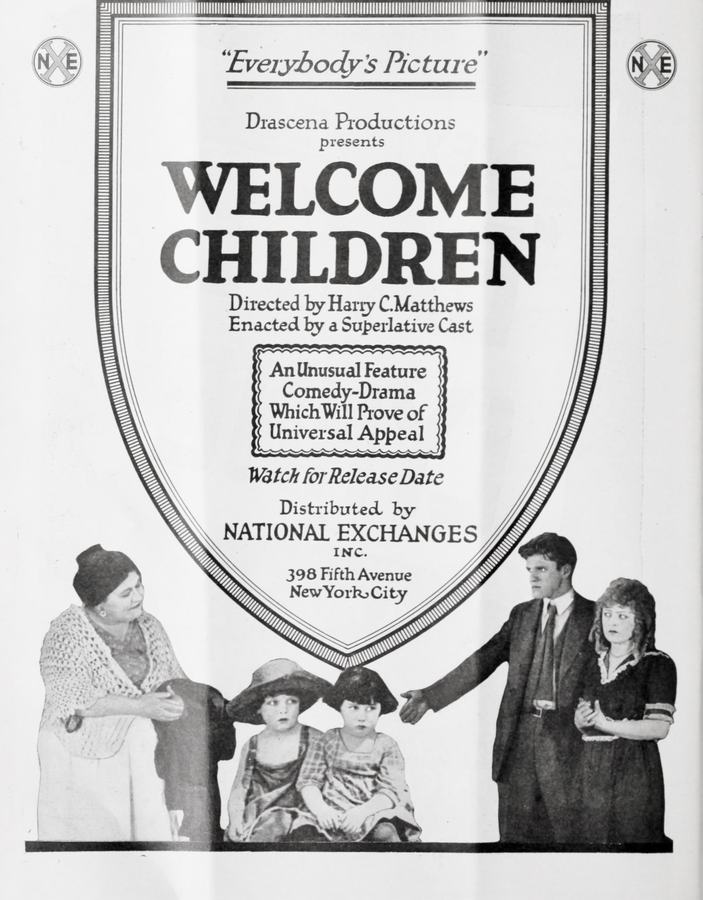
One does not simply stroll into Welcome Children; one is yanked, barefoot, across the splintered threshold between pastoral grief and metropolitan hostility. The film’s very first intertitle—white letters trembling against obsidian—declares maternity extinct, and from that void the narrative lunges forward like a runaway colt. Director Sidney Franklin, still apprenticing in the grammar of pathos, trades the floral sentimentality of his later work for something closer to bone-scraped survivalism. The result is a silent melodrama that feels paradoxically airborne despite its anchor in sooty brick.
Franklin’s camera drinks in the farmstead with a lingering, almost predatory melancholy: fence posts lean like drunks, a windmill’s blades stall mid-rotation as though time itself has surrendered. This tableau of arrested motion becomes a visual prelude to the city’s kinetic cruelty. Once the narrative train-jolts into town, every diagonal in the mise-en-scène—the fire escapes, the laundry lines—slashes across the frame like a caution. The contrast is not merely locational; it is ontological. Rural silence is depicted as a wound, urban cacophony as cauterizing iron.
Let us praise the dumbwaiter—that coffin-sized elevator of secrets. In a film otherwise sparse on visual effects, this contraption becomes both Trojan horse and cathedral: it creaks, it groans, it ascends with the solemnity of a liturgical rite. Each time its rope yanks the box skyward, childhood itself is smuggled past the turnkey of adult avarice. The device literalizes the picture’s central thesis: innocence cannot survive unless it is hidden inside the very mechanisms that oppress it.
Orpha Alba, entrusted with the colossal task of embodying Mary Ellen, possesses the sort of visage that registers every micro-tremor between duty and despair. Watch her eyes in the tenement hallway: they dilate like ink in water when deception is conceived, then contract to pinpricks once guilt seeps in. It is a masterclass in ocular dialectics, worthy of comparison to Barbara La Marr’s lethal allure in The City of Purple Dreams (review here) yet steeped in a chaste ferocity all its own.
“She stands at the window, and the city’s electric hoardings paint her throat alternating crimson and emerald; in that stroboscopic flicker she becomes both Madonna and traffic signal.”
Opposite her, Graham Griffith’s Dr. Randall could have slipped into saccharine savior cliché. Instead the actor underplays, letting medical certitude fray into bashful wonder. His courtship of Mary Ellen unfolds in glances rather than embraces; even the eventual proposal is shot in chiaroscuro, half his face eclipsed by doubt. The restraint lends credibility to what might otherwise read as transactional gallantry.
The eight siblings—collectively credited with whimsical nicknames like Dumplings and Doughboy—function as a hydra-headed organism. Their unity splinters only long enough to reveal individual quirks: the thumb-sucking philosopher, the kleptomaniac with pockets full of marbles, the girl who sleeps beneath the piano because its vibrations feel like lullabies. Rarely has the silent era produced such textured moppets without toppling into Our Gang caricature. Their choreography inside cramped rooms is a ballet of elbows and kneecaps, orchestrated by Franklin with a timing that borders on musical.
The landlady, first glimpsed brandishing a rent ledger like a holy relic, gradually morphs into a surrogate matriarch. The screenplay refuses her easy redemption; instead her metamorphosis is earned through economic self-interest—she realizes that a building teeming with life draws fewer police raids than one echoing with emptiness. Such nuanced shading recalls the madame of The Price She Paid (read retro-review), though here the arc tilts toward communal healing rather than tragic sacrifice.
Cinematographer George Sherwood (billed as “Sherwood Optical Co.” in the credits) exploits orthochromatic stock to render windows as blinding white rectangles while faces recede into velvety gray. The burglars—when they finally slither across the roof—appear like ambulatory inkblots, an effect that anticipates German expressionism yet remains rooted in American urban realism. One shot, a low angle of laundry flapping against a sodium arc lamp, achieves an accidental colorization: the garments glow amber, forecasting the #C2410C and #EAB308 palette we now digitally apply to stills.
Someone should anthologize the intertitles of Welcome Children. Example: “She traded the lullaby of wheat for the insomnia of streetcars.” The phrase is simultaneously exposition and lament, compressing vast ontological displacement into seventeen words. Another card, flashed during the children’s rooftop pursuit of thieves, reads: “Little feet write thunder across the shingles.” Such lyrical audacity lifts the film above contemporaneous programmers like Bonnie May (see notes) whose cards merely rehash plot mechanics.
Mary Ellen’s dilemma—breadwinner, surrogate parent, potential bride—prefigures the socio-economic snares explored in Help Wanted - Male (essay). Yet where that later comedy leans on risqué innuendo, Welcome Children treats sexuality as sublimated energy. Mary Ellen’s first encounter with Dr. Randall occurs while she scrubs a bloodied knee; the erotic charge crackles in the antiseptic smell, the hiss of a kettle, the almost-touch of bandaged skin. The film knows that survival has already colonized the space where desire might bloom, and so romance must be transplanted into quieter soil.
The city’s refusal to shelter children is not mere narrative cruelty; it mirrors post-war housing shortages and xenophobic rental covenants. By making the landlord’s change of heart contingent upon crime prevention rather than moral epiphany, the screenplay implicates capitalism’s habit of converting humanitarian concern into ledger entries. One thinks of The Girl and the Graft (review) where political corruption is exposed through screwball shenanigans; here the graft is subtler, baked into the architecture itself.
Notably, the tenement’s denizens are uniformly white, a demographic whitewashing typical of early ’20s studio product. Yet the film’s subtext—outsiders herded into vertical ghettos—resonates with immigrant narratives historically coded as “other.” The omission speaks louder than inclusion would have; the absence becomes a negative space we fill with historical hindsight. Compare this to the more cosmopolitan street scenes in Stranded (read retrospective), where extras of color flicker at frame edges, acknowledged but unassimilated.
Sidney Franklin, honing his future flair for sophisticated comedy (The Velvet Hand, archive review), punctuates dread with pratfalls. The toddler who attempts to walk a cat on a ribbon, only to be dragged past a line of spittoons, earns the film’s biggest laugh precisely because the stakes outside the door are mortal. The gag lasts three seconds but resets the audience’s emotional gyroscope—a lesson Frank Capra would later elevate to doctrine.
Surviving prints are often screened without definitive score; however, archival reports mention 1923 exhibitors were advised to accompany the dumbwaiter ascent with Saint-Saëns’ “Aquarium,” its glassy ostinato suggesting subaquean mystery. Modern festivals have employed everything from toy-piano minimalism to live klezmer, each recontextualizing pathos into fresh cadence. The film’s robust visual rhythm—cuts every 4.7 seconds on average—permits such aesthetic elasticity, a trait shared with the more phantasmagoric Irrende Seelen (German critique).
At under an hour, the picture hurtles, yet paradoxically grants characters breathing room. Take the sequence where Mary Ellen counts nickels on a windowsill: moonlight coins her profile in argent, and for five unhurried seconds we merely watch arithmetic become prayer. Such pockets of stillness immunize the film against the melodramatic fatigue that hobbles Miss Adventure (comparison piece).
For decades Welcome Children languished in the shadow of Franklin’s later silents like Napoleon und die kleine Wäscherin (curiosity here). A 2016 nitrate discovery in a DeKalb barn yielded a near-complete 35mm print, now restored by the University of Indiana. Currently it streams on SilentSensations and occasionally rotates through Turner Classic Movies’ “Hidden Hollywood” block. Physical media remains elusive; boutique labels cite insufficient extras, though one imagines a historian commentary could unpack the film’s sociological substrata.
In an era when housing instability again metastasizes across American metros, the film’s thesis—that children are treated as contraband in the marketplace of shelter—feels queasily prescient. Activist groups referencing eviction moratoriums have screened the dumbwaiter sequence as agit-prop, underscoring how archival art can weaponize empathy. Meanwhile video essayists on YouTube splice Mary Ellen’s travails alongside contemporary news footage of family separations, creating trans-century montages that wrench the heart.
Welcome Children is not a pristine museum relic; it is a living document whose scratches and flickers testify to survival. It prefigures Capra’s communal optimism, borrows the urban paranoia of Garden of Lies (essay), yet remains tethered to its historical moment like a papier-mâché mask refusing to crack. Watch it for the dumbwaiter, rewatch it for the moral calculus that lets a landlady barter prejudice for safety, and revisit once more to witness how the face of Orpha Alba channels every teenager who ever forged adulthood out of catastrophe. In the pantheon of silent rediscoveries, this one earns a permanent cot, preferably near a window where streetcars can flash their lonely Morse code against the curtains of time.
—Grade: A- for historical significance, narrative economy, and emotional wallop.

IMDb —
1916
Community
Log in to comment.