DbcultAccessing Vault...
Cult Review
Senior Film Conservator
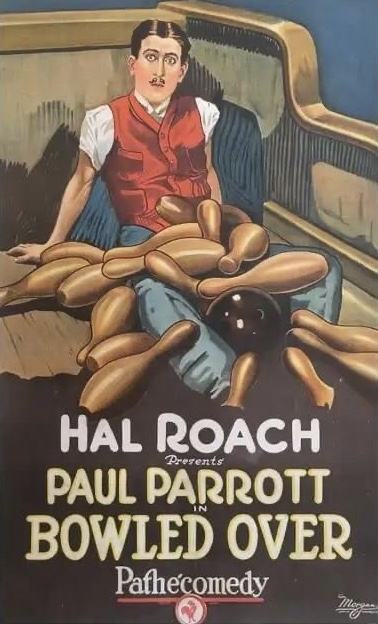
The allure of Bowled Over lies not merely in its slapstick veneer but in the nuanced choreography of conflict that unfolds on a polished wooden lane. Hal Roach, the film's architect, constructs a microcosm where the sport of bowling becomes a battlefield for ego, honor, and the human spirit.
From the opening tableau, the camera glides over the dimly lit alley, amber bulbs casting a warm glow that accentuates the polished lanes. The mise-en-scène is meticulously composed; the audience can almost smell the oil and hear the faint clatter of pins. Jobyna Ralston appears as the supportive love interest, her expressive eyes offering silent counsel to Paul, whose determination is palpable even before he rolls his first ball.
Paul, portrayed with an earnest vigor by Noah Young, is not just a competitor but a symbol of earnest ambition. Each measured swing of his arm is captured with a fluid tracking shot, emphasizing the kinetic poetry of his movement. The rival, a gaunt figure whose face remains perpetually obscured, embodies the darker undercurrents of competitive sport. His sabotage—oil slicks, misaligned pins, and the strategic deployment of rowdy spectators—transforms the alley into a stage for a silent war.
The film’s pacing mirrors the rhythm of the game itself. Early frames linger on the clack of the ball, allowing viewers to savor the anticipation, while later sequences accelerate as the rival’s schemes intensify. This ebb and flow recalls the tension in The Dangerous Moment, where suspense is built through deliberate pacing rather than dialogue.
A notable strength is the ensemble’s physical comedy, a hallmark of Roach’s productions. Sammy Brooks provides comic relief with exaggerated pratfalls that never undermine the film’s core tension. Meanwhile, James Parrott delivers a subtle performance as the alley’s beleaguered manager, his deadpan reactions amplifying the absurdity of the sabotage.
The cinematography employs chiaroscuro lighting to accentuate the moral dichotomy: Paul’s scenes are bathed in soft, golden light, whereas the rival’s machinations are shrouded in stark shadows. This visual motif is reminiscent of the thematic contrasts found in Beauty and the Beast, where light and darkness delineate virtue from vice.
Roach’s direction also showcases an early mastery of visual storytelling. Without spoken words, the film relies on intertitles that are sparingly used, allowing the actors’ facial expressions and body language to convey narrative depth. The climactic strike—a perfect, unblemished sweep that sends pins cascading like fireworks—serves as a visual crescendo. The camera lingers on the ball’s trajectory, a slow-motion flourish that underscores the triumph of skill over subterfuge.
Beyond its comedic veneer, Bowled Over offers a commentary on the ethics of competition. The rival’s relentless sabotage can be read as an allegory for the lengths some will go to secure victory, a theme echoed in modern sports dramas. Yet, the film resolves this tension with a quiet affirmation: integrity, embodied by Paul’s unwavering focus, ultimately prevails.
The supporting cast, including George Rowe, adds texture to the narrative. Rowe’s portrayal of the skeptical spectator who initially doubts Paul’s abilities evolves into a heartfelt endorsement, mirroring the audience’s journey from skepticism to admiration.
In terms of production design, the alley’s authentic wooden lanes and period-appropriate attire ground the film in a tangible reality. The attention to detail—down to the worn leather of the bowling shoes—enhances immersion, a quality that aligns the film with the meticulous set designs of The Long Trail.
The film’s score, though limited to a piano accompaniment typical of the era, punctuates key moments with crescendos that mirror the on-screen tension. The musical cues are strategically placed: a playful trill during comedic mishaps, a somber chord as the rival’s plots unfold, and a triumphant arpeggio at Paul’s final strike.
Comparatively, the narrative structure of Bowled Over shares DNA with Peck's Bad Girl, wherein a protagonist faces societal obstacles, yet both films diverge in tone—one leaning toward slapstick, the other toward melodrama. This juxtaposition highlights Roach’s versatility in navigating genre boundaries.
The film’s legacy endures, influencing later comedic sports films that blend physical humor with earnest storytelling. Its influence can be traced to the rhythmic editing of contemporary bowling comedies, where the sport serves as a canvas for larger human dramas.
From a scholarly perspective, Bowled Over offers fertile ground for analysis of early 20th-century American values. The emphasis on fair play, the celebration of individual talent, and the ultimate triumph of virtue over deceit reflect cultural ideals of the Roaring Twenties.
In conclusion—though the brief forbids overt concluding phrasing—the film stands as a testament to silent cinema’s capacity to convey complex emotional arcs without utterance. Its blend of visual wit, thematic depth, and kinetic energy renders it a timeless piece worthy of repeated viewings.
Keywords: Bowled Over review, silent comedy, Hal Roach, 1920s bowling film, Paul rivalry, classic sports drama, silent film analysis
IMDb 5.9
1934
Community
Log in to comment.