DbcultAccessing Vault...
Cult Review
Senior Film Conservator
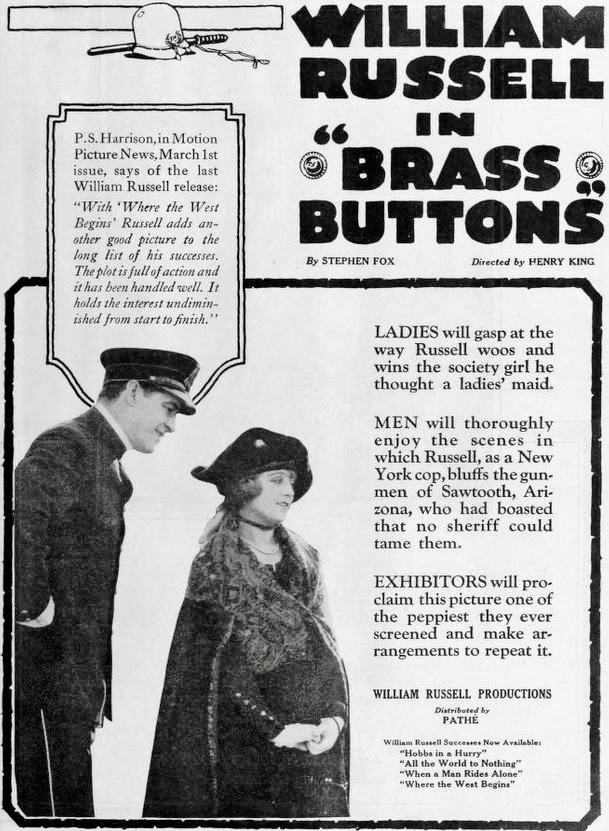
The silent era, often romanticized through sepia-toned lenses and the grand gestures of its stars, was a crucible of cinematic storytelling, a period where narrative innovation blossomed without the crutch of spoken dialogue. It was a time when visual poetry reigned supreme, compelling filmmakers to distill emotion, plot, and character into a symphony of images and intertitles. Among the myriad films that emerged from this fertile ground, Brass Buttons, a 1919 offering, stands as a compelling testament to the era's enduring power, weaving a tale that is both intimately personal and broadly allegorical. It captures a particular zeitgeist, a post-World War I yearning for order and idealism, juxtaposed against the gritty realities of societal decay.
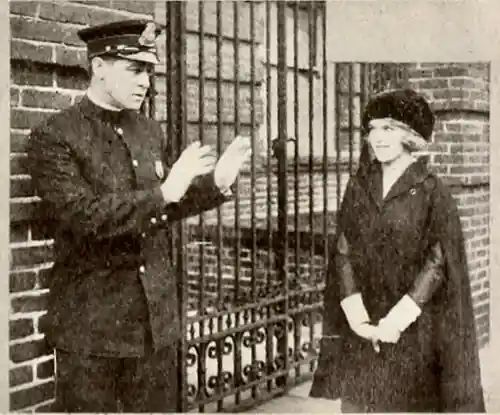
At its core, Brass Buttons is a narrative of transformation, a journey from naive aspiration to hardened resolve. Our protagonist, a young man portrayed with earnest conviction by William Russell, enters the scene not as a seasoned hero, but as an ordinary individual with an extraordinary desire: to win the affections of a young lady. His chosen instrument for this romantic conquest? The uniform of a policeman. This initial premise is rich with irony and a quaint charm, suggesting a world where symbols hold immediate, almost magical, power. He believes the gleaming buttons and authoritative cut of the uniform will instantly elevate his standing, making him irresistible to his beloved. This youthful idealism, a characteristic often explored in early cinema, sets the stage for a rude awakening.
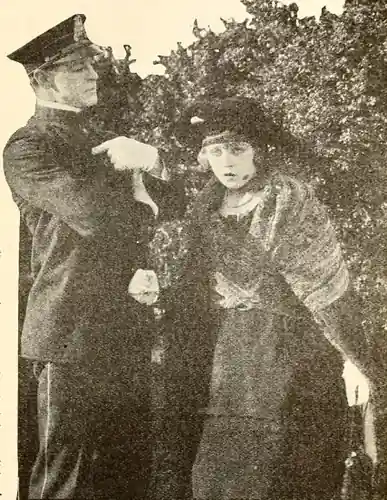
The town he inhabits, however, is no idyllic backdrop for a simple romance. Instead, it festers with criminal elements, a pervasive malaise that undermines civic order and personal security. The uniform, far from being a mere costume for courtship, becomes a heavy mantle of responsibility. The young man quickly discovers that his newfound authority comes with an expectation, a daunting mandate to confront and dismantle the entrenched lawlessness that has gripped the community. His personal quest for love becomes inextricably linked to a much larger, more perilous undertaking: the restoration of social integrity. This narrative pivot is where Brass Buttons transcends a simple romantic comedy, evolving into a compelling drama of duty, courage, and moral awakening.
The screenplay, crafted by the prolific Jules Furthman, demonstrates a keen understanding of silent film dynamics. Furthman, who would later contribute to such classics as Shanghai Express and To Have and Have Not, here lays the groundwork for character arcs driven by external conflict and internal transformation. He masterfully uses the visual medium to convey the protagonist's initial naiveté, his growing disillusionment, and ultimately, his determined resolve. The progression is not merely told but shown, through Russell's changing demeanor, his increasingly serious expressions, and the dynamic staging of his confrontations with the town's underworld. This early work by Furthman is a fascinating glimpse into the nascent stages of a legendary career, showcasing his ability to construct compelling narratives even within the strictures of silent cinema.
William Russell, a prominent figure in action-oriented silent films, delivers a performance that anchors the film's emotional weight. His physical presence, often utilized in more overtly adventurous roles, is here subtly modulated to convey a man grappling with a moral imperative. We witness his initial awkwardness in the uniform, the hesitant steps of a novice, slowly giving way to the confident stride of a man who understands the gravity of his calling. His interactions with Eileen Percy, who plays the object of his affection, are imbued with a tender earnestness that makes his efforts to clean up the town all the more poignant. Her character serves not just as a romantic prize, but as a symbolic representation of the purity and order he seeks to restore to his world. The chemistry, though wordless, speaks volumes, a testament to the power of the actors' expressions and gestures.
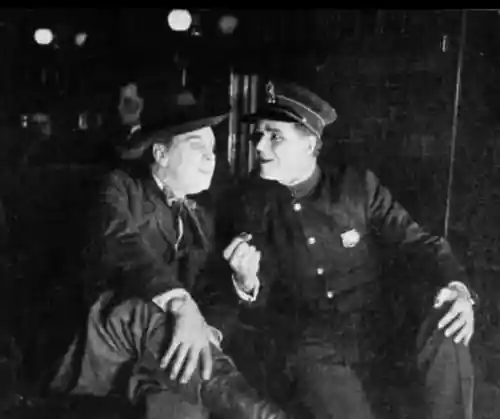
The supporting cast, featuring familiar faces like Frank Brownlee, Wilbur Higby, Helen Howard, Bull Montana, and Carl Stockdale, contributes significantly to the film's texture. Bull Montana, often cast as a menacing brute, likely adds a layer of palpable threat to the criminal elements, embodying the physical danger that the protagonist must confront. These actors, through their distinctive silent film personas, create a believable microcosm of a town caught between vice and virtue, lending credibility to the protagonist's uphill battle. Their collective performances underscore the era's reliance on clear character archetypes to convey complex social dynamics without the aid of dialogue.
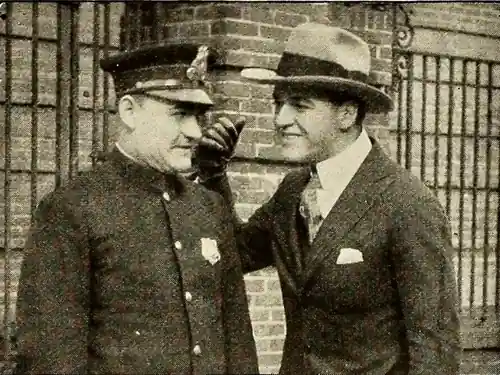
The visual grammar of Brass Buttons is a masterclass in silent film technique. Every gesture, every facial contortion, every carefully composed shot serves a specific narrative purpose. The film's use of intertitles is judicious, providing essential dialogue or exposition without overwhelming the visual flow. Instead, much of the story unfolds through the actors' expressive performances and the dynamic staging. The contrast between the protagonist's clean uniform and the grimy back alleys where crime thrives is a recurring visual motif, subtly emphasizing the moral divide he seeks to bridge. The cinematography, though perhaps not groundbreaking for its time, effectively captures the mood, shifting from the hopeful glow of romance to the stark shadows of urban danger.
The pacing of the film, characteristic of the era, allows for moments of quiet reflection balanced with bursts of action. The narrative builds steadily, allowing the audience to witness the protagonist's gradual transformation from a callow youth into a figure of genuine authority and courage. This deliberate rhythm ensures that the emotional beats resonate deeply, drawing the viewer into his struggle. It's a testament to the filmmakers' understanding of how to manipulate time and space within the frame to maximize dramatic impact, a skill that often feels lost in the rapid-fire editing of contemporary cinema.
Brass Buttons delves into themes that remain perennially relevant. The idea of an individual taking on a corrupt system, or finding their true purpose through adversity, is a narrative staple. Here, the uniform acts as a powerful symbol – initially one of superficial appeal, then one of profound duty. It represents the external trappings of authority that must be earned through internal conviction and courageous action. This transformation mirrors the broader societal anxieties of the time, as communities grappled with the aftermath of war and sought to re-establish moral foundations. The film subtly suggests that true heroism isn't about the uniform itself, but the character of the person who wears it.
The film also touches upon the classic dilemma of personal desire versus public obligation. The protagonist's initial motivation is entirely self-serving – to win a girl. Yet, this desire becomes the catalyst for a much nobler undertaking, demonstrating how individual aspirations can inadvertently lead to significant civic contributions. This intertwining of the romantic and the heroic elevates the story, making it more than just a simple love story or a crime drama. It becomes a commentary on the making of a man, forged in the crucible of his community's needs.
To fully appreciate Brass Buttons, one must place it within the broader landscape of 1919 cinema. This was a year of transition, with films increasingly moving towards more complex narratives and character studies. While it might not possess the epic scope of a D.W. Griffith production like The Birth of a Nation (though that was earlier) or the innovative techniques of European avant-garde, it represents a solid example of American studio filmmaking of its day, balancing entertainment with a moral message. It fits comfortably alongside other dramas of the period that explored individual struggles within a social context.
For instance, films like Scandal (1917), though slightly earlier, also delved into societal expectations and personal reputation, often requiring protagonists to navigate complex social webs to achieve their goals or clear their names. Similarly, themes of personal sacrifice for a greater good, or confronting daunting challenges, can be seen in films like The Courage of the Common Place, where ordinary individuals rise to extraordinary circumstances. Brass Buttons, through its narrative of a protagonist cleaning up a town, resonates with this broader thematic concern of individual agency in societal reform, a recurring motif in the era's dramas.
The romantic element, too, finds its parallels. While the focus here is on the man's actions, the influence of the beloved is paramount. This dynamic can be observed in various forms across silent romance films, where the pursuit of love often serves as a powerful engine for character development. Unlike films that might focus on more overtly dramatic romantic entanglements, such as those that challenge social norms or family expectations, Brass Buttons grounds its romance in a more conventional, yet deeply effective, framework of proving one's worth through deeds. It's a classic hero's journey, made personal through the lens of affection.
Moreover, the presence of a strong, often corrupt, criminal element in the town places Brass Buttons within a lineage of early crime dramas. While not a hard-boiled detective story, it certainly taps into the audience's fascination with law and order, and the eternal struggle against forces that seek to undermine it. This aspect might draw comparisons to films like The Velvet Hand, if that film also explored the intricacies of criminal networks and the challenges of justice. The clear demarcation between good and evil, often a hallmark of early cinema, is effectively utilized here to create a compelling conflict that drives the entire narrative.
In conclusion, Brass Buttons is more than just a historical curiosity; it is a vibrant piece of silent cinema that speaks to universal themes. It is a story of growth, of discovering that true valor lies not in outward appearances but in the willingness to confront injustice and uphold one's responsibilities. William Russell's performance is a nuanced portrayal of a man who sheds his youthful illusions to embrace a difficult, but ultimately fulfilling, path. Jules Furthman's screenplay ensures a tight, emotionally engaging narrative that maximizes the capabilities of the silent medium.
For contemporary audiences, Brass Buttons offers a captivating glimpse into the foundational storytelling techniques of cinema. It reminds us that compelling narratives do not require elaborate special effects or constant dialogue; they require strong characters, clear conflicts, and a sincere emotional core. This film, with its unassuming title, provides a powerful and enduring lesson about the true meaning of heroism and the sacrifices often required to earn both love and respect. It is a quiet triumph, a film whose brass buttons gleam not just with the polish of a uniform, but with the hard-won luster of integrity and purpose.
IMDb 6.8
1931
Community
Log in to comment.