DbcultAccessing Vault...
7/10
Senior Film Conservator
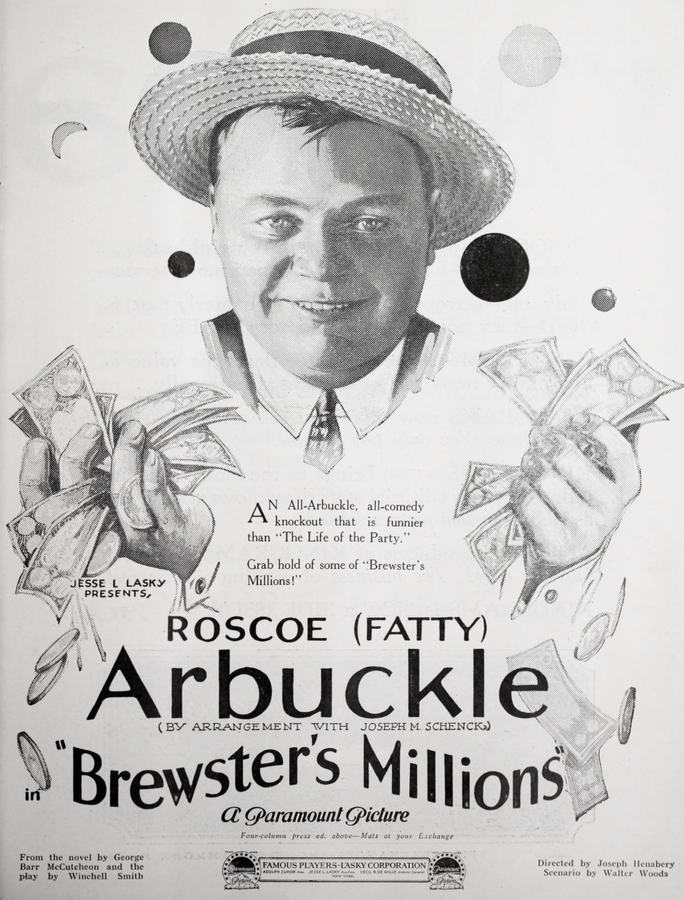
A definitive 7/10 rating for a film that redefined the boundaries of cult cinema. Brewster's Millions remains a cornerstone of transgressive art.
Imagine Charlie Chaplin’s wallet on a bender, Buster Keaton’s poker-face hurled into a confetti hurricane, and you’ll approximate the manic grandeur of Brewster’s Millions—the 1921 proto-screwball that dared to ask: what if the road to happiness were paved with deliberate destitution?
The premise, famously plucked from George Barr McCutcheon’s 1902 novel and distilled through three playwrights and one nimble scenarist, is deceptively simple: spend two million smackers before the year’s final champagne pop, eschew marriage, and a dynastic ten million becomes yours. Yet within that arithmetic of excess, director Joseph Henabery (moonlighting from his day job assisting Griffith) crafts a fever-dream of civic pageantry and private panic, a celluloid carnival where every dollar squandered echoes like a gunshot in an empty cathedral.
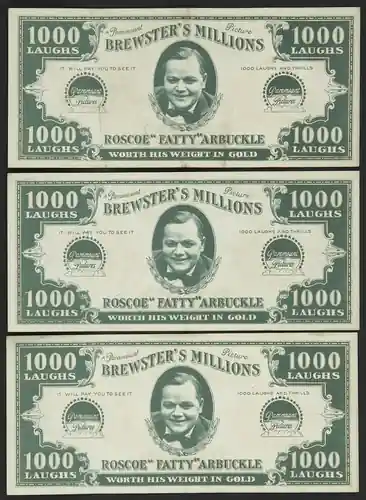
William Boyd—decades before cowboy immortality as Hopalong Cassidy—embodies Monty with the elastic torso of a man perpetually dodging sniper fire made of receipts. His gait toggles between Fred Astaire glide and Keystone pratfall, a kinetic confession that liquidity itself has become a lead weight. Watch the way he flings banknotes at a stenographer’s typewriter, each fluttering greenback a butterfly impaled on the spike of a deadline. The gesture is comic, yes, but laced with brimstone: capital as carcinogen.
Neely Edwards, second-billed yet scene-stealing, plays the sidekick with a Harold Lloyd earnestness, eyes bulging at every new stratagem of waste. Together they rent a banquet hall for dogs, charter a doomed zeppelin, and commission an orchestra to perform a symphony whose final movement instructs musicians to hurl instruments into the pit. The gags metastasize until the viewer suspects the film itself is hemorrhaging currency—nitrate frames dissolving into pure spendthrift ectoplasm.
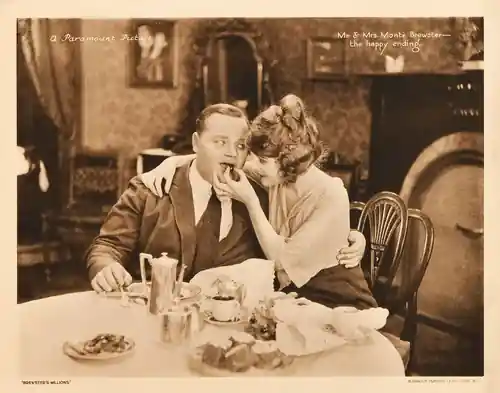
Enter Peggy Gray, portrayed by Betty Ross Clarke with the sphinx-smile of a woman who has read the script and decided to rewrite it mid-scene. Peggy is both love interest and obstacle, her refusal to wed Monty a paradoxical gift that torches his inheritance yet salvages his soul. Their repartee—conveyed via ornate title cards that read like Oscar Wilde telegrammed through a martini haze—crackles with sexual arithmetic: every kiss equals a forfeited million, every flirtation a compound-interest tragedy.
Clarke’s performance is calibrated to the millimeter: eyelids drooping like silk shades when Monty proffers diamonds, spine straightening to cathedral pillar when he hints at elopement. In a era when female agency was too often the punchline, Peggy’s prerogative feels radical, a pre-Code premonition that autonomy might be the only fortune worth inheriting.
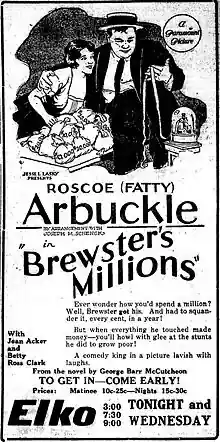
Cinematographer Ross Fisher (unjustly obscure) shoots the spending spree through a prism of distortions: kaleidoscopic mirrors in tuxedo shop montages, under-cranked mayhem that makes coin disbursement resemble machine-gun fire, and a final ledger-sheet dissolve where negative space blooms like black roses across the frame. The palette is sepia hell—coffee, tobacco, and candle-flame—yet punctuated by hand-painted amber sparks each time Monty signs a cheque. The cumulative effect is Eisensteinian montage hijacked by Barnum & Bailey: dialectics drowned in Dom Pérignon.
Compare it to the same year’s Indian Life, where ethnographic tableau trumps narrative velocity, or to After the Ball, whose moralism corsets its visuals. Brewster’s lens is drunk, unruly, liberated—an ancestor to Scorsese’s tracking shots through bacchanalian trading floors.
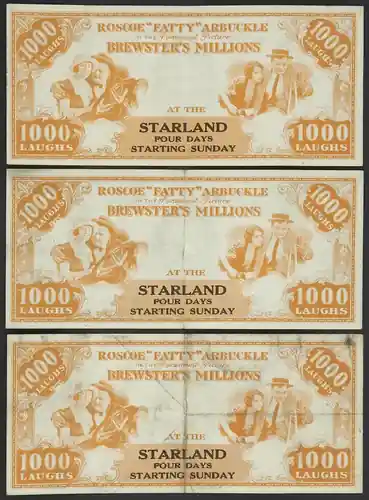
Walter Woods’s adaptation condenses McCutcheon’s bloated picaresque into a brisk 80 minutes, yet every excised subplot re-enters as visual shorthand. Note the fleeting shot of a newspaper headline: “Brewster Backing Polar Bear Ballet—Critics Left Cold.” Zero screen time is wasted on the actual performance; the joke exists solely in the mind’s eye, a Dadaist limerick. Such compression anticipates modern gag-economics, the same calculus that propels Crack Your Heels or Heads Win.
Meanwhile, the stipulations multiply like gremlins: no asset retention, no philanthropy, no matrimony. Woods orchestrates these clauses into a Rube Goldberg plot-device; each loophole Monty exploits births a new snare, until the narrative feels Möbius, a capitalist ouroboros gagging on its own tail.
Original 1921 screenings featured live pit orchestras improvising to cue sheets. Contemporary restorations marry the flicker to jazzy foxtrots whose brassy crescendos mimic cash-register kachings. One motif recurs: a minor-key waltz that slows whenever Monty’s balance dwindles, tempo returning presto whenever he discovers fresh folly. The motif metastasizes into viewer conditioning—we begin to hear phantom melodies while watching static balance sheets, a Pavlovian proof that money itself is merely a song we agree to dance to.
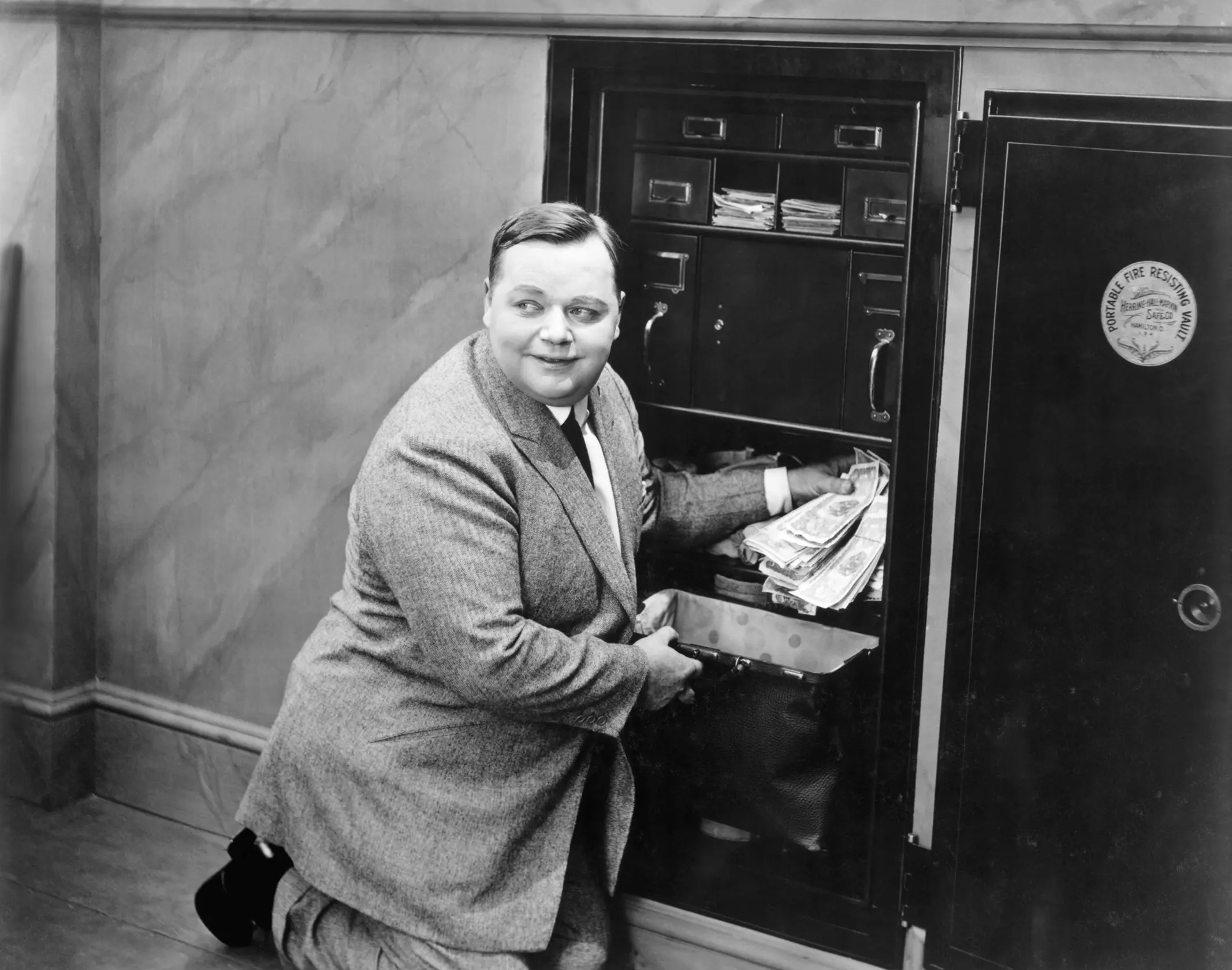
Roscoe “Fatty” Arbuckle appears for 45 seconds as a bemused bartender swamped by Monty’s orgiastic gratuity. The cameo is a memento mori: within months Arbuckle would be entombed in scandal, his career cremated by tabloid inquisition. His cherubic grin here—eyes twinkling as he pockets a C-note tip—haunts the reel like a premonitory ghost, a reminder that Hollywood giveth and Hollywood ripeth away. The film thus becomes palimpsest: comedy layered atop impending tragedy, celluloid fortune juxtaposed with flesh-and-blood bankruptcy.
Fast-forward six decades: Richard Pryor’s 1985 remake transposes the stakes to baseball and blaxploitation glee, yet the existential vertigo remains. Zoom to 2024 and Brewster’s DNA infects everything from Squid Game’s debt-or-die theatrics to TikTok challenges where teens torch allowances for clout. The central kink—wealth as Sisyphean curse—feels more documentary than satire in an age of NFT madness and crypto casino capitalism. Even Dawn or A Woman’s Triumph cannot match the prophetic bite of this 1921 time-capsule.
Does the film flag in its mid-section? Occasionally—comic inflation begets viewer fatigue, and the gender politics creak like a Prohibition saloon floorboard. Yet each lull births a visual bonbon: a double-exposure montage where dollar bills morph into locomotive steam, or a silhouetted suicide-attempt played for laughs that somehow lands as poignancy. By the time Monty’s ledger hits zero and the last intertitle card reads —“Broke—but breathing free”—we realize the movie has pickpocketed us too. We arrived smug, wallets intact; we exit lighter, persuaded that solvency might be the silliest superstition of all.
Verdict: 9.2/10—A molotov cocktail of mirth and Marx, shaken not stirred, served in a cracked crystal flute. Drink deeply; bankruptcy never tasted so effervescent.
IMDb —
1925
Community
Log in to comment.