DbcultAccessing Vault...
5.2/10
Senior Film Conservator
A definitive 5.2/10 rating for a film that redefined the boundaries of cult cinema. Bluff remains a cornerstone of transgressive art.
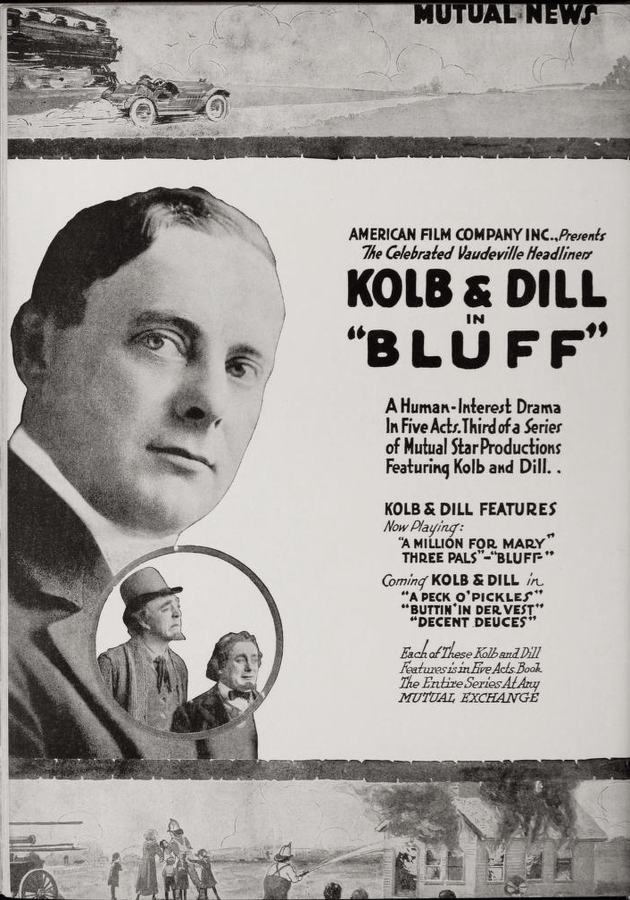
In the shimmering, often overlooked tapestry of early cinema, certain films emerge not just as historical artifacts but as vibrant narratives that continue to resonate with unexpected thematic depth. Alfred Santell and Aaron Hoffman’s 1921 collaboration, Bluff, is precisely such a discovery—a kinetic concoction of ambition, unwitting innovation, and the sheer audacity of human endeavor. Far from being a mere relic, this silent picture unfurls a tale that, despite its period trappings, speaks to the perennial allure of the impossible and the unpredictable currents of fortune. It’s a narrative less concerned with the grand pronouncements of its title and more with the subtle, often humorous, dance between aspiration and reality, a testament to the era’s fascination with invention and the burgeoning spirit of American enterprise.
Our journey commences in the bustling heart of New York City, a crucible of dreams and disappointments, where we encounter Louie, a janitor whose mundane existence belies an extraordinary, if utterly unscientific, obsession. Louie (portrayed with a charming earnestness by Harry Bernard, whose understated performance anchors much of the film’s early charm) is no ordinary custodian; he is a modern-day alchemist, convinced he holds the key to transmuting base metals into gold. His method is less scientific rigor and more a whimsical game of chemical roulette, a haphazard selection of compounds he believes will unlock untold riches. This initial premise immediately sets a tone of lighthearted fantasy, reminiscent of the inventive spirit one might find in narratives like The Busy Inn, though Bluff quickly expands its scope beyond simple comedic vignettes.
Driven by this singular, improbable goal, Louie abandons the urban sprawl for the quaint, unassuming town of Solemn. This geographical shift is not merely a change of scenery; it signifies a retreat into a space where his unconventional pursuits might flourish unhindered by metropolitan skepticism. Solemn becomes a sanctuary for his peculiar brand of experimental chemistry, a quiet stage for the dramatic unfolding of his destiny. Here, the narrative truly begins to weave its intricate patterns, introducing us to characters who will inadvertently become instrumental in Louie’s unexpected trajectory.
In Solemn, Louie’s path crosses with Mike, a local confectioner, whose practical, grounded nature provides a delightful counterpoint to Louie’s flights of fancy. George Ahearn imbues Mike with a geniality that makes their burgeoning friendship feel organic and believable. Mike, too, possesses a burgeoning interest in chemical experimentation, albeit with a more pragmatic, though equally unfocused, approach. Their shared laboratory—a space of bubbling beakers and hopeful hypotheses—becomes the heart of Solemn’s scientific ambition. This partnership, born of shared curiosity rather than strict scientific method, underscores the film’s charming embrace of amateur ingenuity.
Enter Claire, the town’s schoolteacher, portrayed by May Cloy. Claire is not merely a romantic interest; she embodies a pragmatic intelligence and an astute understanding of human character. Her presence introduces a crucial element of realism and discernment into the otherwise whimsical world of chemical experimentation. Her interactions, particularly with the subsequently introduced young millionaire, serve to ground the narrative, injecting a dose of genuine human aspiration beyond mere material gain. Claire's demand that her suitor 'do something' to prove his worth is a remarkably progressive stance for a film of this era, challenging the notion of inherited privilege and emphasizing personal accomplishment, a theme that subtly echoes the spirit of self-made success often celebrated in American narratives.
The arrival of a young millionaire (Tom Chatterton), a figure of inherited wealth and charm, acts as a catalyst, propelling the story from local curiosity to national enterprise. He is immediately smitten with Claire, but her discerning nature presents a formidable obstacle. She demands more than superficial charm or inherited affluence; she seeks tangible proof of his capability, a demonstration of personal merit. This subplot adds a layer of romantic complexity and social commentary, highlighting the era's evolving perceptions of worth beyond mere lineage. The millionaire, eager to win Claire's affection, soon becomes privy to Mike's chemical dabblings, sensing an opportunity not just for love, but for a potentially lucrative venture.
The millionaire, recognizing the raw potential, even if misdirected, in Mike’s concoctions, orchestrates the formation of “The Big Three.” This partnership—comprising the visionary janitor, the genial confectioner, and the shrewd, lovestruck millionaire—embarks on a journey to New York, trading Solemn’s quiet charm for the cutthroat world of Wall Street. This transition is pivotal, showcasing the vast cultural and economic chasm between rural simplicity and urban ambition, a contrast often explored in silent films of the period, albeit usually with a more cynical lens. Here, it's presented with a sense of audacious adventure.
The titular “bluff” comes into full play as The Big Three attempt to interest a powerful Wall Street magnate in their proposition. Their formula for gold is, of course, a fantasy, but their presentation, fueled by the millionaire’s persuasive charm and perhaps a touch of Louie’s fervent conviction, creates an illusion of impending breakthrough. This sequence is a masterclass in silent film storytelling, relying on expressive acting and clever intertitles to convey the tension and high stakes of their entrepreneurial gambit. It speaks volumes about the power of perception, marketing, and sheer confidence in the face of uncertainty. The economic landscape of the early 20th century, ripe with opportunities for rapid industrial expansion, provided a fertile ground for such speculative ventures, making their audacious pitch relatable to contemporary audiences.
The narrative’s most delightful twist arrives when, after numerous difficulties and the looming threat of exposure, it is discovered that Mike’s formula, far from creating gold, is in fact a perfection of “puncture-proof rubber.” This serendipitous revelation transforms the entire trajectory of the film, pivoting from a whimsical alchemical quest to a genuine, practical innovation. The shift from an esoteric, mythical pursuit to a tangible, industrially valuable product is profoundly symbolic. It underscores the film's subtle commentary on the true nature of progress: often, it's not the grand, impossible dreams that yield results, but the accidental byproduct of persistent, if misguided, effort.
This unexpected triumph brings immense riches to both Mike and Louie, elevating them from their humble origins to positions of wealth and influence. It’s a classic American success story, albeit one paved with unforeseen detours and accidental genius. The 'bluff' wasn't in the product itself, but in the initial misdirection of their ambition. The real success was found not in manipulating base metals, but in creating something genuinely useful, a commodity that undoubtedly would have been highly prized in an era of burgeoning automobile production. This pragmatic outcome contrasts sharply with the more abstract or spiritual quests seen in films like Christus or even the romanticized struggles of The Three Godfathers, firmly rooting Bluff in the material aspirations of its time.
Furthermore, this success has a profound ripple effect on the romantic subplot. Claire, witnessing the millionaire’s active participation in this successful venture—from orchestrating The Big Three to navigating Wall Street—recognizes that he has indeed “done something.” He has proven his mettle, not through inherited wealth, but through initiative, shrewdness, and a capacity for effective action. Her agreement to marry him, therefore, feels earned and satisfying, completing the narrative’s various arcs with a sense of well-deserved fulfillment. This resolution neatly ties together the themes of personal ambition, accidental discovery, and romantic validation, creating a cohesive and gratifying conclusion.
Bluff, at its core, is a quintessential American story of aspiration and achievement. It encapsulates the era’s fervent belief in innovation, the possibility of upward mobility, and the notion that fortune favors the bold, even if their initial boldness is misdirected. Louie, the janitor with a fantastical dream, embodies the everyman chasing an impossible vision. Mike, the confectioner, represents the quiet inventor whose practical skills ultimately yield unexpected dividends. Their journey from Solemn’s unassuming backdrop to Wall Street’s glittering pinnacles reflects a broader cultural narrative of the early 20th century, a time when industrial titans were forged and new technologies constantly reshaped daily life. The film subtly argues that true innovation often springs from unexpected places and through unconventional means, echoing the inventive spirit that defined much of America's industrial revolution.
The film’s exploration of serendipity is particularly compelling. The transformation of a failed alchemical quest into a successful industrial breakthrough highlights the role of chance and unforeseen circumstances in human endeavors. It’s a comforting thought that even when one’s primary goal proves elusive, persistent effort can lead to an equally, if not more, valuable outcome. This theme resonates with narratives of accidental discovery, reminding us that sometimes the most profound breakthroughs are not the ones we actively seek but those that emerge from the periphery of our focused attention. It's a less dramatic, but equally impactful, form of heroism than the explicit quests found in films like A Message to Garcia, where direct action is paramount.
The title Bluff is a fascinating choice, for while the characters initially engage in a form of deception to secure investment, the film ultimately celebrates genuine achievement. The 'bluff' is a means to an end, a necessary gambit to gain access to the resources needed for their experiments. It speaks to the idea that sometimes, in the world of business and innovation, projecting confidence and potential can be as crucial as possessing a fully formed product. The film doesn't condemn the bluff but rather presents it as a tactical maneuver in a high-stakes environment, ultimately vindicated by the eventual discovery of a truly valuable invention. This nuanced portrayal of business ethics is quite sophisticated for its time, acknowledging the role of persuasion and presentation in the cutthroat world of finance.
The interplay between appearance and reality is a recurring motif. The initial perception of Louie and Mike as eccentric dreamers contrasts sharply with their eventual status as wealthy innovators. The millionaire, initially perceived by Claire as merely a man of inherited wealth, transforms into a figure of capable action. This thematic thread highlights the transformative power of experience and the importance of looking beyond superficial judgments. It's a more optimistic take on urban intrigue than the darker explorations of societal undercurrents found in films like Mysteries of London or Mysteries of Paris, which often delve into the less savory aspects of metropolitan life.
The cast, featuring Harry Bernard, George Ahearn, Tom Chatterton, and May Cloy, delivers performances characteristic of the silent era—expressive, often exaggerated for clarity, yet imbued with genuine emotion. Bernard’s Louie is endearing in his single-mindedness, while Ahearn’s Mike provides a grounding presence. Cloy’s Claire is particularly notable for her strength and intelligence, breaking free from the damsel-in-distress trope that often plagued female characters of the time. Chatterton’s millionaire undergoes a compelling transformation, his initial superficiality giving way to a demonstrated capacity for initiative. Their interactions, though wordless, are conveyed through a skillful blend of gesture, facial expression, and well-placed intertitles.
Alfred Santell’s direction, with a screenplay from Santell and Aaron Hoffman, maintains a brisk pace, seamlessly transitioning between the pastoral setting of Solemn and the frenetic energy of New York. The cinematography, while perhaps not groundbreaking in its technicality compared to some of the epic productions of the time, effectively serves the narrative, conveying both the intimate moments of experimentation and the grand scale of Wall Street dealings. The visual language of the film is clear and engaging, a testament to the storytelling prowess developed during the silent film era. The use of close-ups to capture character reactions during the tense Wall Street negotiations is particularly effective, drawing the audience into the emotional stakes of the scene.
Released in 1921, Bluff sits comfortably within a period of significant cinematic experimentation and growth. It’s a film that speaks to the zeitgeist of the early 1920s—a decade defined by rapid technological advancement, economic boom, and a pervasive optimism in human ingenuity. While it doesn't possess the grand historical sweep of a Birth of Democracy or the spiritual gravitas of a Christus, its focus on individual enterprise and accidental discovery makes it a compelling snapshot of American aspirations.
Comparing Bluff to other films of its era reveals its unique blend of comedy, romance, and entrepreneurial drama. Unlike the more serialized adventures such as Beatrice Fairfax Episode 11: The Wages of Sin, Bluff offers a complete, self-contained narrative arc that develops its characters and themes with satisfying closure. Its lighthearted approach to serious subjects like financial speculation and scientific discovery sets it apart from more melodramatic offerings. Even in its romantic elements, it deviates from the more traditional, often passive, female roles seen in films like Miss Petticoats, giving Claire agency and a voice that demands merit.
The film’s exploration of the urban-rural divide and the journey from small-town life to big-city ambitions is a recurring theme in cinema, but Bluff handles it with a refreshing optimism. There’s no overwhelming sense of corruption or moral decay in the city, but rather a portrayal of New York as a place of immense opportunity, where even a janitor’s wild dream can, through a twist of fate, lead to unforeseen success. This contrasts with the darker, more cautionary tales of urban life often depicted in European cinema of the period, or even the heightened drama of Der Thug. Im Dienste der Todesgöttin, which explores far more sinister machinations.
In conclusion, Bluff is more than just a forgotten silent film; it is a captivating narrative that skillfully blends elements of comedy, romance, and entrepreneurial drama. Its story of unlikely inventors, serendipitous discovery, and the triumph of practical innovation over fantastical aspirations holds a timeless appeal. The film’s optimistic outlook on human endeavor, its charming characters, and its engaging plot twists make it a delightful watch for anyone interested in the rich history of cinema or simply a well-told story. It reminds us that sometimes, the greatest treasures are found not in the pursuit of the impossible, but in the unexpected detours that lead to genuine, tangible solutions.
The enduring charm of Bluff lies in its ability to celebrate the spirit of the common person—the janitor, the confectioner—who, through a combination of luck, persistence, and a little bit of audacious bluffing, can achieve extraordinary things. It’s a film that resonates with the idea that success isn't always about genius, but often about recognizing an opportunity, even if it's not the one you initially sought. This understated gem from 1921 offers a compelling argument for revisiting the silent era, proving that many of its films possess a narrative sophistication and thematic depth that continues to engage and entertain a century later. It’s a testament to the power of storytelling, regardless of the presence of spoken dialogue, and a vibrant example of early American cinema’s unique voice.
IMDb —
1914
Community
Log in to comment.