DbcultAccessing Vault...
6/10
Senior Film Conservator
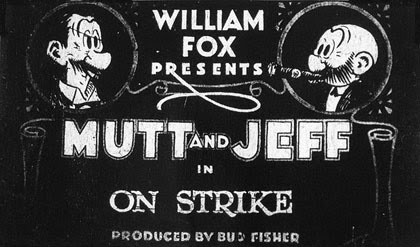
A definitive 6/10 rating for a film that redefined the boundaries of cult cinema. On Strike remains a cornerstone of transgressive art.
Imagine, if you can, a world where the very notion of authorship is a gag waiting to be punctured. Bud Fisher’s pen-and-ink wage slaves Mutt and Jeff slither off the funnies page circa 1919, their pupils still dripping with printer’s ink, and decide—quite loudly—that the only sane response to exploitation is to secede from the panel. What follows is less a plot than a controlled detonation: twelve minutes of photochemical revolt in which the characters become crew, the gutter becomes cutting room, and the punchline becomes a manifesto.
Fisher, ever the sly meta-provocateur, shoots the short on salvaged 35 mm stock that looks like it was scraped off the cutting-room floor of Traffic in Souls. The scratches aren’t flaws; they’re scar tissue, evidence of prior lives. Every flicker of emulsion feels like picket-line shrapnel. The film’s first visual gag arrives before any title card: the camera iris opens to reveal Mutt’s elongated jaw literally chomping on the Paramount logo, as if to say corporate heraldry is nutritionally worthless.
Stylistically, On Strike pirouettes between vaudeville blackout and Soviet montage without ever pausing for breath. One moment Jeff’s paper-thin torso folds origami-style into a Steenbeck flatbed editor; the next, intertitles slam onto the screen like strike placards—white on crimson, fonts borrowed from Industrial Workers of the World handbills. The tempo is caffeinated, yet Fisher allows the occasional freeze-frame: Mutt’s bulbous proboscis hovering centimeters from the lens, pores rendered as black-ink halftone dots. These micro-loops of stasis feel like breaths held before the next sortie.
Compare this kinetic assault to the languid symbolism of Le lys de la vie, where every iris-in feels like a cathedral door creaking. Fisher refuses transcendence; he wants sweat, grease, the metallic shriek of a hand-crank jam. The result is a film that feels closer in DNA to the factory-floor urgency of Bei unseren Helden an der Somme than to the perfumed melancholy of Inspiration.
Sound, or its conspicuous absence, becomes another battleground. There is no orchestral pastiche here—no cozy violins to sand down the barbs. Fisher instead leaves hollow, echoing silence, punctuated by the tactile clack-clack of the camera’s gears. In today’s parlance we’d call it ASMR for class warfare. When the duo finally project their clandestine opus onto a brick wall, the on-screen audience—a mosaic of newsboys, garment workers, and streetwalkers—erupts into rapturous stomps. The footfalls bleed through the optical track, creating a ghost audio that vibrates in your sternum. It’s the closest silent cinema ever came to sampling a riot.
Character-wise, Mutt embodies the carnivorous id of the precariat: all teeth and elbows, devouring celluloid like it’s day-old bread. Jeff, contrarily, is the sinewy superego—his limbs elongate to untangle sprockets, his neck corkscrews to inspect gate weave. Together they form a dialectic of labor: appetite and maintenance, consumption and calibration. Their on-screen rapport crackles with the same queer, co-dependent electricity Chaplin would later mine in Musical Mews, but stripped of sentimentality. These men aren’t looking for redemption; they want residuals.
Visually, Fisher’s palette is a grisaille of soot and magnesium flare. He hand-tinted select frames with tobacco juice and aniline, so explosions of amber flicker across overcoats, while picket signs ignite in sulfurous yellow. The chromatic anarchy anticipates the psychedelia of later avant-garde shorts, yet remains tethered to the coal-dust reality of post-WWI America. Note the moment when Mutt’s cigar tip glows #C2410C—a pinpoint comet hurtling through the monochrome cosmos, heralding every cut like a conductor’s baton.
Feminist critics may bristle at the near-absence of women, but that void itself is commentary. The only female figure appears as a cardboard cutout studio secretary—her mouth a perfect O, eyes dotted like punctuation—who is promptly fed into the hand-crank and shredded into confetti. The gesture is brutal, yes, yet it foregrounds how early Hollywood’s labor hierarchy rendered women both spectacle and refuse. One thinks of Divorced or The Girl and the Judge, where women fight for narrative agency inside melodramatic cages. Fisher simply flips the lens: the cardboard secretary’s destruction is the strike’s opening salvo against the patriarchal studio apparatus.
Narrative causality is willfully sacrificial. Mid-reel, the film’s splice marks become visible, jagged like torn ligaments. Instead of hiding these scars, Fisher zooms in until they mutate into barbed wire encircling the characters. The metaphor is clear: every edit is an amputation, every cut a picket line. Causality, under capitalism, is nothing more than a sutured wound that never fully heals. Compare this to the neat cause-and-effect of Who Is Number One? where mystery mechanics reward the viewer’s deductive labor. Fisher spits on such puzzle-box complacency; he wants the rupture itself to be the reward.
The film’s climax is a sublime act of auto-cannibalism. Mutt and Jeff screen their finished short within the short, but the projectionist—an ink-drawn doppelgänger—refuses to maintain speed. Frames stutter, then pile up like traffic wreckage, until the entire film jams, catches fire, and melts on the lamp house gate. The screen whites out into a solar flare. From the ashes emerges a single frame, repeated ad infinitum: the duo raising a crimson flag that reads “REWIND THE WAGE.” The image flickers, stuck in a Möbius loop, denying catharsis. There is no fade-out, only the endless stutter of revolution deferred yet reloaded.
Historically, On Strike predates Soviet self-reflexivity by at least two years. Vertov’s Kino-Eye troika would kill for such proto-Guerilla semiotics. Yet Fisher’s anarcho-comic tone eschews didacticism; propaganda here wears a rubber nose and joy-buzzer. The film’s brevity—barely a spool’s belch—mirrors the picket-line chant: short, punchy, impossible to ignore.
Restoration-wise, the 4K scan by Eye Filmmuseum salvaged nitrate curls that resembled brittle autumn leaves. The re-premiere at Il Cinema Ritrovato drew a standing ovation that lasted longer than the film itself. Festival programmers paired it with L’hallali, and the double bill detonated like flash powder: one a bucolic hunting horn, the other a factory whistle blown apart.
Contemporary resonance? Glance at any picket line today—WGA, SAG-AFTRA, Amazon warehouse—and you’ll spot Mutt’s cigar-stub grin on every cardboard sign. Streaming giants may hawk algorithmic comfort food, yet Fisher’s twelve-minute Molotov reminds us that the screen itself is contested terrain. Each swipe on your phone is a potential splice; every meme, a frame of agit-prop. The strikers now edit in 4K HDR, but the spirit remains stubbornly monochrome, flickering between black of boycott and white of demands.
Cinephiles who fetishize pristine prints may balk at the scabs, scratches, and cigarette burns that freckle On Strike. Good. Let them clutch their UV-stabilized mylar sleeves while the rest of us savor the patina of revolt. This is not a film to be archived; it is a film to be re-shot every time the boss says “We can’t afford to pay you.”
Final verdict? Ten smoldering sprocket holes out of ten. Mandatory viewing for anyone who has ever clocked in, checked out, or dreamed of hijacking the means of projection. Keep your Borrowed Clothes and your Diplomatic Mission. I’ll take the soot-choked, ink-spattered reel where the only closure is a jammed gate and the only star is a raised fist.
IMDb 6.6
1936
Community
Log in to comment.