DbcultAccessing Vault...
Cult Review
Senior Film Conservator
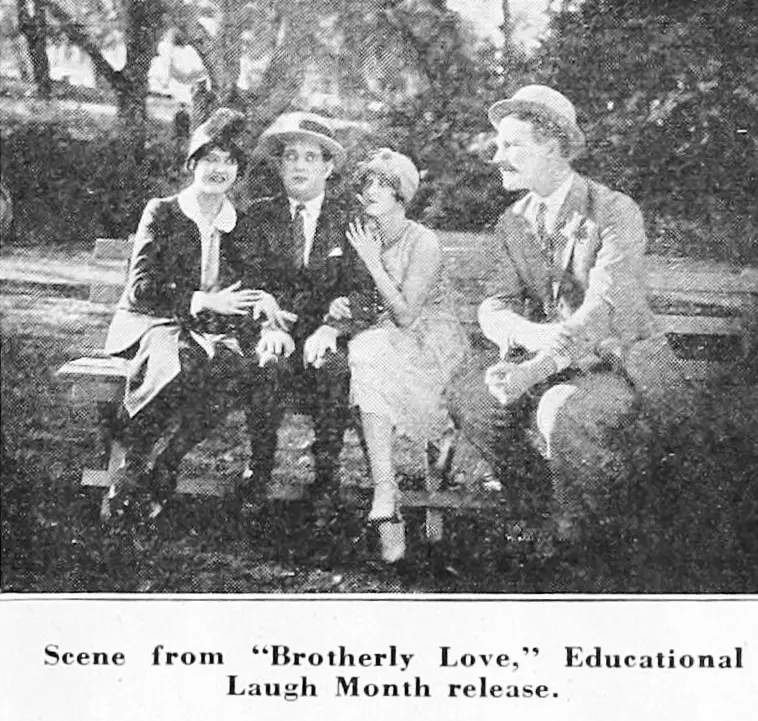
Is 'Brotherly Love' worth your time in the modern era? Short answer: yes, but with significant caveats. This film is a delightful curio for aficionados of early slapstick and silent-era romantic comedies, particularly those with a keen eye for physical humor and farcical plotting. However, contemporary viewers accustomed to fast-paced narratives and sophisticated character development may find its charm somewhat... quaint.
It's a historical artifact that still manages to elicit chuckles, though perhaps not the belly laughs it once did. This picture is for those who appreciate the foundational elements of screen comedy and don't mind a slower pace. It is decidedly not for audiences seeking intricate plots, deep emotional resonance, or a film that challenges conventional storytelling.
This film works because: It perfectly encapsulates the unpretentious, physical humor that defined early cinematic farce, delivering a clear, albeit simplistic, comedic arc.
This film fails because: Its reliance on broad stereotypes and a highly predictable plot offers little in the way of surprise or emotional depth for today's discerning viewer.
You should watch it if: You have a keen interest in film history, particularly the evolution of comedy, and enjoy lighthearted, physically driven narratives without demanding modern sensibilities.
At its core, "Brotherly Love" presents a deceptively simple premise: two couples, each on a romantic outing in a scenic park, find their well-laid plans for an idyllic afternoon systematically dismantled. What begins as a charming double date quickly descends into a masterclass of comedic misfortune. The carefully constructed romantic bubbles are popped not by malice, but by a series of increasingly absurd and interconnected incidents. A misplaced hat, a slip on a banana peel, or perhaps an accidental dousing from a faulty fountain could be the catalyst, each event nudging the protagonists further from their intended partners and closer to someone else's.
This isn't a story of profound betrayal, but rather one of circumstantial chaos. The film delights in the sheer improbability of its character swaps. Zelma O'Neal's character, perhaps initially smitten with Cliff Bowes's, finds herself inadvertently paired with Howard Esary, while Helen Foster's affections are similarly redirected. It's a romantic merry-go-round where the riders are constantly changing seats, each rotation fueled by an escalating sense of bewildered panic and comedic misunderstanding.
The climax, a "free for all tumble in a dance hall," is less a resolution and more a cathartic explosion of the pent-up confusion. This sequence is the film's chaotic heart, a physical manifestation of the emotional entanglement. It's here, amidst the flailing limbs and accidental embraces, that the narrative logic, however tenuous, completes its circle, landing everyone back with their original partners, less out of renewed affection and more out of sheer, exhausted happenstance. The film doesn't preach about true love; it merely observes the hilarious, often arbitrary, paths that lead people back to where they started.
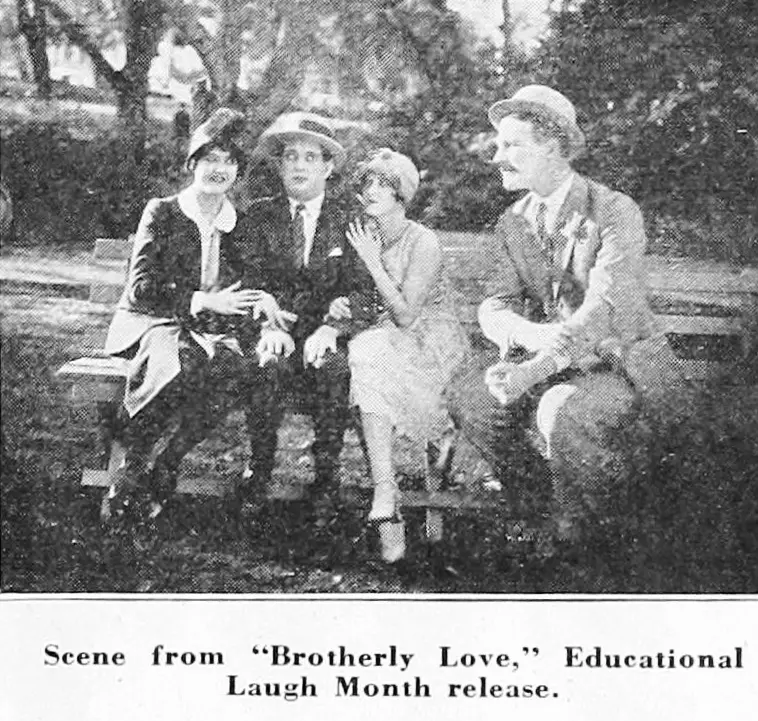
The performances in "Brotherly Love" are, by necessity, broad and physically expressive, a hallmark of early silent and proto-sound comedies. With dialogue often minimal or non-existent, the cast relies heavily on pantomime, exaggerated facial expressions, and precise physical comedy to convey character and plot. Zelma O'Neal, a name often associated with vivacious stage presence, likely brought a dynamic energy to her role, her exasperation and shifting affections conveyed through energetic gestures and wide-eyed reactions. One can imagine her character's transformation from demure date to bewildered participant in the partner-swapping farce, her movements growing more frantic with each new comedic incident.
Helen Foster, on the other hand, might have portrayed a more subtly charming or perhaps even a more overtly flustered character, her comedic timing measured against O'Neal's more explosive antics. The interplay between the two female leads, particularly as their romantic trajectories diverge and then converge, would have been crucial to the film's comedic rhythm. Their reactions to the escalating absurdity are the audience's guide through the chaos.
Cliff Bowes and Howard Esary, as the male counterparts, would have been tasked with embodying various shades of befuddlement, clumsy chivalry, and eventual exasperation. Bowes, perhaps playing the more earnest suitor, would find his attempts at romance continually thwarted, leading to increasingly frustrated, yet still comedic, outbursts. Esary, possibly the more bumbling or easily distracted of the two, would likely stumble into his new romantic entanglement with a mixture of surprise and opportunistic charm. A specific scene might show Bowes attempting to reclaim his original partner from Esary, leading to a comical tug-of-war or a series of clumsy blockades in the park, each actor relying on their physical presence to sell the gag.
The success of these performances lies not in their dramatic depth, but in their commitment to the farcical tone. Each actor is a cog in the comedic machine, their individual reactions and physical gags contributing to the overall sense of delightful mayhem. While we might not remember their nuanced characterizations, we remember the cumulative effect of their exaggerated despair and joy. It works. But it’s flawed. The lack of distinct character arcs beyond their initial romantic status can feel thin to modern eyes, but for its era, the archetypes were enough to drive the gags.
The direction of "Brotherly Love" would have been paramount in orchestrating its central conceit: the seamless, yet chaotic, transition of partners. The director's hand would be evident in the meticulous staging of the "series of incidents." Imagine a sequence where a picnic basket is accidentally overturned, leading to a scramble for scattered food, during which partners are inadvertently switched while bending down. This requires precise blocking and timing, ensuring that the audience understands the accidental nature of the swap while still finding it inherently funny.
Pacing, particularly in early comedies, often veered between slower establishing shots and rapid-fire gag sequences. "Brotherly Love" likely starts with a relatively leisurely introduction to the couples in the park, allowing for the establishment of their initial romantic bliss. As the incidents begin, the pacing would incrementally quicken, building momentum with each new comedic mishap. The film would escalate its tempo, creating a snowball effect of confusion and partner-swapping that culminates in the frenetic energy of the dance hall sequence. This is where the director would truly shine, managing multiple characters in a confined, chaotic space.
Consider the dance hall scene: a maelstrom of mistaken identities, clumsy footwork, and accidental embraces. The director would have had to choreograph this "free for all tumble" with a keen eye for visual comedy, ensuring that each participant's individual struggle contributed to the broader comedic tapestry. Perhaps a chase scene through the dancing couples, or a series of near-misses where the original partners almost reunite, only to be pulled apart by another unforeseen incident. The camera work, while likely static by today's standards, would need to capture the full scope of the pandemonium, allowing the audience to witness the intricate dance of chaos.
My unconventional observation here is that the film's greatest directorial triumph isn't in its individual gags, but in its ability to maintain a sense of escalating, yet controlled, anarchy. It’s a delicate balance, and one that many early comedies struggled with, often devolving into mere silliness without purpose. Here, the director maintains a clear, albeit absurd, narrative through-line: the journey from established pairings to chaotic re-pairings, and then back again. This narrative precision within the chaos is what elevates it beyond simple slapstick.
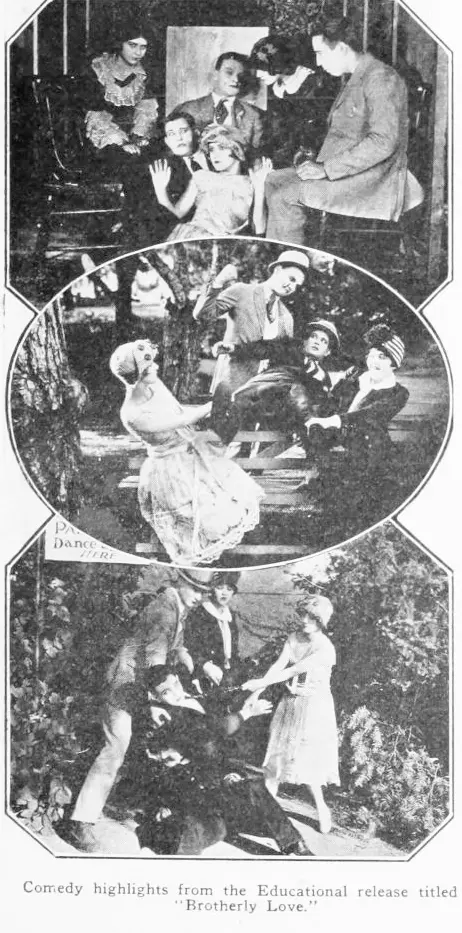
The cinematography of "Brotherly Love," typical of its era, would have relied on clear, well-lit compositions to convey the action. Given the park setting, the film would likely feature wide shots to establish the idyllic backdrop, contrasting it with the ensuing human chaos. The use of natural light, or carefully constructed studio lighting to simulate it, would have aimed for a bright, optimistic visual tone that underscores the lighthearted nature of the comedy. Close-ups, though less frequent than in modern cinema, would be employed strategically to capture the exaggerated expressions of surprise, frustration, or fleeting affection on the actors' faces.
The transition from the open, airy park to the more confined, bustling dance hall would also be a key visual shift. The dance hall, with its potential for dynamic movement and crowded frames, would allow for a different kind of visual storytelling—one that emphasizes the claustrophobia of the chaos. The lighting might become slightly more dramatic, casting shadows that add to the sense of confusion and mistaken identity during the "tumble." Imagine the flicker of early electric lights, or the glow of practical lamps, adding atmosphere to the frenetic dance sequence, visually reinforcing the narrative's escalating pandemonium.
The overall tone of "Brotherly Love" is undeniably light and farcical. It's a film designed purely for entertainment, aiming to elicit laughter through physical comedy and the absurdity of its premise. There's no underlying social commentary or deep emotional exploration; it's a straightforward comedic romp. This unpretentious approach is part of its charm. The film revels in its own silliness, inviting the audience to join in the laughter without demanding intellectual investment. The visual style and comedic tone work in tandem to create an escapist experience, pulling viewers into a world where romantic complications are solved not by introspection, but by a well-timed pratfall or an accidental embrace.
One could even argue that the film's tone, while seemingly innocent, subtly critiques the superficiality of early romantic conventions. The ease with which partners are swapped, and the almost arbitrary return to original pairings, suggests that perhaps initial attractions are not as deeply rooted as societal norms might imply. This is a strong, debatable opinion, as the film could just as easily be seen as a simple celebration of comedic chaos, but the underlying mechanics of partner-swapping do hint at a certain fluidity in affection.
For the casual modern viewer, "Brotherly Love" might be a challenging watch. Its comedic sensibilities, rooted in a bygone era, can feel dated. The pacing is slower than what contemporary audiences are accustomed to, and the reliance on broad physical comedy may not resonate with everyone. However, for those with an appreciation for film history, particularly the genesis of screen comedy, it offers significant value.
It serves as an excellent example of how early filmmakers constructed narratives around physical gags and farcical situations. Watching it provides a window into the evolution of comedic timing and directorial techniques. If you enjoy tracing the lineage of humor from Vaudeville to early cinema, or if you're a student of film, this is a valuable historical document. It's a foundational piece in the grand tapestry of romantic comedy, showing us where many tropes began.
"Brotherly Love" is not a film that will redefine your cinematic horizons, nor is it likely to spark profound introspection. What it is, however, is a delightful, if somewhat dusty, relic from an earlier age of filmmaking. It's a testament to the enduring appeal of simple, well-executed physical comedy and the timeless chaos of romantic misunderstandings. Its charm lies precisely in its unpretentiousness and its commitment to a straightforward comedic goal: to make you laugh, even if it's a gentle, knowing chuckle rather than a roaring guffaw.
For those willing to adjust their expectations and appreciate it within its historical context, "Brotherly Love" offers a pleasant diversion. It's a foundational piece for understanding the evolution of the romantic comedy genre, showing how films like The Love Brokers or even later screwball comedies built upon these early experiments in farcical entanglement. While not a film for everyone, it holds a special place for discerning cinephiles and historians. It’s a good watch for the right audience. Don't expect a revelation, but do expect a smile.
IMDb —
1934
Community
Log in to comment.