DbcultAccessing Vault...
5.5/10
Senior Film Conservator
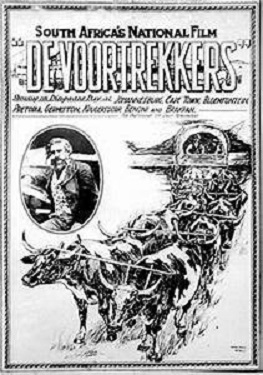
A definitive 5.5/10 rating for a film that redefined the boundaries of cult cinema. De Voortrekkers remains a cornerstone of transgressive art.
To gaze upon De Voortrekkers in the modern era is to witness the very moment a nation’s mythology was calcified into light and shadow. Released in 1916, a year that saw the global cinematic language evolving through works like Snow White and the sociological explorations of Where Are My Children?, Harold M. Shaw’s South African epic operates on a scale that few contemporary productions dared to inhabit. It was, for all intents and purposes, the Southern Hemisphere's answer to the sweeping historical spectacles emerging from the United States and Europe, sharing the grandiosity found in Defense of Sevastopol.
Director Harold M. Shaw, an American import with a background at Edison’s studios, brought a level of technical sophistication to the African Film Productions company that was previously absent in the region. Collaborating with the historian and journalist Gustav Preller, Shaw didn't just film a story; he orchestrated a nationalistic ritual. The film’s narrative structure is less about individual character arcs and more about the collective movement of a people—a human tide pushing against the geographic and political constraints of the 1830s. While films like Pennington's Choice focused on individual ruggedness, De Voortrekkers prioritizes the communal struggle, making the ox-wagon itself a central protagonist in the drama.
The cinematography in De Voortrekkers is nothing short of revolutionary for 1916. Shaw utilizes the natural light of the highveld to create a high-contrast aesthetic that feels more authentic than the staged interiors of many silent dramas of the time. The vastness of the landscape is not merely a backdrop; it is an active antagonist. We see the wagons descending the precipitous slopes of the Drakensberg mountains, a sequence that rivals the physical daring seen in Marvelous Maciste. The sheer logistical effort of mobilizing thousands of extras—including many Zulu participants who had lived through the twilight of the Zulu Empire—lends the film a verisimilitude that modern CGI cannot replicate.
The portrayal of the Zulu King Dingane and his court is handled with a mixture of awe and dread. While the film undeniably views the conflict through a Eurocentric lens, the sheer presence of the Zulu warriors on screen provides a visceral power. This is not the whimsical fantasy of A Yankee from the West; this is a somber, often brutal depiction of a clash between two incompatible worldviews. The massacre of Piet Retief’s party is staged with a chilling, rhythmic precision that highlights the vulnerability of the pioneers when stripped of their technological advantages.
The centerpiece of the film is undoubtedly the Battle of Blood River. It is here that Shaw’s directorial prowess reaches its zenith. The formation of the 'laager'—the defensive circle of wagons—is filmed with a tactical clarity that makes the ensuing chaos comprehensible. As the Zulu impis charge against the Boer fire-power, the editing quickens, creating a sense of claustrophobic intensity. This sequence serves as the film’s moral and narrative resolution, a moment where divine providence (as interpreted by the characters) meets military discipline. In comparison to the religious allegories in Maria Magdalena, the spiritual undertones of De Voortrekkers are inextricably tied to the soil and the blood shed upon it.
The ensemble cast, featuring Caroline Frances Cooke, Charles Kitts, and Edna Flugrath, delivers performances that are surprisingly restrained for the silent era. Flugrath, in particular, avoids the histrionics often found in early cinema, such as the exaggerated gestures in The Stolen Voice. Instead, she conveys a stoic endurance that mirrors the film’s broader themes of perseverance. The inclusion of Goba and other indigenous actors adds a layer of ethnographic interest, even if their roles are dictated by the colonial hierarchies of the period.
When we place De Voortrekkers alongside other 1916 releases, its unique position becomes even more apparent. While Nankyoku tanken katsudô shashin was documenting real-world exploration in the Antarctic, Shaw was fictionalizing history to create a foundational myth. There is a didactic quality here that reminds one of The Disciple, yet Shaw’s work is far more expansive in its environmental scope. The film doesn't just ask us to watch a story; it asks us to witness the birth of a social order. Even the mystery elements—though subtle—hint at the investigative pacing found in Where Is Coletti?, as the Boers constantly scout and interpret the signs of the land and the movements of their adversaries.
The film’s legacy is complex. For decades, it was shown annually in South Africa as a sacred text of Afrikaner nationalism, a status that has made it a subject of intense scrutiny in the post-apartheid era. However, from a purely cinematic standpoint, one cannot deny the artistry involved. The use of depth of field, the handling of large-scale movement, and the integration of historical documents into the narrative flow show a filmmaker at the height of his powers. It lacks the whimsicality of Captivating Mary Carstairs, opting instead for a somber, almost liturgical tone that demands the viewer's undivided attention.
In the final analysis, De Voortrekkers is a haunting artifact. It captures a landscape that has since been irrevocably altered and a mindset that shaped the course of a century. Its technical achievements in 1916 set a benchmark for African cinema that would not be challenged for many years. Much like the forgotten reels of Lime Kiln Club Field Day, it offers a window into the racial and social dynamics of the early 20th century, though from a vastly different perspective. It is a film of shadows—the shadows of the wagons against the setting sun, and the shadows of a history that continues to be debated and deconstructed.
Whether viewed as a masterpiece of early silent spectacle or a controversial piece of propaganda, De Voortrekkers remains essential viewing for anyone interested in the evolution of the cinematic form. It is a grueling, beautiful, and deeply uncomfortable experience that proves cinema’s power to not only reflect history but to actively participate in its creation. As the final frames fade into the blackness of the African night, one is left with the indelible image of the trek—an endless, slow-moving line of white-canvassed wagons, carving a path into the unknown, forever etched into the celluloid of 1916.
Critique by the Cinephile Collective - 2024 Analysis
IMDb 4.5
1919
Community
Log in to comment.