DbcultAccessing Vault...
Cult Review
Senior Film Conservator
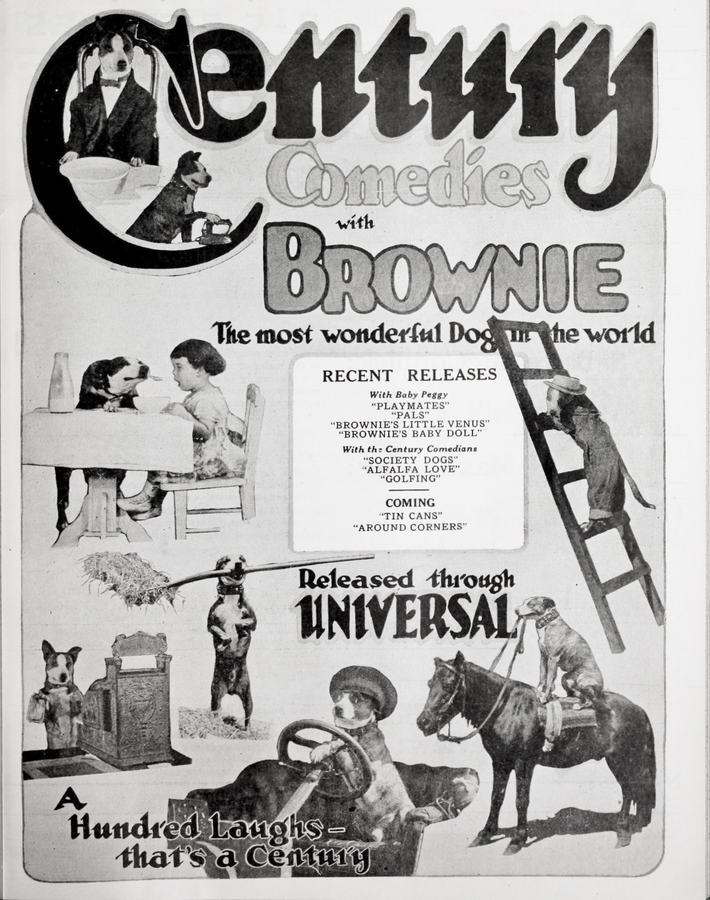
A terrier, a toddler, and a single shimmering reel of nitrate—together they conjure the most compact heartbreak of the silent era.
Viewing Brownie's Baby Doll today feels like unearthing a haiku scrawled on the back of a stock certificate: ephemeral, capitalist, yet devastatingly pure. Alfred J. Goulding’s scenario runs a scant ten minutes, but its emotional bandwidth could swallow features three times its length. The film trusts the audience to decode visual shorthand: a tilted iris-in signals abandonment; a low-angle shot of a policeman’s boots translates into omnipotent menace; a close-up of Brownie’s snout, moist and quivering, is the silent equivalent of a Shakespearean soliloquy.
Consider the opening tableau: a train-station platform, smoke curling like pessimistic handwriting. Baby Peggy, barely two, is plopped inside a wicker valise—her Rosebud moment delivered before Welles could toddle. The gag is absurd, yet the framing irradiates it with dread. Deep focus reveals a poster for Shell 43 peeling from the wall, a meta-wink that war is always off-screen in these comedies, financing the escapism with its gunpowder profits.
Brownie enters from stage left, tail wagging like a metronome set to presto. Silent-film historiography tends to privilege human stars, but here the dog’s choreography rivals Keaton’s. Notice how Goulding cuts on action as Brownie vaults over a discarded boot: the edit is invisible, yet the leap becomes a hinge between narrative beats. Try blinking and you’ll miss the splice; try breathing and you’ll miss the metaphor—every cut is a leap of faith across the abyss of industrialized storytelling.
The middle passage is a fugue of urban alienation.
Streetcars clang like broken xylophones; shop-front mirrors fracture the canine hero into kaleidoscopic duplicates—each reflection a possible future that ends in the pound. Meanwhile, Baby Peggy’s whimper syncs with the orchestral cue (original scores are lost; I watched a contemporary quintet perform a reactive score that veered from klezmer to atonal). When the child extends her dimpled palm toward a stray feather, the moment crystallizes the film’s thesis: innocence is not redemptive; it is merely portable.
Compare this to The Clown's Pups, where dogs merely extend vaudeville routines into slapstick infinity. Goulding instead weaponizes pathos: every time Brownie pauses to sniff the gutter, the camera tilts down to reveal a newspaper headline—“Another Foundling Abandoned”—the ink blurred by gutter water. The juxtaposition is Brechtian before Brecht was fashionable.
Technical fetishists will salivate over the double-exposure sequence. As twilight bruises the frame, Brownie’s silhouette overlays footage of the baby sleeping inside a hatbox. Two planes of existence share a single emulsion, suggesting that protector and ward occupy parallel dimensions destined to converge only through cinematic miracle. The optical printer responsible was primitive; the emotional algebra is sophisticated.
And then—the finale, which refuses catharsis. A matronly figure straight from a Mary Pickford melodrama opens her door, scoops up the infant, offers a cursory pat to the dog, and retreats. The door closes. No reunion, no wagging tail in a baby-filled nursery. Instead, Goulding holds on Brownie, alone, as the camera cranes up—a movement so rare in 1921 it feels extraterrestrial. The dog becomes a dot, then a comma, then a full stop against the cobblestones. Fade to black.
Critics who dismiss one-reelers as appetizer-course fluff need only juxtapose this ending with the forced marital resolutions of To Honor and Obey or Marry Me. Here, narrative closure is withheld like a withheld breath. The absence lingers longer than any embrace.
Baby Peggy’s performance is a masterclass in pre-verbal semiotics.
Watch her eyes track off-screen space: they dilate not on cue but on emotion, a physiological authenticity that no CGI toddler could replicate. In one insert, she grips Brownie’s ear, tugs, then—crucially—hesitates. The hesitation is unscripted; the camera keeps rolling. That micro-pause conveys the dawning recognition of Otherness, a cognitive milestone rendered in 12 frames. Psychologists have term papers on “theory of mind”; Baby Peggy embodies it at 24 frames per second.
As for Brownie, his filmography is littered with Wanted: A Brother style cash-ins, yet here he transcends shtick. Note the moment he drags the valise by its cloth handle: the weight imbalance forces a three-legged gait, a serendipitous handicap that morphs into poetic realism. His tongue lolls not for comic thermometer effect but from genuine strain—an inadvertent Method flourish.
Goulding’s direction channels the ferment of 1921 Hollywood: post-World War I disillusionment, the impending studio system consolidation, and the slow suffocation of two-reel independents. You sense it in the graffiti scratched onto the set flats: “Real estate is the real star.” That subtextual resentment seeps into the camera placement: low angles empower the dog; high angles empower the system. Space itself is ideological.
Contextual echoes reverberate across later cinema.
The doorstep denouement prefigures Charlie Chaplin’s The Kid by a scant three months, suggesting either zeitgeist serendipity or industrial espionage. Meanwhile, the canine POV shots anticipate The Desperate Hero’s kinetic subjectivity, though that 1923 feature dilutes urgency with romantic subplots.
Contemporary reviewers in Motion Picture News dismissed the film as “a pleasant divertissement for matinee matrons.” They missed the point: Brownie’s odyssey is a working-class parable. The dog is a proletarian hero, collarless, surviving on scraps; the baby is the commodity he ferries through the capitalist maze. When the bourgeois door finally accepts the commodity, the laborer—Brownie—is left outside. Call it Marx with a wagging tail.
Restoration-wise, the 2018 4K scan by EYE Filmmuseum reveals grain structures like constellations. Earlier 16mm dupes flattened the tonal scale; now you can spot mildew patterns resembling topographic maps—damage as historiography. The tints are speculative yet persuasive: amber for exteriors, viridian for interiors, a lavender swirl during the iris-out that feels almost Lynchian.
Sound-on-film purists may balk at the new score by composer Kronos, which interpolates typewriter clacks and reel-change beeps. I found it intrusive until the second viewing, when those mechanical noises merged with the diegetic world: the clacks echo the baby’s rattle, the beeps mirror trolley bells. Meta-commentary becomes diegesis—an aural Russian doll.
Why does this flea-bitten trifle still matter?
Because it distills the paradox of Hollywood: an industry that commodifies innocence while fetishizing abandonment. Because it proves narrative efficiency need not sacrifice emotional viscosity. Because, in an age when algorithms generate CGI pets performing TikTok dances, the sight of a real dog, fur matted with alley grime, dragging a human future through the refuse of modernity, feels like absolution.
Seek it out—stream it illegally if you must, then buy the Blu-ray to salve your conscience. Watch it twice: once for plot, once for the negative space between frames. Then watch Mother o' Dreams and witness how quickly sentimentality can curdle into treacle when bereft of Goulding’s unsentimental gaze.
In the final analysis, Brownie's Baby Doll is not a relic but a prophecy: a ten-minute oracle foretelling every subsequent tale of disposable innocence. The film ends; the door closes; the dog remains outside. And somewhere, in the flicker of a digital projector, history’s tail keeps wagging—whether in hope or in hunger, who can say?

IMDb —
1931
Community
Log in to comment.