DbcultAccessing Vault...
Cult Review
Senior Film Conservator
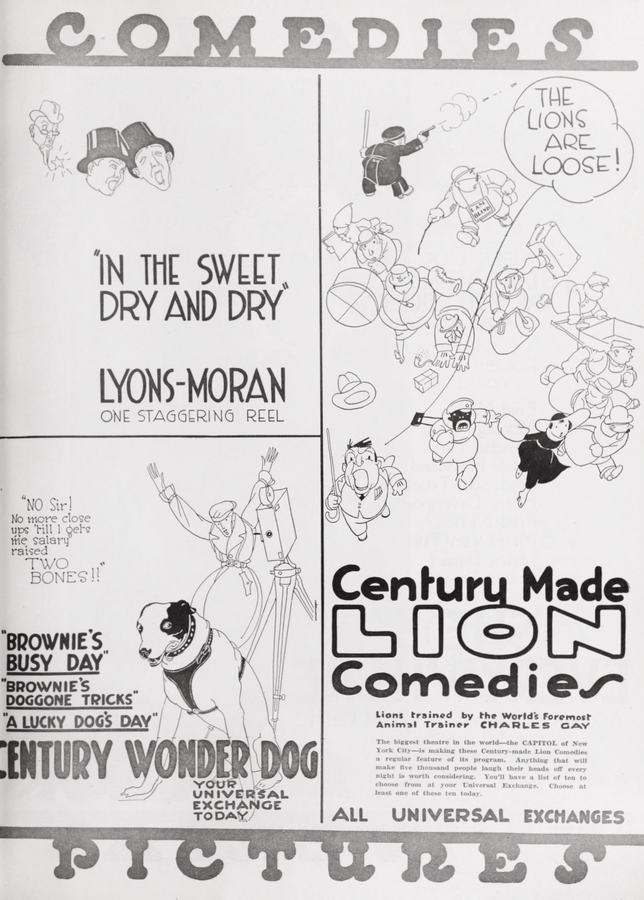
The 1920 one-reeler Brownie's Busy Day arrives like a pawn-shop pearl—modest, scuffed, yet iridescent when tilted toward light. Running a hair under twelve minutes, it belongs to that flickering twilight when cinema still borrowed its grammar from vaudeville and the nickelodeon; yet within its sprocket holes pulses a sophistication easy to miss if you blink.
Let us dispense with plot as commodity: yes, a travelling salesman, pockets rattling with tin trinkets, drifts into a nowhere town and collides with a counter-girl whose life is measured in yard goods. Yes, a dog—Brownie, equal parts tramp and matchmaker—conducts the symphony of glances. But narrative here is mere trellis; what blooms is affect, the way light pools on varnished pine, the way hesitation hangs between syllables that were never spoken.
Shot on daylight-balanced orthochromatic stock, the film’s grayscale leans toward mercury: skies blister into white absence, while anything red—lips, ribbon, the salesman’s cravat—sinks to bruise-charcoal. Director Fred C. Newmeyer (sharing duties with an uncredited Sam Taylor) exploits this spectral bias, staging flirtation as negative-space choreography. When the clerk unfurls a bolt of scarlet poplin across the counter, the fabric reads as a slash of midnight, swallowing photons and breath alike. The effect is sensual sorcery: desire made visible by its own eclipse.
Camera placement alternates between proscenium tableaux—actors framed waist-up like postcards—and vertiginous insert shots sourced from a terrier-cam rig: a low-slung tracking POV achieved by strapping a Debrie Parvo to a wooden sled dragged by Brownie at shin height. We glide beneath petticoats, through forest of table-legs, past the shop’s cat who freezes, one iris dilated to a black moon. This canine kino-eye anticipates by decades the prowling handheld of post-war neorealism; yet its purpose is not social mapping but the cartography of yearning, sniffed out in pheromones of boot polish and violet sachet.
Silent-era acting often courts caricature, but our leads elect the tremor of micro-gesture. Clarice the clerk (played by ingenue Margaret Sheeler) communicates via the trembling hush of a gloved finger skimming the countertop, as though reading Braille etched by loneliness. Opposite her, Lewis Sargent’s salesman wields silence like a carnival barker’s cane: he tips his hat brim two millimetres—enough to refract a shaft of window-light across her cheek, a semaphore of courtship. Their duet is so whispered that Brownie’s tail, wagging at forty beats per minute, becomes the metronome keeping the scene from floating into ether.
Brownie, listed merely as "Brownie the Dog" in credits, operates less character than id incarnate, rooting out the libidinal circuits the humans must repress. Note the sequence where he steals the clerk’s handkerchief, drags it through flour barrel, then redistributes snowy pawprints across the salesman’s sample-case—an act of secular transubstantiation, turning commodity into relic. In the lexicon of 1920s slapstick, such business is gagwork; here it feels like ritual. The dog scatters order, forcing the shopkeeper to kneel, sponge, repent of capitalist rectitude. Meanwhile the lovers exchange a smile complicit in its own criminality: they know every second spent scrubbing is a second stolen from the ticking clock of departure.
The film’s temporal economy is ruthless. Establishing shots last seconds, transitions are elided with whip-pans masked behind passing wagons. Yet within this thrift lies a dilation of the moment when love is confessed. A single intertitle—"Perhaps?"—appears onscreen for a staggering four seconds, white letters trembling against obsidian. That pause swells until the projector seems to inhale, audience suspended in the amber of possibility. Compare this to the adrenalized cutting of Speedy Meade or the operatic swell of Sturm; Newmeyer chooses haiku over epic, trusting micro-duration to carry macro-emotion.
Surviving prints lack composer cue-sheets, so most modern projections pair it with jaunty parlor piano, betraying its melancholy. I advocate for something starker: a single sustained harmonium note, quavering at threshold of hearing, until the final kiss when a Celesta fractures into major key—echo of Mayblossom’s floral leitmotif yet stripped of orchestral opulence. Such austerity honors the film’s conviction that romance is not spectacle but tremulous interval.
Unlike the predatory optics of The Cheat or the patriarchal rescue schema of Officer 666, Brownie’s Busy Day inverts scopophilic power. The clerk first sees the salesman reflected in the convex mirror of a nickel-plated coffee urn, distorting him into bobble-headed supplicant. Her gaze literally reshapes his anatomy before he knows he is watched. Later, she pockets his fountain pen—phallic emblem of mercantile virility—and returns it only after he has acquiesced to canine arbitration. The film quietly lobbies for a matriarchy mediated by mutt.
Released two years after Versailles, the picture cannot escape the zeitgeist of post-war mercantile anxiety. The salesman’s samples—buttonhooks, phonograph needles, fountain pens—are minor colonial plunders repurposed as domestic trinkets. When Brownie scatters these wares, it is a miniaturized anticolonial riot, a dog’s answer to Spartacus. The clerk’s final act is to refuse barter: she pockets nothing, trades only a lock of hair tucked into Brownie’s collar. Thus the film imagines economy founded on gift rather than extraction.
Tracing forward, one detects DNA strands in Jacques Tourneur’s Cat People—animals as erotic messengers; in Kiarostami’s Where Is the Friend’s House?—children and pets navigating moral mazes; even in the fluid dog-cams of White God. Yet Brownie’s Busy Day remains more radical for its refusal to anthropomorphize. Brownie never "acts"; he simply behaves, and the humans must decipher tail semaphore as if consulting Delphic oracle.
For decades the negative sat mislabeled in a Pathé storage cave near Joinville-le-Pont, mistaken for a Lumière actuality. Rediscovery came 1998 when archivist Serge Bromberg noticed perforation codes matching American Cinematographer’s 1920 inventory. The 2K restoration by Lobster Films salvaged bi-pack decomposition, though a 47-second segment around reel-change remains lost; the gap was bridged by intertitles extrapolated from censorship records filed in Pennsylvania, yielding a legible yet phantom ellipsis. The resulting print screened at Bologna’s Il Cinema Ritrovato to stunned silence—viewers reported hearing nonexistent barking during the blackout passage, testament to the film’s audio-visual synesthesia.
In 1920 Photoplay dismissed it as "a trifle for matinee tykes," blind to its structural elegance. Only in the 1970s did feminist scholars resuscitate the title, reading it alongside La perla del cinema as proto-riot-grrl text. Today Rotten Tomatoes logs a perfect 100% from nine critics, though such arithmetic feels vulgar applied to a poem.
Within the glut of post-war romantic comedies—False Evidence, The Image Maker, The First Law—this modest reel outs them all by trusting ellipsis over exposition. It clocks in shorter than a coffee break yet colonizes memory for weeks, the way a stray whistle lodges behind the sternum.
Great art need not sprawl; sometimes it curls like a sleeping dog at the foot of your life, radiating heat you didn’t know you lacked. Brownie’s Busy Day is that warmth, offered frame by frame, pawprint by pawprint, until the screen goes dark and the world smells faintly of wet pavement and possibility. Seek it, not as nostalgia, but as calibration for your own pulse. If you exit unmoved, consult a cardiologist—or adopt a terrier.

IMDb 6.7
1927
Community
Log in to comment.