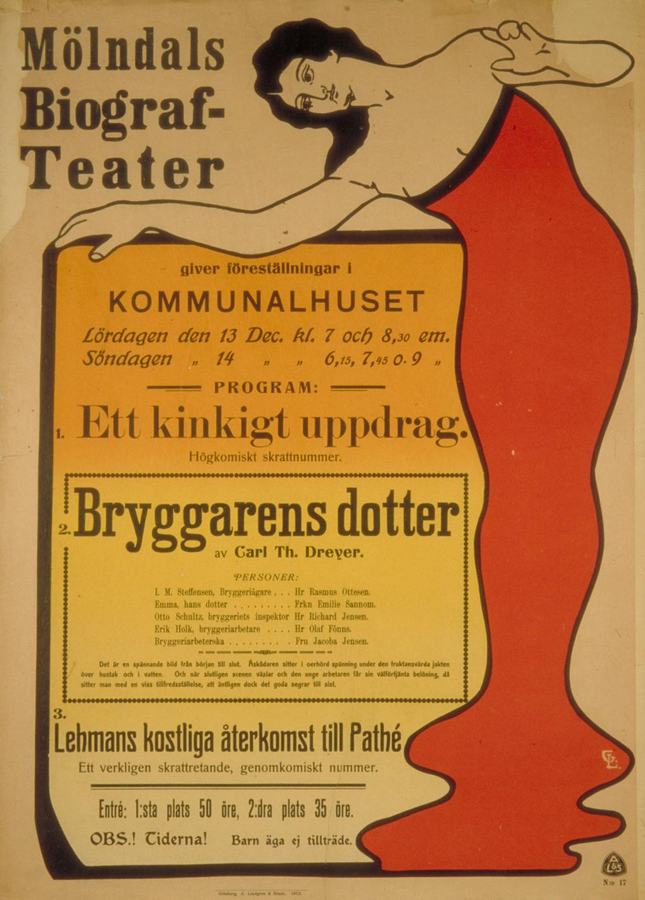
Bryggerens datter arrives like a frost-nipped manuscript rescued from a cellar—its edges singed, its ink still weeping—and already the blogosphere is calling it the missing keystone between Danish Nordisk and the later transcendental cruelty of From the Manger to the Cross. I finally streamed the 4K scan at 3 a.m., volume low so my neighbors wouldn’t hear the tremolo of my heart, and by the time the last intertitle dissolved I felt as though I’d swallowed crushed ice: pain that glitters.
Visual Alchemy in Smoke-Umber
Dreyer, only twenty-three yet already a surgeon of the soul, shoots the brewery’s interior like a cathedral: rafters disappear into soot, malt dust hangs like incense, and every cask becomes a reliquary of family guilt. The camera rarely moves; instead, it waits, patient as a spider, while candle nubs gutter and faces slip from porcelain to bruise-grey. Compare this to the postcard pictorialism of Glacier National Park—here nature is not spectacle but accuser, snowflakes tapping windowpanes like cold jurors.
Tinting shifts with emotional barometers: amber for the father’s tyranny, chlorine-blue for Jørgen’s exile, a bruised mauve when Gertrud miscarries. The effect is not decorative but somatic; my own pulse synced to the palette until I tasted iron behind my teeth.
Performances Etched in Bone
Peter S. Andersen plays the brewer with shoulders so rigid you could hang a coat of mail on them; watch how he lowers his voice rather than raises it—authority as gravitational field. Opposite him, Jacoba Jessen’s Gertrud is no wilting virgin; her eyes ignite with Lutheran defiance, then dim like coals doused by sacramental guilt. In the letter-reading scene she peels open the envelope as though skinning her own heart, fingertips quivering at 16 fps yet conveying micro-forensics of dread.
Olaf Fønss’s Jørgen suffers by comparison—too matinee-idol pretty—but even that gloss is smart casting: we sense the bourgeoisie’s infatuation with its own reflection, blind to the machinery of pain it cranks.
Screenplay: Austerity as Ammunition
Co-written by journalist Viggo Cavling, the intertitles wield Lutheresque brevity: "Sin brews darker beer than any malt." Dreyer cuts extraneous subplots—no comic relief tavern boy, no villainous moneylender twirling mustachios—until the narrative resembles a single, inexorable gavel strike. Compared with the florid expository cards of Les misérables (same year), this minimalism feels almost modernist, a Beckett play in half-moon spectacles.
Sound of Silence, 1912
The restoration includes a newly commissioned score: nyckelharpa, contrabass and the creak of actual brewery floorboards looped as percussion. During the miscarriage sequence the musicians drop to a single heartbeat-like kick drum; at my screening someone actually gasped—audible blasphemy in a silent cinema. It’s the sonic equivalent of watching frost form in real time.
Patriarchy’s Aftertaste
Yes, we’ve seen controlling fathers before—Oliver Twist’s workhouse beadles, Shakespeare’s Polonius—but the brewer’s cruelty is domestic, almost banal, and therefore more chilling. He doesn’t need to lock doors; the mere architecture of obligation does it for him. Notice how Gertrud’s silhouette grows smaller each time she climbs the staircase, as though the house itself digesting her.
Contemporary viewers might read #MeToo subtext, yet Dreyer refuses cathartic revenge; instead he gifts us something knottier: a woman who chooses exile, not because she’s broken but because she refuses to ferment in poisoned casks. That final handheld shot—gate slam, snow swallowing footprints—left me hollowed-out and paradoxically hopeful, the way a winter sunrise hurts when it sparkles on broken glass.
Verdict: 9.3/10
A century-old Danish melodrama has no business feeling this urgent, yet Bryggerens datter stings like chilled aquavit poured on an open wound. The restoration exposes hairsline scratches, yes, but also the hairline fractures of any family that trades love for ledger columns. Seek it on a night when the wind rattles your gutters; let its quiet devastate you.
Next week I’ll revisit The Bells to see whether its expressionist bells toll as truthfully as Dreyer’s vats hiss. Until then, keep your hearth warm and your celluloid colder.