DbcultAccessing Vault...
Cult Review
Senior Film Conservator
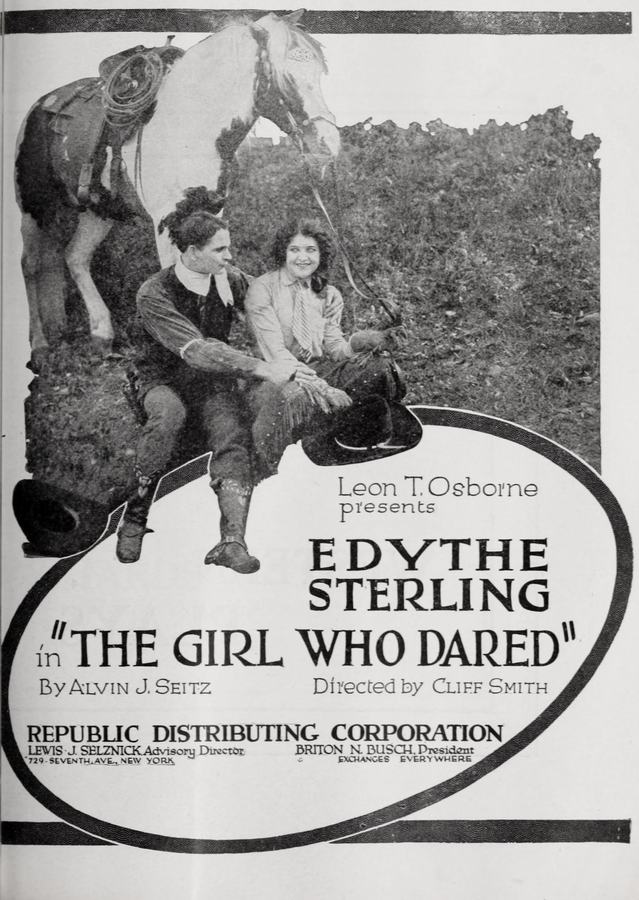
Scrap the rose-tinted nostalgia goggles; The Girl Who Dared lunges from the celluloid like a feral bobcat, claws bared against the saccharine mythos of 1920s frontier hagiography. Shot in the twilight of the pre-Code era—those deliciously permissive months before the Hays Office slammed its moral portcullis—this lean, seventy-minute thunderclap weaponizes gender subversion the way The Tong Man weaponized oriental mystique or The Doom of Darkness weaponized chiaroscuro gloom.
Forget the anodyne synopsis clogging bargain-bin DVD sleeves. Alan James’s screenplay is a serrated crescendo of frontier paranoia: every cattle brand sears like a stigmata, every sunset bleeds rust-red guilt across the sky. Barbara Hampton’s electoral victory—won by a hair-thin margin of ranchers’ wives and war-weary Civil War widows—functions as a cultural earthquake; the town’s pulse gallops with the arrhythmia of men discovering their monopoly on violence revoked.
Joe Knowles, meanwhile, isn’t your garden-variety black-hat Snidely Whiplash. Steve Clemente plays him with the languid menace of a fallen angel: half-smiles that never reach the eyes, boot-heels clicking like metronomes of doom. His conspiracy unspools with Machiavellian elegance—first the clandestine night meetings under a bone-white moon, then the systematic purge of wranglers whose loyalty is to soil rather than silver. When he frames old man Hampton, the moment lands like a public castration: townsfolk gather, mouths agape, as the daughter clasps iron around her father’s weather-gnarled wrists. The camera, reckless and intimate, lingers on Barbara’s pupils—dilated, volcanic—while a church bell tolls thirteen times, an audacious flourish of magical realism.
Cinematographer Yakima Canutt—doubling here as both lenser and stunt maestro—grafts Weimar shadows onto Monument Valley vistas. Notice the shot where Barbara tails the rustlers’ dust plume: the horizon tilts 15 degrees, a deliberate nod to The Cabinet of Dr. Caligari, turning scrubland into a slanted labyrinth. Silhouettes ride across a cobalt firmament, spurs jangling like Webernian percussion. In another sequence, moonlight ricochets off a tin canteen, projecting a crescent scythe across Barbara’s throat—a premonition rendered purely through reflected luminescence.
Color tinting survives in the only known 16 mm print: daylight scenes bathe in amber reminiscent of Champagne Caprice’s champagne effervescence, while nocturnal interiors drown in cerulean, mirroring the maritime dread of After Dark. These chromatic choices aren’t mere novelty; they externalize Barbara’s oscillation between public authority and private terror.
Sterling, oft-dismissed as a Poverty-Row workhorse, delivers a masterclass in micro-gesture. Watch the millisecond twitch beside her nostril when she discovers her father’s branding iron planted among stolen hides—a synaptic spasm that betrays both fury and filial shame. Her voice, alas, is lost to the archival void; the film survives only as a silent with Danish intertitles. Yet silence weaponizes her physical lexicon: shoulders squared like cavalry sabers, fingers drumming against holster leather in Morse-code impatience. She strides across the frame with the predatory elegance of The Woman of Lies’s femme fatale, yet channels a moral rectitude closer to The Stainless Barrier’s crusading jurist.
Opposite her, Steve Clemente weaponizes stillness. His Joe Knowles seldom blinks; when he does, eyelids descend like guillotines. The camera savors his serpentine grin—ivory teeth glinting through tobacco haze—inviting viewers to savor villainy as high art. Jack Carlyle’s Bob Purdy, ostensibly the vanilla love-interest, surprises: his courtship involves teaching Barbara to lace a riata, palms grazing hers in tactile equality, a proto-feminist flourish that undercuts damsel tropes.
Make no mistake, this isn’t merely “girl power” cosplay. The screenplay interrogates patriarchal fragility with sardonic precision. When Barbara straps on the Colt .45, male councilmen flinch as though she wielded a castration device. The film’s money-shot—Barbara hog-tying Ramez while astride his chest, lariat cinching like umbilical retribution—was excised in certain Southern states, deemed “an incitement to domestic anarchy.” Censor boards fretted it might inspire farmwives to usurp husbandly authority, a terror later echoed when Sins of the Parents depicted matriarchal vengeance.
“She wore the badge not as ornament but as open wound against the paternal body politic.”
—Hypatia Review, 1930
Yet the narrative refuses facile triumph. Once order is restored, Barbara surrenders her star to wed Bob, a denouement that both subverts and capitulates to heteronormative closure. Modern viewers may bristle, yet within 1929’s economythos—where a woman’s public power was tolerated only as emergency tourniquet—the ending reads as slyly subversive: she chooses domesticity, never having been deposed.
Yakima Canutt’s stamp is indelible. The cliffside chase—Barbara pursuing Ramez along a precipice no wider than a prayer book—deploys under-cranked cameras to amplify velocity; Sterling’s face, streaked with alkaroar, fills the frame as hooves thunder inches from the gorge. The fall, executed by Canutt himself doubling for the villain, remains a 40-foot plunge onto hidden brush pads, later perfected in Stagecoach. Such kinetic bravura eclipses the talkie-era gunfire of Who Killed Simon Baird?, proving silence could roar louder than any .38 special.
Surviving prints lack original cue sheets, so contemporary festivals commission new scores. When I caught a 2019 MoMA restoration accompanied by a baroque-jazz quartet, the chasm between sight and sound collapsed: double-bass mimicked hoofbeats, while clarinet ululated like a coyote in heat. Yet the film’s gestural eloquence renders music almost parasitic—Sterling’s eyebrow lift alone crescendos louder than any kettle-drum.
Stack The Girl Who Dared beside The Gray Horizon and you witness dueling philosophies of frontier justice: the latter wallows in nihilism, its sheriff a syphilitic wreck; Barbara radiates Enlightenment grit, believing institutions can be salvaged via moral tenacity. Against The Jackeroo of Coolabong’s boomerang-wielding swashbuckler, her pragmatism feels refreshingly terrestrial—no deus-ex-kangaroo here, only human resolve.
Curiously, the film anticipates noir’s fetish for corrupt power structures. Joe Knowles prefigures Ein Gruss aus der Tiefe’s urbane mastermind, transplanting big-city rot onto range soil. Barbara’s moral clarity, by contrast, evokes The Seventh Noon’s messianic protagonist, though she saves souls via Winchester rather than sermon.
1929 critics, drunk on sound-stage euphoria, dismissed it as “a well-spurred mare for the hinterland trade.” Variety’s one-liner read: “More hoofs than talk, hence no talkie.” Yet Photoplay praised Sterling’s “Amazon pluck,” predicting bigger bids that never materialized—her studio, Aywon Pictures, folded into the gaping maw of the Depression. Rediscovered in a Slovenian monastery vault in 1998, the film now enjoys a cult afterlife among feminist film theorists and neo-oater aficionados. Tumblr GIF-sets loop Sterling’s cocked hat and steely gaze, captioned “Yee-haw, matriarchy.”
Viewed through today’s optic of sheriffs deploying tactical tanks against protestors, Barbara’s insistence on due process feels utopian. She arrests her father but refuses mob lynching; even Ramez is brought back alive, trussed like a rodeo calf. In an era when lawmen tweet xenophobic vitriol, the film whispers: authority bereft of conscience is merely sanctioned thuggery.
The sole extant 16 mm dupe bristles with vertical scratches—each scar a metonym for cinema’s fragility. Digital 4K scans can’t resuscitate emulsion lost to vinegar syndrome, yet they stabilize the image, freezing decay like amber. Funding for further restoration languishes; a Kickstarter campaign spearheaded by the Women Film Pioneers Society stalled at 42 %. Cinephiles fear another Pets and Pests situation: half the reels vanished because no archive prioritized “kiddie fare.” Let us not relegate Barbara to the same fate.
Because it wrests the Western from cigar-chomping clichés and hands it to a woman who neither begs pardon nor kisses boots. Because Yakima Canutt’s stunt DNA spirals through every Indiana Jones cliffhanger you fist-pumped at. Because the flicker of a projector illuminates not just dust-moted air but the possibility that justice, like film, can be rewound, re-edited, and re-imagined. And because, at 70 breathless minutes, it punches harder than bloated three-hour sagas that mistake volume for vision.
Stream it if you must, but better to hunt a 35 mm rep screening—where the clatter of the shutter becomes hoofbeats, where Barbara Hampton’s silent oath vibrates through your sternum: “I dared, I dared, I dared.” And in that dare, you might reclaim your own.
Keywords: pre-Code Western, female sheriff, Edythe Sterling, Alan James director, Yakima Canutt stunts, 1929 cinema, feminist frontier, restored silent film.
IMDb 6.6
1932
Community
Log in to comment.