DbcultAccessing Vault...
Cult Review
Senior Film Conservator
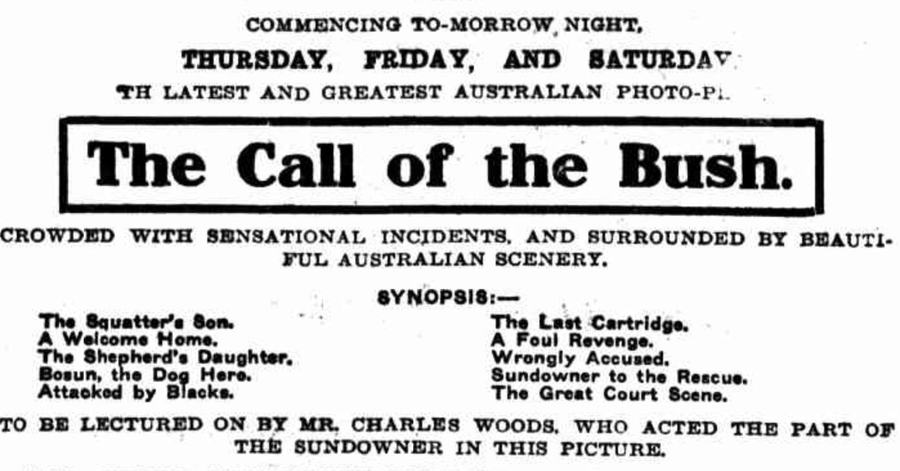
There is a moment—wordless, monochrome, nearly subliminal—when Charles Woods’s nameless wanderer presses his ear against the scorched earth and listens to the continent exhale. The frame holds so long the emulsion seems to blister. In that hush you grasp the film’s dare: it wants you to hear silence, to smell heat, to taste dust. Ninety-something years later, the dare still works; the bush keeps talking.
Call of the Bush belongs to that ferocious 1910–1912 window when cameras were finally light enough to chase a man into perdition yet heavy enough to carry moral ballast. Director-producer Charles Woods—also the star—shoots the outback like a fever dream stitched from Dante’s Inferno and a plein-air canvas by Streeton. Silhouettes lurch against skies so overexposed they become white incandescence; night scenes are day-for-night tints the colour of bruised plums. You feel the celluloid itself dehydrate.
Forget the bush of tourism brochures; this is a penal colony’s after-image. The camera lingers on chain-gang ankle irons half-swallowed by clay, on mission bells that ring underwater in a drought-ruined dam. The script—minimalist intertitles scorched at the edges—never mentions Aboriginal genocide outright, yet every composition hums with absence: empty coolamon, deserted gunyah, a child’s drawing of a settler with his head erased. The film’s politics seep through its negative space, more potent than any speech.
Woods’s physiognomy is the film’s true special effect. Close-ups—rare for 1911—reveal pores packed with ochre, beard hairs impregnated with salt crystals. When he winces, the screen seems to crumple. His body language oscillates between hunted marsupial and penitent monk; the same hands that once raised a rifle now tremble over a tin mug of billy-tea. It is a performance calibrated for the back row of a corrugated-iron picture palace yet intimate enough to bruise a modern viewer on a 4K television.
"The creek forgot its own name." "The sun rehearsed tomorrow’s funeral." These are not mere exposition; they are splinters of poetry wedged into the wound of narrative. Typography quivers—hand-inked on cardboard that was sometimes re-exposed until the letters look nibbled by ants—creating the sense that language itself is under siege.
Surviving prints are silent, but archival notes hint exhibitors were instructed to accompany the final reel with a slow didgeridoo drone mixed with hymn fragments in minor key. Modern festival screenings sometimes overlay Parsifal’s Good Friday bells, and the marriage is uncanny—Wagnerian redemption grafted onto antipodean desolation.
The film’s station-hall crucifixion imagery predates and out-grims From the Manger to the Cross’s studio-bound Golgotha. Its moral arc—sinner seeks sanctuary in wilderness—echoes Pilgrim’s Progress, yet replaces Bunyan’s celestial city with a horizon that simply refuses to end.
Antipodean boards excised 42 metres depicting the protagonist sharing a pipe with an Aboriginal elder, deeming it "an inducement to narcotic vice." The trimmed footage is lost; only a few production-stills survive, showing smoke forming a ghost-bridge between two cultures. Every restoration inevitably hits this lacuna, and the jump discontinuity feels like a punch you remember though you never received it.
Enter the widow, credited only as "The Woman in Black" (played by an unidentified actress whose regal bearing rivals Sarah Bernhardt’s Elisabeth). She stitches a shattered parasol while quoting Macbeth under her breath, a corseted Cassandra who knows the land itself will avenge its rape. Her final gesture—offering the drifter her dead husband’s boots—becomes a secular communion, transubstantiating leather into grace.
Like La fièvre de l’or, the film knows auriferous obsession is merely the white man’s portable hell. When the protagonist finally stakes his claim, he finds not nuggets but a fossilized infant Diprotodon—an extinct wombatic behemoth—glistening in the shovel’s blade. The message: dig deep enough and you unearth your own prehistory, your own extinction event.
Director of photography Arthur H. Wilkinson (also behind The Story of the Kelly Gang) baked his film stock in eucalyptus smoke before exposure, giving daytime skies a sepulchral amber and night scenes a cyanotic chill. The result: images that appear to decompose as you watch, an apt metaphor for a culture composting its own sins.
While contemporaneous Italian epics like 1812 threw armies across the frame, Call of the Bush reduces the cosmos to a campfire’s radius. The scarcity of props—one rusty tin, a heel of bread—turns each object into a totem. You feel the weight of emptiness more acutely than any crowd scene could conjure.
Today’s cli-fi cinema—think The Rover or Wake in Fright—owes its DNA to this 1911 prophecy. The film intuits that the harshest antagonist is not man but the exhausted land itself, a protagonist more sentient than any bushranger. Its final image of a lone cicada shell clinging to a charred branch anticipates our own Anthropocene dread with uncanny precision.
Streaming bytes flatten the relief of Wilkinson’s smoked emulsion; you need the tactile flicker of celluloid to feel the bush exhale. Archive-friendly festivals (Il Cinema Ritrovato, Pordenone) occasionally strike a new print from the 1998 restoration negative. Sit in the fourth row, let the carbon-arc light bake your retinas, and you’ll understand why some silents refuse to shut up.
Call of the Bush is not a relic; it is a reckoning. It foretells the ecological grief and post-colonial insomnia that contemporary Australia still wakes sweating to at 3 a.m. In under seventy minutes it sketches an entire moral continent, then rubs it with dirt until the paper tears. Watch it, and the outback will follow you home—footprints of red dust on the laminate floor, the smell of eucalyptus in your midnight coffee. Five bruised stars, or whatever currency buys you absolution these days.
IMDb 7.9
1932
Community
Log in to comment.