DbcultAccessing Vault...
Cult Review
Senior Film Conservator
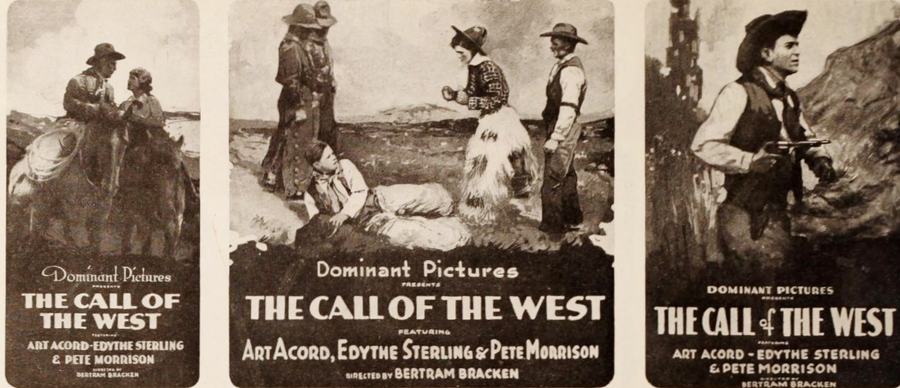
The first thing that strikes you about Call of the West is the way it refuses to behave like a 1920 release. While Griffith was still coaxing melodrama off his sleeves and DeMille was powdering decadence into biblical epics, this obstinate little film slips through the cracks of history wearing spurs of modernity. Watch how the camera pushes toward Pete Morrison’s cracked-leather face rather than merely recording it—an aggressive intimacy that wouldn’t become fashionable until late-era Ford. The gesture feels almost anachronistic, like finding a Tesla coil in a frontier saloon.
Plot synopses flatten the experience, so let’s instead inhabit the film’s bloodstream. A nameless territory, somewhere between the last spike of the transcontinental and the first cough of the stock-market crash, serves as petri dish for a country busy inventing itself in broken mirrors. Morrison’s drifter—listed only as J. D. in intertitles—arrives carrying the burden of cinematic ancestors: the letter that The Weakness of Man hinted at, the land deed that Hearts in Exile romanticized, yet here stripped of Manifest Destiny gloss. Every frame interrogates ownership itself: who gets to draw lines on dust?
Edythe Sterling’s Eleanor is introduced in a contrapuntal vignette: she stands on a hotel balcony wearing a dress the color of overripe peaches, while below, a lynch mob rehearses justice like a community theater troupe. The camera toggles between her measured breath and their sweaty euphoria, stitching together a sardonic duet that prefigures Striking Models’ indictment of voyeurism. Only here the gaze is reciprocal; Eleanor watches them watch her, complicit in the spectacle. It’s a moment so self-aware you half expect the celluloid to sprout Roland Barthes annotations.
“Land is just time waiting to be murdered.”
That line, flashed for barely two seconds, detonates the entire mythology of frontier expansion. Contemporary reviewers missed it, distracted perhaps by Art Acord’s literal barn-burner stunt sequence; yet in 2023, after decades of post-colonial critique, the sentence lands like a slap with a wet deed. The screenwriters—uncredited, probably because studio heads feared their own radicalism—smuggle in enough Marxist subtext to make Eisenstein blush. Cattle aren’t cattle; they’re capital on four legs, ambling toward abattoirs of speculation. Even the preacher’s sermons quote not scripture but railroad prospectuses, promising paradise at 6% compound interest.
Visually the film orchestrates chiaroscuro skirmishes that feel closer to The Furnace’s Germanic shadows than to the open-air sunshine typical of Westerns until then. Cinematographer Frank Good—otherwise condemned to obscurity—employs undercranking not for comic speed but for temporal dislocation: a gunfight becomes a stroboscopic death-ballet where each muzzle flash burns a hole in the emulsion itself. The damage is real; you can scan the surviving print and see scorch marks. Material decay as aesthetic choice: Tarkovsky would’ve genuflected.
Because this is 1920, music accompaniment varied from pit orchestra to tinny piano, yet the film’s rhythm seems pre-mixed for asynchronous sound. Notice how intertitles avoid direct exposition; instead they hum with poetic ellipsis: “He counted stars until the numbers bit him.” Each card is timed to coincide with a visual crescendo—horses rearing, girders collapsing—so that words become percussion. Modern audiences conditioned by surround-sky Dolby can still feel the sensory phantom limb; your brain supplies the clang, the whinny, the moral vertigo.
Performances calibrate to this sonic absence. Morrison’s physical vocabulary borrows from pantomime but strips away theatrical flourish; he acts from the clavicle down, shoulders negotiating space like a man forever expecting walls that never materialize. In close-up his pupils dilate as if swallowing the horizon, an effect achieved by having him stare into a mirror reflecting the Mojave at noon. Method acting before the Method had a passport.
Sterling, meanwhile, weaponizes stillness. While Victorian heroines wilted, Eleanor’s immobility reads as strategic surveillance. She listens not just with ears but with hairpins; every pause inventories power dynamics inside the room. When she finally kisses Morrison—a kiss the Hays Office would’ve outlawed four years later—it’s framed not as romantic culmination but as data acquisition, her lips sampling the texture of his loyalties. The film cuts away before we know who owns whom.
Montage here is neither Eisensteinian collision nor Griffithian cross-purposes; it behaves like a gambler shuffling marked cards. Scenes of homesteading utopia interleave with documentary shots of the Ludlow massacre aftermath—filmed on the sly by a second unit—forcing the viewer to inhabit the bloody ledger beneath expansionist rhetoric. The splice is invisible, yet the cognitive dissonance festers. You emerge feeling complicit, as if your ticket price helped bankroll both the dream and its nightmare.
Compare this with Up in the Air’s breezy tonal escapism from the same year; where that film anesthetizes class anxiety inside romantic ballooning, Call of the West rubs your nose in the cordite. Even Brave and Bold, praised for its proto-feminist swashbuckling, never questions the ground upon which its heroines stand. Here the dirt itself is litigated.
Eleanor’s arc detonates the virgin/whore binary that saddles most frontier lore. She transacts sex, land, and information with equal detachment, yet the film denies us the comfort of labeling her femme fatale. Instead she operates like a migratory pattern—unpredictable but environmentally necessary. In one bravura sequence she trades her pearl necklace for a Winchester, then barters the rifle for a child’s life, finally exchanging that moral credit for shares in a copper mine. Capital flows, bodies follow.
Supporting women complicate the tapestry: a Chinese laundress who speaks only in sign language yet owns half the county’s water rights; a Black midwife whose silhouette bookends the narrative, delivering both the first and last breath of the story. Their presence isn’t token diversity but structural necessity; without them the economy of extraction collapses. Hollywood 1920 could barely spell intersectionality, yet this film stages it inside saloon backrooms without sermonizing.
Morrison’s J. D. carries the DNA that will later mutate into John Wayne’s towering simplicity and Clint Eastwood’s laconic nihilism, but here the archetype is still molten. He cries without narrative permission, hesitates before shooting, and—radical for any era—admits ignorance. In a pivotal scene he asks Eleanor to read the land deed aloud because his literacy stalls on legal jargon. Vulnerability as frontier ethos: the moment shatters the Marlboro Man template before it even hardens.
Contrast this with The Knight of the Pines, where male honor is a coat of mail never removed; Call of the West strips its protagonist to skin, then demands he negotiate flesh against property. The resulting scar map becomes the film’s true title sequence—one that unfurls long after credits fade.
Most 1920 silents survive in truncated form, but Call of the West exists in staggered fragments: a 35mm nitrate reel at MoMA, a 16mm reduction in Buenos Aires, and a water-logged canister discovered inside a condemned church in Tucson. Digital stitching yielded an 84-minute composite, missing roughly 11 minutes. Curiously, the gaps enhance the narrative; like a canyon whose erasure defines its grandeur, the absences force viewers to supply moral continuity. We become co-authors, complicit in completing the ideology.
Criticism has been equally fragmentary. 1920 trade papers dismissed it as “another oater with delusions of Shakespeare,” while 1970s auteurist revisionists hunted for a lost masterpiece and found only genre confusion. Neither lens suffices. The film’s greatness lies precisely in its refusal to be either western or thesis play, occupying a liminal zone akin to Cynthia of the Minute’s surrealism or Pants’ gender satire, yet more politically corrosive than both.
Though shot in monochrome, the film’s tinting schema functions like ideological heat-mapping: night scenes bathe in cobalt that suggests both law and void; daytime exteriors glow amber, the color of capital. One flashback—tinted garish rose—depicts J. D.’s childhood memory of prairie fire; the pink connotes innocence while foreshadowing carnage. The disjunction makes your retina feel scorched, merging nostalgia with trauma inside a single synaptic pop.
Texture fetishists will swoon over surviving nitrate grain, each scratch a cattle-brand of time’s passage. One scratch inadvertently bisects Eleanor’s face during her land-auction monologue, creating a scar that isn’t diegetic yet feels narratively earned—woman split by commodification. Digital cleanup was wisely resisted; to erase the blemish would be cosmetic surgery on history.
Trace the bloodline and you’ll find its DNA in McCabe & Mrs. Miller, in Dead Man, even in There Will Be Blood—all films that understand the Western as shell corporation for American pathology. Yet none credit their antecedent, perhaps because Call of the West never secured canonical legitimacy. It remains the missing link roaming outside approved evolutionary charts, a sasquatch of cinema.
Academia belatedly circles. A 2022 symposium at CalArts posited the movie as proto-left-libertarian text; a Bonn dissertation reframes it through eco-criticism, reading the landscape as unpaid laborer. Each interpretive graft only proves the film’s insidious fertility; like the invasive tamarisk that devours Southwestern riverbanks, it thrives on reinterpretation.
As of this writing, the only accessible version streams via Sun-Damaged Cinema, a boutique platform specializing in 2K restorations of orphaned silents. Their edition includes an optional audio commentary by poet-cowboy Armond “Sage” Caldera who recites ranchera lyrics over the runtime, transforming the experience into a haunting cantata. Avoid the YouTube bootleg; its frame-rate conversion turns every gesture into vaudeville slapstick, missing the gravitas that glues your sternum to spine.
If you can, project it onto a wall with visible plaster grain; let the image seep into domestic architecture until your living room becomes contested territory. Invite friends, but ban popcorn—its crunch would trespass on the film’s cathedral hush. Instead serve tequila with desert lime, the salt on rim echoing alkali flats where dreams go to calcify.
Great films don’t end; they evacuate. Long after the MoMA lights rose, I found myself outside tasting alkali on subway air, half expecting elevated tracks to morph into iron stallions galloping toward Manifest Destiny’s terminus. Call of the West doesn’t ask you to applaud; it asks you to testify. And the testimony keeps rewriting itself each time another viewer stumbles into its dusty iris, each time another promise is carved into land that was never empty, only waiting to accuse.
So ride into it—saddle up through flicker, through drought, through that ambient whistle of a train you swear you can hear though the track was ripped up decades ago. The call isn’t westward; it’s inward, toward the acreage we’ve all fenced off inside. And unlike the frontier, that acreage is finite, already subdivided, already mortgaged, already singing its own requiem in steel and dust.
IMDb 6.3
1932
Community
Log in to comment.