DbcultAccessing Vault...
Cult Review
Senior Film Conservator
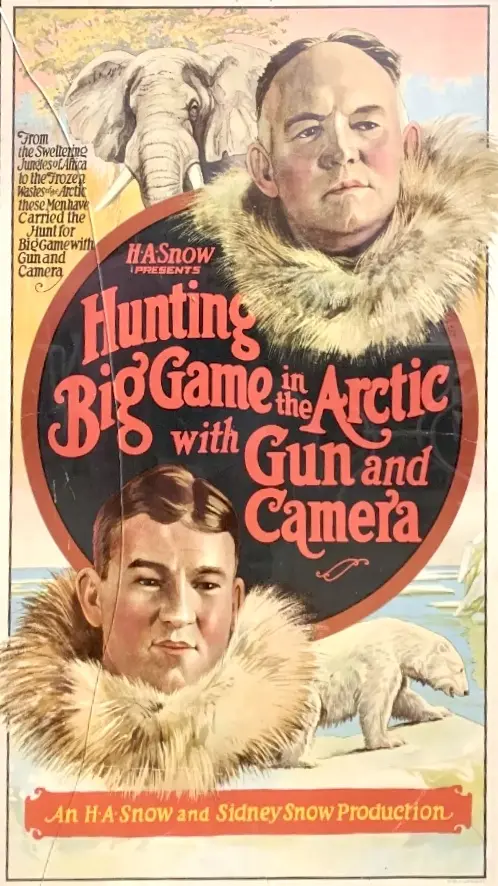
Is 'Hunting Big Game in the Arctic with Gun and Camera' a film that demands your attention in the 21st century? Short answer: yes, but with significant caveats. This isn't a film for casual viewing; it's a historical document, a raw window into a specific moment in early cinema and human interaction with the natural world, presented without modern polish or ethical framing.
This film is unequivocally for historians, anthropologists, early cinema enthusiasts, and those with a keen interest in the evolution of documentary filmmaking and exploration. It is emphatically NOT for viewers seeking contemporary storytelling, high production values, or a comfortable, ethically aligned narrative about wildlife. It challenges, provokes, and ultimately educates through its very existence.
This film works because: It offers an unparalleled, unvarnished glimpse into a specific historical period, capturing the immense challenges of Arctic exploration and early wildlife documentation with a raw authenticity that modern recreations simply cannot replicate. Its historical value as a pioneering documentary is immense, showcasing the very genesis of capturing reality on celluloid.
This film fails because: Its antiquated ethical stance on hunting and wildlife, while historically accurate for its time, can be deeply unsettling for contemporary audiences. Furthermore, its rudimentary filmmaking techniques and lack of narrative sophistication by modern standards can make it a challenging, even tedious, watch for those not specifically attuned to early cinema's unique rhythm.
You should watch it if: You are fascinated by the origins of documentary film, the history of exploration, or the shifting societal attitudes towards nature and conservation. It's a challenging watch, but one that offers profound insights for the right audience.
To truly appreciate "Hunting Big Game in the Arctic with Gun and Camera," one must first shed the expectations of modern cinema. This is not a film designed for entertainment in the contemporary sense; it is an artifact. It represents a monumental undertaking, both in its subject matter—an expedition into the brutal Arctic—and in its very creation, filming under conditions that would challenge even today's most robust equipment.
The film, starring H.A. Snow and Sidney Snow, is a testament to the sheer audacity of early 20th-century filmmakers and explorers. Imagine lugging heavy, cumbersome cameras and film stock into one of the most inhospitable environments on Earth. The 'directing' here isn't about crafting a narrative arc; it's about simply capturing existence, survival, and the pursuit of a goal against overwhelming odds. This raw, almost accidental authenticity is its greatest strength.
While there are no 'actors' in the traditional sense, H.A. Snow and Sidney Snow are the central figures, performing the reality of their expedition. Their presence on screen is less about emoting and more about embodying the stoic, determined spirit of the era's explorers. They are not playing roles; they are living them, and the camera captures the physical toll and mental fortitude required for such an endeavor. Their interactions with the environment and the animals, however unsettling to a modern eye, are presented as an intrinsic part of their mission.
One particular sequence, likely involving the tracking and eventual confrontation with a large animal, would have been exceptionally difficult to film. The camera operator, presumably one of the Snows or a dedicated member of their small crew, would have had to maintain focus and composure in extremely dangerous, unpredictable circumstances. This isn't a staged encounter; it's a testament to the bravery, or perhaps recklessness, of those behind and in front of the lens.
The cinematography, rudimentary by today's standards, is nonetheless revolutionary for its time. Each frame is a struggle against the elements, a triumph of capturing light and movement in a world designed to resist it. The stark white expanse of the Arctic, the jagged ice formations, and the fleeting glimpses of wildlife are rendered with a raw, almost painterly quality born of necessity rather than artistic choice.
There are no sweeping crane shots or elaborate camera movements. Instead, the camera is often static, observing, or following with a handheld immediacy that predates the verité style by decades. The sheer effort of merely framing a shot, ensuring adequate exposure in the glare of snow and ice, and keeping the camera operational in sub-zero temperatures makes every surviving frame a small miracle. This technical struggle imbues the visuals with an unintentional gravitas, a sense of hard-won truth.
Consider the challenge of capturing a polar bear or a walrus in motion. The limited telephoto capabilities, the heavy equipment, the need for precise manual focus – these factors mean that every successful shot of an animal is a victory. The resulting images, though perhaps grainy or shaky, possess an undeniable power, transporting the viewer directly into that harsh, majestic environment.
The pacing of "Hunting Big Game in the Arctic with Gun and Camera" is deliberate, almost glacial, mirroring the environment it depicts. There are long stretches of observation, of travel, of waiting. This slow burn might test the patience of a modern audience accustomed to rapid-fire editing, but it also forces a different kind of engagement. It demands that the viewer slow down, observe, and reflect on the sheer scale of the expedition.
The tone is one of detached observation, a scientific or ethnographic gaze rather than an emotional one. There is little in the way of overt commentary or dramatic embellishment. This neutrality, however, is precisely what makes the film so potent and, at times, so uncomfortable. It presents the act of hunting for what it was: a means of survival, a sport, and a form of scientific collection in an era when such practices were widely accepted and even celebrated.
This unblinking portrayal of hunting is where the film's ethical complexities truly emerge. Modern sensibilities rightly recoil at the casual depiction of killing animals for sport or collection. The film forces us to confront this historical disconnect, challenging us to understand the past without necessarily endorsing its values. It's a stark reminder of how much our relationship with the natural world has evolved, or perhaps, how much it needed to evolve.
"Hunting Big Game in the Arctic with Gun and Camera" is more than just a film; it is a historical document of immense importance. It captures the spirit of early 20th-century exploration, a period marked by a relentless drive to conquer, categorize, and document the last wild frontiers of the Earth. The film stands alongside other early non-fiction works, albeit in a more remote and physically demanding genre, reflecting a world still largely unknown to the general public.
It predates the sophisticated nature documentaries of figures like Jacques Cousteau or David Attenborough by decades, offering a raw, unmediated precursor to the genre. Where later films would emphasize conservation and beauty, this film highlights a more utilitarian and often brutal interaction with nature. It’s a snapshot of a time before widespread environmental consciousness, when the concept of 'big game' was intrinsically linked to human prowess and dominance.
The inclusion of both 'gun' and 'camera' in the title is particularly telling. It signifies a dual purpose: the traditional act of hunting for sustenance or sport, and the emerging technology of film to capture and share these experiences. The camera, in this context, is almost as much a tool of conquest as the gun, extending the reach of human observation and mastery over the natural world. It’s a fascinating, if troubling, juxtaposition.
While direct comparisons to narrative films like The Idle Class or The Hick are moot, its significance can be contextualized against other early non-fiction. It shares a spirit of raw, unpolished documentation with very early newsreels or ethnographic films, where the novelty was simply in capturing moving images of distant lands or unusual activities. It's a foundational text for the travelogue and adventure documentary genre.
Its legacy lies in its sheer existence. It proved that cinema could capture extreme environments, that it could be a tool for exploration and scientific record, however flawed by modern standards. It paved the way for future generations of filmmakers who would venture into the wild, eventually shifting the focus from conquest to appreciation and, ultimately, preservation. It works. But it’s flawed. Deeply so, for a modern audience.
"Hunting Big Game in the Arctic with Gun and Camera" is not a film to be enjoyed in the conventional sense. It is a historical document, a challenging relic that demands intellectual engagement rather than passive consumption. Its immense value lies in its raw, unfiltered portrayal of a specific time, a specific place, and a specific human endeavor that is both awe-inspiring in its ambition and deeply unsettling in its execution when viewed through a modern lens.
It stands as a testament to the pioneering spirit of early cinema and exploration, a gritty, unvarnished record of man versus nature, captured with groundbreaking effort. While it will undoubtedly provoke discomfort and ethical debate, its importance as a historical artifact and a foundational piece of documentary filmmaking cannot be overstated. It’s a film that requires patience and an open mind, but for the right viewer, it offers profound insights into a world that has long since passed, leaving behind a legacy that continues to spark discussion about our place within the wild. It's a difficult watch, but an important one.
Community
Log in to comment.