DbcultAccessing Vault...
Cult Review
Senior Film Conservator
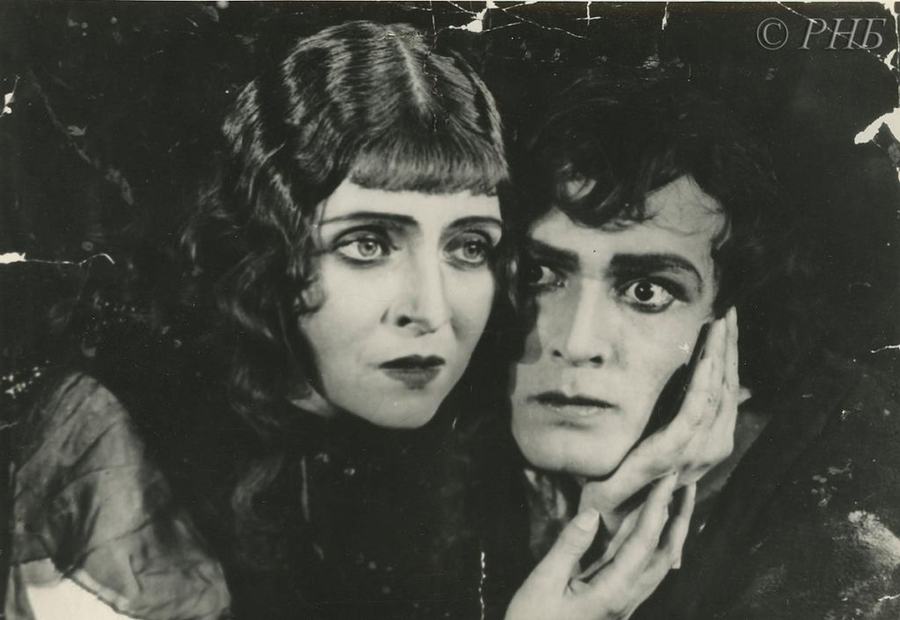
A frost-latticed fever dream shot on the eve of the Great War, Iola is less a story than a séance conducted on frayed nitrate.
Imagine, if you can, a film that inhales the mildew of crumbling manor walls and exhales it as silver-tinted breath on-screen. Director-cinematographer Vladimir Gajdarov (also essaying the neurasthenic Andrey) achieves exactly that: every frame feels humid with decay, yet paradoxically dusted in the shimmer of crushed pearls. The year is 1913; Russian cinema still whispers in pre-Revolutionary hush, and here comes a one-reel poem whose very title—Iola—sounds like a sigh frozen mid-air.
From the first iris-in, we are thrust into a candle-starved corridor where shadows crawl like black-velvet spiders. Gajdarov’s camera—hand-cranked, tremulous—glides past suits of armor that appear to inhale. Then she appears: Olga Gzovskaya’s Iola, veiled in a lace so diaphanous it might have been knitted from moonbeams. Close-ups linger on her clavicle, where a single opal brooch pulsates with a life distinctly its own. No intertitle intrudes; Efros’s scenario trusts the spectator to drown in the ocular.
Comparative minds may hurl Iola into the same crypt as Birth, another tale where eros and thanatos waltz on a razor’s edge. Yet where Birth externalizes reincarnation through lush modernist décor, Iola internalizes grief until the mansion itself becomes a reliquary of unspoken vows.
Gajdarov’s Andrey quivers like a tuning fork struck by ancestral guilt. His eyes—black, enormous, framed by hair that refuses to obey the pomade of polite society—betray the shell-shock of a man who has kissed Death on the mouth yet been jilted at the altar. Watch how, upon seeing Iola’s silhouette glide across the parquet, his fingers spasm as though remembering the weight of a dueling pistol. It is silent-film acting at its most synesthetic: we hear the imagined gunshot because his body convulses so vividly.
Gzovskaya counters with glacial minimalism. She floats rather than walks; when she lifts her veil, the reveal is not a face but a porcelain absence, a portrait scrubbed of identity. In one bravura moment, the camera captures her reflection in a tarnished mirror; the silver backing of the glass has fretted away, so her likeness is half-eaten by void. She smiles—barely—yet the curvature of that rictus etches itself into your retina like frost on a windowpane. She is at once Ophelia and the river that claimed her.
Contemporary critics dismissed the film as “inscrutable Slavic necromancy,” and they were not wrong. Efros offers no linear scaffolding: we piece together that Iola was affianced to Andrey’s half-brother, a cavalry officer who perished in the Carpathians, but the information arrives via peripheral hauntings—a blood-stained letter clutched by an epileptic servant, a sabre suspended above the hearth like the sword of Damocles. Dialogue intertitles, sparse as winter leaves, read like fragments of a suppressed Orthodox liturgy.
Yet the ellipses are the point. Efros treats narrative as gossamer; tug too hard and it tears, revealing only the abyss beneath. The effect is proto-Lynchian decades before Lynch’s birth: a non-Euclidean soap opera where every emotional climax is deferred, deferred, until the deferral becomes its own catharsis.
Gajdarov’s lighting schema deserves its own canto in the annals of photochemical sorcery. He under-exposes the negative, then hand-tints select frames so that Iola’s opal brooch flickers between sea-green and arterial crimson. Candles burn with a sodium-orange halo that makes human skin resemble illuminated parchment. In exterior shots of the Baltic shoreline, he sandwiches the print with a blue filter, turning waves into mercury slabs that look solid enough to walk upon.
Most haunting is the inverted chapel sequence. The camera—bolted to a gibbet-like apparatus—tilts until the world is upside-down. Chandeliers become stalactites; gravity reverses so that tears ascend toward the frescoed eye of a forgotten saint. The gag was achieved by rotating the set itself, Spielberg-style, decades before The Kid Is Clever attempted similar trickery for slapstick effect. Here, the flourish is existential: love inverted becomes worship, worship inverted becomes damnation.
Though released without musical cue sheets, Iola demands a score of skeletal violins and contrabass heartbeats. Contemporary exhibitors reported patrons swearing they heard distant sleigh bells whenever Iola’s silhouette melted into fog—an early instance of perceptual synesthesia, proof that cinema can coax the ear into hallucinating sound. If you stream a modern restoration, queue Arvo Pärt’s Fratres; its tintinnabulation syncs uncannily with the film’s pulse.
Scholarly exegeses love to label Iola a femme fatale, but that noir lens distorts. She is closer to the unquiet dead of Eastern folklore: a rusalka stranded inland, her bridal garb a perverse life-vest. Notice how Efros denies her agency in death; she is summoned, never self-propelled. Even her final disappearance into the fog bank is triggered by Andrey’s act of kissing the opal brooch—an unwitting necromantic consent. The film thus indicts patriarchal melancholia: men mourn through fetishization, women survive through spectral evasion.
That critique reverberates across later occult romances—from The Cloud to Fear—yet none achieve the same frigid eroticism Gzovskaya embodies. Her Iola is desire without digestion: you can pine for a ghost, but the ghost will never metabolize your longing; it merely stores it like frost in a crypt.
Set in a Livonian manor perched on the fringes of the Tsarist dream, Iola exudes the vertigo of empire. Crumbling portraits of Prussian generals share walls with Orthodox icons; servants whisper in Latvian, masters respond in French. This linguistic palimpsest externalizes the empire’s frayed seams: the viewer intuits that the half-brother died not merely in battle but in a skirmish whose geopolitical stakes no longer make sense. The manor, then, is a pocket of liminal sovereignty—neither Russia nor Europe, but a Gothic interzone where identity ossifies into ritual.
Compare this to Beresford and the Baboons, where colonial absurdity is played for satire. Iola offers no comic relief; its humor is cadaverous, a chuckle that catches in the throat like bone dust.
For decades Iola was lost, rumored melted for its silver halide. Then in 1998, a Latvian archivist unearthed a 35mm nitrate reel in a mislabeled canister marked “Riga Weather Report 1914.” The print was warped like a cathedral window; frames bubbled with nitrate sickness. Yet under digital 4K scanning, the ghost emerged: elemental hazes resolved into Gzovskaya’s cheekbones, candle soot into star-fields. The restored edition toured arthouses in 2022 with a live tintinnabular score, and viewers fainted—yes, literally—during the inverted chapel scene.
Such resurrection ironically mirrors Iola’s own half-life: a film that died, refused to stay dead, and now stalks contemporary festivals, opal brooch glinting under LED spotlights.
To watch Iola is to submit to hypothermia of the soul. Its pleasures are not warm; they are cold fire—the kind that burns without consumption, leaving you shivering yet illuminated. Gajdarov and Gzovskaya have fashioned a pocket-sized Metaphysical Romance that predates German Expressionism by a full year, yet feels more modern than most 21st-century horror. It is a film you do merely see; you inherit it, like a cursed locket passed down a maternal bloodline.
Seek it out—whether on a 4K restoration Blu or a 16mm print rattling in a university archive—and surrender to its frost. Let the opal brooch wink at you from across a century. Let the candles gutter. Let the fog roll in. And when the screen cuts to black, resist the urge to whisper her name; Iola might answer, and you are not wearing the ring.
— 35mm frostbite forever.

IMDb 6.3
1927
Community
Log in to comment.