DbcultAccessing Vault...
Cult Review
Senior Film Conservator
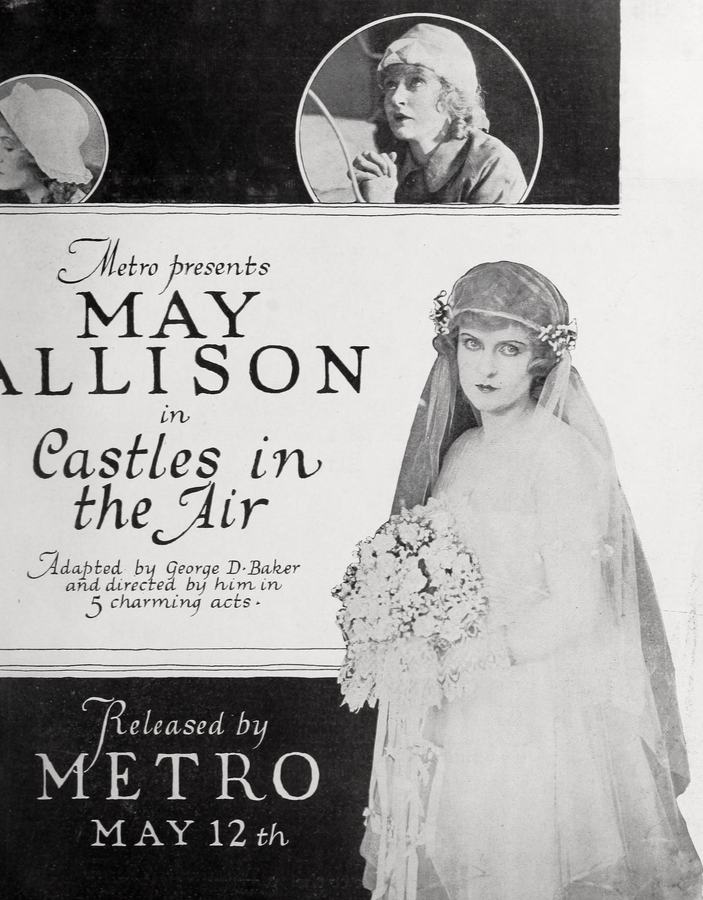
The year 1919 stood as a watershed moment for American cinema, a period where the primitive flickers of the nickelodeon era matured into the sophisticated visual grammar of the silent feature. George D. Baker’s Castles in the Air emerges from this transitional epoch not merely as a romantic trifle, but as a fascinating sociological artifact. It is a film that explores the liminal spaces between the working class and the landed gentry, using the physical architecture of the theater as a metaphor for the performative nature of social mobility. While many films of the era, such as Nearly a King, dealt with the whimsical nature of mistaken identity, Baker’s work here feels grounded in a more palpable, almost gritty emotional reality despite its fairytale title.
The narrative begins with Fortuna Donnelly, portrayed with a delicate luminescence by May Allison. Fortuna is an usherette at the Halcyon Theater—a name that evokes a sense of idyllic peace that the film’s central conflict routinely undermines. The theater serves as more than just a backdrop; it is a cathedral of dreams where the lower classes go to worship the shadows of the elite. Baker’s direction highlights the shadows and the dust motes of the auditorium, creating a sense of atmospheric density that rivals the work seen in Le Cirque de la Mort. Within these walls, Fortuna is a gatekeeper of sorts, directing patrons to their seats while her own life remains precariously unanchored.
Eddie Lintner, the theater manager, represents the stagnant safety of her current station. His jealousy is not merely the byproduct of unrequited love, but a manifestation of class anxiety. When the wealthy Englishman Owen Pauncefort enters the frame, he represents the 'castle in the air'—an ethereal, unattainable promise of luxury. The tension between Lintner’s possessive pragmatism and Pauncefort’s polished predation forms the emotional core of the first act. It is a dynamic we see mirrored in other contemporary works like Das amerikanische Duell, where the duel is less about physical combat and more about the psychological warfare of social standing.
The pivotal sequence occurs at Pauncefort’s residence. The shift in lighting here is masterful; the warm, amber tones of the theater are replaced by a colder, more clinical opulence. Pauncefort’s sexual advances toward Fortuna are handled with a surprising degree of frankness for 1919. It is not the mustache-twirling villainy of a melodrama like Den kulørte slavehandler, but rather a more insidious, entitled form of exploitation. However, the film subverts our expectations when Pauncefort retreats into a state of vulnerable contrition. His apology isn't just a plot device; it’s a moment of genuine human frailty that complicates his character immensely.
The discovery of the photograph of his estranged wife introduces a theme common in the works of writers George D. Baker and Kate Jordan: the haunting presence of the past. Much like the narrative weight of secrets in From the Valley of the Missing, the photograph acts as a silent witness. It strips Pauncefort of his mystery, revealing him to be not a prince in a castle, but a man hiding in a fortress of his own making. Fortuna’s role shifts from a victim of interest to an agent of providence. Her decision to use her position at the theater to reunite the couple is a brilliant narrative symmetry. The theater, which once fueled her delusions, becomes the stage upon which she performs a very real act of healing.
When comparing Castles in the Air to its contemporaries, one must look at Castles for Two. While both films utilize the motif of the 'castle' as a symbol of romantic aspiration, Baker’s film is far more concerned with the actual labor involved in maintaining such illusions. There is a tactile quality to the ushering scenes—the tearing of tickets, the guiding of flashlights—that grounds the film in a way that the more fantastical Panopta II lacks. Even the darker undertones of the film, which touch upon the vulnerability of working women, echo the cautionary tales found in Wehrlose Opfer.
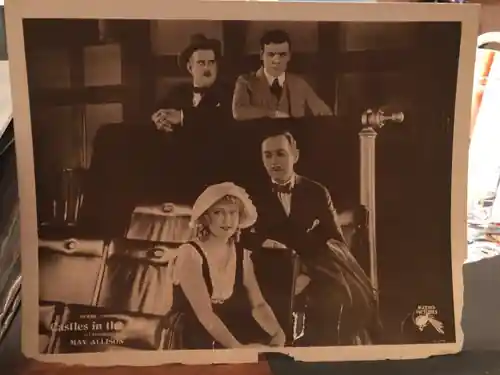
Furthermore, the film’s treatment of the male ego is surprisingly nuanced. Eddie Lintner’s jealousy is not rewarded; he must learn to trust Fortuna’s agency. Similarly, Owen Pauncefort’s redemption is not found through a new romance with the protagonist, but through the repair of his existing commitments. This maturity of storytelling is a hallmark of Kate Jordan’s writing, which often bypassed the simplistic moral binaries of the era. It shares a certain narrative complexity with The Destroying Angel, where the female lead is the primary driver of the plot’s resolution rather than a passive observer.
George D. Baker’s eye for detail is evident in the theater sequences. The way he captures the audience—a sea of faces illuminated by the reflected light of the screen—is a meta-commentary on the medium itself. It reminds the viewer that they are watching a film about the experience of watching. This self-reflexivity is rare for the time, though perhaps hinted at in the playfulness of The Kid Is Clever. The cinematography uses depth of field to great effect, often placing Fortuna in the foreground while the looming figure of Lintner or the distant, elegant Pauncefort occupies the background, visually representing her torn loyalties.
The pacing of the film is deliberate, eschewing the frantic energy of slapstick or the breathless chase sequences of films like Prohibition. Instead, it allows the emotional beats to breathe. The moment Fortuna recognizes Mrs. Pauncefort in the theater is a masterclass in silent acting. May Allison’s face registers a kaleidoscope of emotions: shock, recognition, pity, and ultimately, a selfless resolve. It is a performance that transcends the often-exaggerated pantomime of the 1910s, leaning into a naturalism that would become more prevalent in the mid-1920s.
At its heart, Castles in the Air is a critique of the escapism that cinema provides. Fortuna spends her days in a dream palace, and for a moment, she believes she can live within the dream. Her eventual return to Eddie and the reality of her life is not a defeat, but an awakening. It rejects the 'Cinderella' trope in favor of something more sustainable. This thematic honesty is what separates it from more purely commercial fare like A World Without Men or the youthful idealism of Tom Sawyer.
The film also offers a fascinating look at the social mores of the post-WWI era. The 'wealthy Englishman' is a character type that suggests a world still reeling from the collapse of old-world empires, seeking refuge in the new-world energy of America. The squabbling between Pauncefort and his wife, though briefly depicted, hints at a deeper malaise that Fortuna, in her youthful innocence, is able to bridge. It is a story of stitching together the frayed edges of society, much like the character arcs in I de unge Aar or the psychological depth of Silnyi chelovek.
In the final analysis, Castles in the Air stands as a testament to the power of small-scale human drama. It does not rely on massive sets or thousands of extras, but on the propinquity of three individuals caught in a web of their own making. The resolution—Fortuna finding happiness with Eddie—is earned through her growth as a character. She moves from being an usher of other people's stories to the author of her own. The 'castles' she once saw in the air have vanished, replaced by the solid ground of a life lived with clarity and purpose.
For those interested in the evolution of the silent melodrama, this film is an essential watch. It balances the theatricality of its setting with a poignant realism that remains effective even a century later. Baker’s direction, combined with Allison’s luminous presence, ensures that while these castles may have been built in the air, the film itself is anchored firmly in the pantheon of early cinematic excellence.
IMDb 7.4
1924
Community
Log in to comment.