DbcultAccessing Vault...
Cult Review
Senior Film Conservator

Is Cheating Cheaters (1927) worth watching today? Short answer: yes, but with significant caveats that anchor it firmly in its historical context. This silent-era caper offers a fascinating glimpse into early cinematic storytelling and the enduring appeal of the double-cross narrative, making it a compelling watch for specific audiences.
It is unequivocally for dedicated silent film enthusiasts, cinephiles interested in the evolution of crime comedies, and film historians eager to trace the roots of plot twists. However, those accustomed to modern pacing, sophisticated sound design, or deep psychological character studies will likely find its deliberate rhythm and broad performances challenging.
Let's cut directly to the chase, as any good critic should.
At its heart, Cheating Cheaters is a masterclass in narrative irony. We are introduced to the Palmers, a family whose outward appearance of newfound wealth is meticulously crafted. They are, in fact, a highly organized group of professional thieves, meticulously planning their next big score. Their target: the Lazarres, their seemingly prosperous new neighbors.
What unfolds is a delightful, unspoken comedy of errors. The Palmers begin their reconnaissance, observing the Lazarres' routines, mapping out their home, and devising intricate plans for infiltration. Their leader, portrayed with a certain understated cunning by Erwin Connelly, orchestrates every move with the precision of a chess grandmaster.
The twist, revealed early to the audience but not to the characters, is the film's true genius: the Lazarres are also a sophisticated criminal outfit. They, too, are sizing up their new neighbors, the 'wealthy' Palmers, as their next mark. This creates a fascinating dynamic where every 'friendly' gesture, every casual conversation, and every seemingly innocent observation is fraught with ulterior motives from both sides.
The plot doesn't just rely on this initial setup; it builds on it. The film explores the awkward, often hilarious attempts by both gangs to gather intelligence without revealing their true intentions. A scene involving a 'borrowed' garden tool, which is secretly used for lock-picking, perfectly encapsulates this delicate balance of suburban normalcy and criminal intent.
It’s a premise that feels remarkably modern, anticipating later films like The Rough Diamond or even certain elements of the Coen Brothers' early work. The tension isn't derived from overt conflict, but from the constant threat of exposure, the delicious anticipation of who will discover the truth first, and what the fallout will be.
In the silent era, acting was a language of grand gestures, expressive eyes, and carefully choreographed body movements. The cast of Cheating Cheaters delivers performances that are largely consistent with the stylistic demands of the time, though with varying degrees of success.

Erwin Connelly, in a dual role of director and actor, portrays the patriarch of the Palmer gang with a restrained intensity. His expressions, often subtle, convey a sense of calculated danger beneath a charming facade. One can almost read his thoughts as he exchanges pleasantries with his 'neighbors,' all while mentally cataloging their vulnerabilities.
Lucien Littlefield, a character actor often praised for his comedic timing, brings a much-needed lightness to the proceedings. His portrayal of a bumbling, yet ultimately effective, member of the Palmer gang provides some of the film's most genuinely funny moments. During a particularly tense sequence where he attempts to disable an alarm system, his exaggerated facial contortions – a mix of fear, concentration, and fleeting triumph – are a highlight.
Betty Compson, as one of the female leads, navigates the delicate balance of charm and cunning. Her character often serves as the 'bait,' and Compson excels at projecting an air of innocent vulnerability that cleverly masks her true intentions. Her interactions with Kenneth Harlan's character, particularly a scene where she feigns distress over a 'lost' pet to gain access to the Lazarre home, are well-executed, relying entirely on visual storytelling and her expressive eyes.
However, the performances, while effective for the era, occasionally veer into overt theatricality, which can feel somewhat dated to a modern viewer. There's a fine line between expressive and over-the-top, and some actors, particularly in the supporting roles, occasionally cross it. This isn't a flaw in their craft, but rather a reflection of evolving performance styles.
Erwin Connelly's direction is competent, if not groundbreaking. He understands the mechanics of building suspense and humor through visual cues. The film makes effective use of parallel editing, particularly during the initial phases of reconnaissance, cutting between the Palmers meticulously planning their entry and the Lazarres simultaneously scouting their 'wealthy' marks. This technique brilliantly underscores the impending collision of their schemes without a single spoken word.
The cinematography, while not pushing the boundaries of the silent era, is functional and clear. The use of close-ups is judicious, often employed to highlight a character's knowing glance, a flicker of deceit in their eyes, or the subtle shift in their demeanor. For instance, a tight shot on Eddie Gribbon's character as he overhears a crucial piece of information perfectly conveys the dawning realization without needing an intertitle.
Connelly also employs visual contrasts to subtly enhance the narrative. The two neighboring houses, while both appearing opulent, are often lit differently. The Palmers' residence, despite its grandiosity, sometimes feels a touch too polished, almost artificial, hinting at their constructed identities. The Lazarres' home, initially presented as a paragon of old-money taste, gradually reveals its hidden passages and shadowed corners, mirroring their own clandestine activities.
However, the visual language occasionally feels constrained by the theatrical origins of the story. Some scenes, particularly those involving physical comedy or chase sequences, could have benefited from more dynamic camera work or innovative editing. Compared to the more adventurous visual flair seen in films like Hot Dog or even the earlier The Luck o' the Foolish, Connelly's approach here feels more reserved.
Cheating Cheaters is about two rival gangs of thieves who unknowingly move in next door to each other. Each gang believes the other is a wealthy, legitimate family, and both begin to plot elaborate schemes to rob their new neighbors. It's a comedic tale of mistaken identities and an impending double-cross.
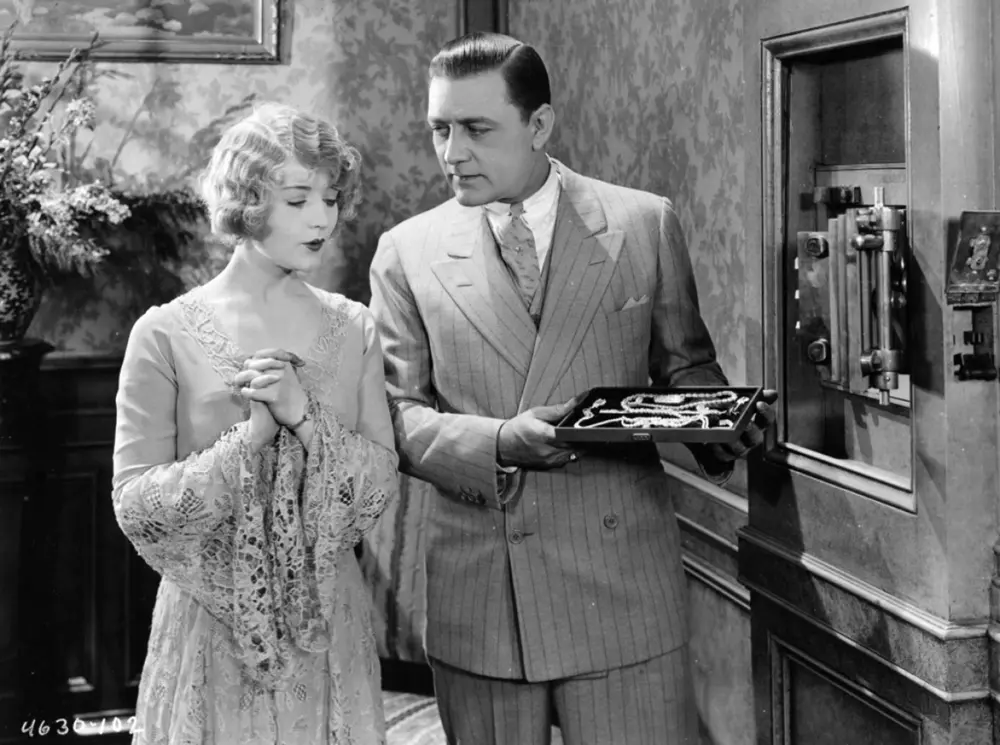
This is where Cheating Cheaters truly reveals its age and, arguably, its biggest missed opportunities. While the initial setup establishes the premise with admirable efficiency, the middle act frequently succumbs to a series of drawn-out, repetitive attempts at infiltration. A particular sequence involving a ladder and a second-story window feels extended beyond its dramatic utility, diluting the otherwise sharp comedic timing that could have been achieved with tighter editing.
The film's tone also wavers. It struggles at times to fully commit to either a pure slapstick comedy or a taut crime thriller. The humorous moments, like Eddie Gribbon’s exaggerated double-takes, often undercut the growing sense of peril, leaving the audience unsure whether to laugh at the escalating stakes or genuinely feel concern for the characters' predicament. This tonal inconsistency prevents the film from achieving the heightened suspense or laugh-out-loud comedy it occasionally flirts with.
The screenplay, penned by Max Marcin, Walter Anthony, Charles Logue, and James T. O'Donohoe, is robust in its conceptualization but occasionally lacks the sharp dialogue (or, in this case, intertitle writing) and rapid-fire pacing that would have truly brought the premise to life. It's a shame, as the core idea is so strong, but the execution often feels like a stage play translated directly to screen without fully embracing the unique capabilities of cinema.
One could argue that the film’s greatest strength is also its greatest weakness – its unwavering commitment to a relatively simple, almost theatrical, setup that ultimately limits its cinematic scope. The narrative rarely ventures beyond the confines of the two houses, which, while focusing the action, also restricts the visual dynamism and broader thematic exploration.
The film offers a surprisingly unconventional observation: it inadvertently critiques the American Dream through its portrayal of two outwardly respectable yet morally bankrupt families. Both are driven by avarice, cloaking their illicit activities under a veneer of suburban respectability. This underlying commentary, while perhaps unintentional, adds a layer of depth that elevates it beyond mere genre fare.
For contemporary audiences, approaching Cheating Cheaters requires a certain mindset. It's not a film that will grab you with modern special effects or rapid-fire dialogue. Its allure lies in its historical significance and the sheer cleverness of its central conceit. If you're willing to engage with the storytelling conventions of the silent era, to appreciate the visual language, and to tolerate a slower pace, then yes, it offers genuine rewards.
It serves as an excellent case study for film students and enthusiasts interested in the evolution of plot mechanics and character archetypes. The film's influence, though subtle, can be traced through countless subsequent caper films. It’s a foundational piece, demonstrating that a strong premise can carry a film even when other elements are less polished.
However, for casual viewers seeking light entertainment without historical context, it might prove a challenging watch. The absence of sound, the reliance on intertitles, and the often broad acting styles are significant hurdles for those not accustomed to the genre. It's not a universally accessible film, but for its niche, it holds considerable value.
Cheating Cheaters (1927) is a film that demands appreciation for its foundational ideas rather than its flawless execution. The premise is solid. The execution, less so. It’s a fascinating historical artifact, a testament to the enduring appeal of the con artist narrative, and a clear precursor to countless future crime capers. However, it’s not a film I would recommend to someone dipping their toes into silent cinema for the first time. For that, one might look to more dynamically paced works like Midnight Molly or 30 Below Zero if seeking a similar vintage thrill.
It works. But it’s flawed. If you are a seasoned silent film viewer, or a student of film history, you will find much to appreciate in its clever setup and the subtle performances that occasionally break through the limitations of the era. Otherwise, approach with caution and an open mind, understanding that you are watching a piece of cinematic history rather than a modern blockbuster. It’s a worthwhile watch for the right audience, a clever concept that, while not perfectly realized, laid important groundwork for the genre.

IMDb 5
1932
Community
Log in to comment.