DbcultAccessing Vault...
Cult Review
Senior Film Conservator
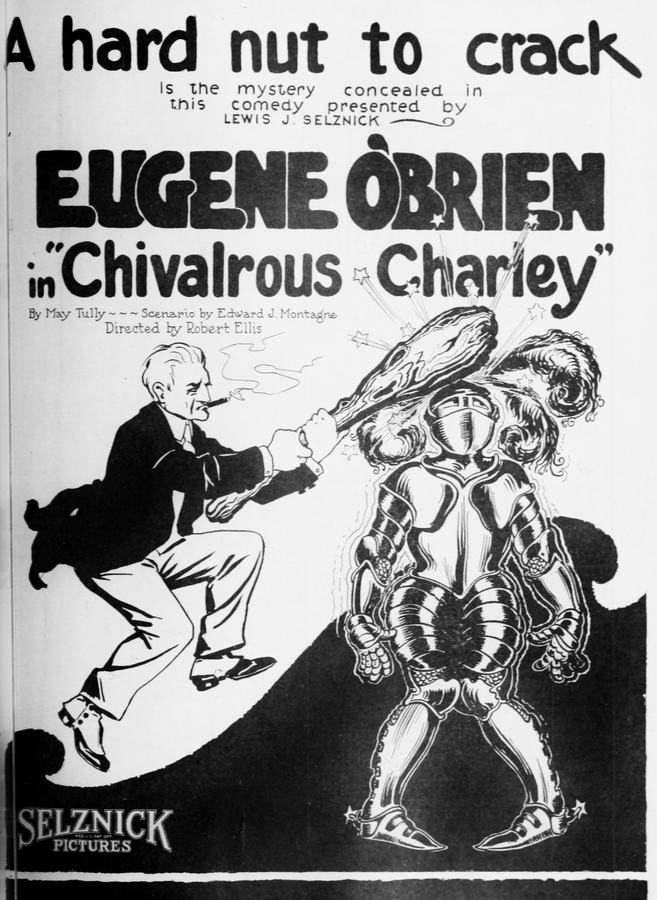
When Charley Riley strides into the frame, one might mistake him for a misplaced character from a Gilbert & Sullivan operetta. His chivalric inclinations, though well-meaning, are as volatile as a dynamite keg in a corset factory. The 1930s film Chivalrous Charley, directed with a mix of earnestness and slapstick, leans into the absurdity of its protagonist’s self-appointed honor code. Charley, portrayed with a blend of earnestness and exasperation by Huntley Gordon, is a man perpetually one misplaced gesture away from societal collapse. His adventures, which zigzag from the American frontier to the cobblestone streets of New York, are less about narrative coherence than a series of escalating farcical misadventures.
The film’s true genius lies in its treatment of Alice, a character who oscillates between damsel and schemer with disarming ease. Nancy Deaver, with a performance that straddles vulnerability and cunning, elevates the role beyond the typical flapper archetype. Her initial plea for sanctuary—"just for the evening!"—is both a narrative catalyst and a microcosm of the film’s central theme: the collision between idealized virtue and pragmatic survival. When her father, a gruff patriarch who demands Charley wed her on the spot, enters the fray, the film pivots from farce to farcical legal drama. The marriage, officiated by a bemused clergyman who seems to understand the absurdity of the moment, is less a commitment than a contractual agreement to unravel the chaos.
The film’s dialogue, penned by May Tully and Edward J. Montagne, dances between witty repartee and unintentional comedy. Lines like "A man of honor is a man of burden" are meant to be pearls of wisdom but land with the subtlety of a cannonball. This tonal inconsistency is both a strength and a flaw—while it prevents the film from taking itself too seriously, it also leaves the audience unsure whether to laugh at the characters or with them. The writers clearly aimed for a blend of screwball comedy and moral allegory, but the result is a narrative that often feels like a series of loosely connected vignettes.
The visual style, with its stark backdrops and over-lit interiors, reinforces the film’s artificiality. Scenes of Charley’s New York apartment, a cluttered stage set that resembles a dollhouse, underscore the protagonist’s detachment from reality. His chivalry is not just a behavioral trait but an aesthetic one—a man who lives in a world of heightened contrasts. When Alice’s father bursts in with a shotgun, demanding marriage, the room’s pastel tones clash with the sudden violence, a visual metaphor for the dissonance between Charley’s ideals and the real world.
In the pantheon of 1930s romantic comedies, Chivalrous Charley is a curio, a film that mistakes its own inanity for profundity. Yet, there’s a strange charm in its unapologetic embrace of chaos. Nancy Deaver’s Alice, with her mix of innocence and manipulation, is a standout, and Huntley Gordon’s portrayal of Charley—equal parts lovable and exasperating—gives the film its emotional core. If the plot feels like a series of unrelated incidents, it’s because the filmmakers were more interested in capturing the spirit of a bygone era’s theatricality than in crafting a coherent narrative.
Ultimately, the film’s legacy is one of contradictions. It’s a satire of chivalry that lionizes its protagonist’s delusions, a farce that treats its chaos as profundity, and a relic of a filmmaking era that prioritized spectacle over substance. If you’re seeking depth, look elsewhere. But if you’re in the mood for a campy romp through the wreckage of misplaced ideals, Chivalrous Charley delivers in spades. Just don’t take its lessons too seriously—at least, not without a sense of humor.
IMDb 4.2
1920
Community
Log in to comment.