DbcultAccessing Vault...
Cult Review
Senior Film Conservator
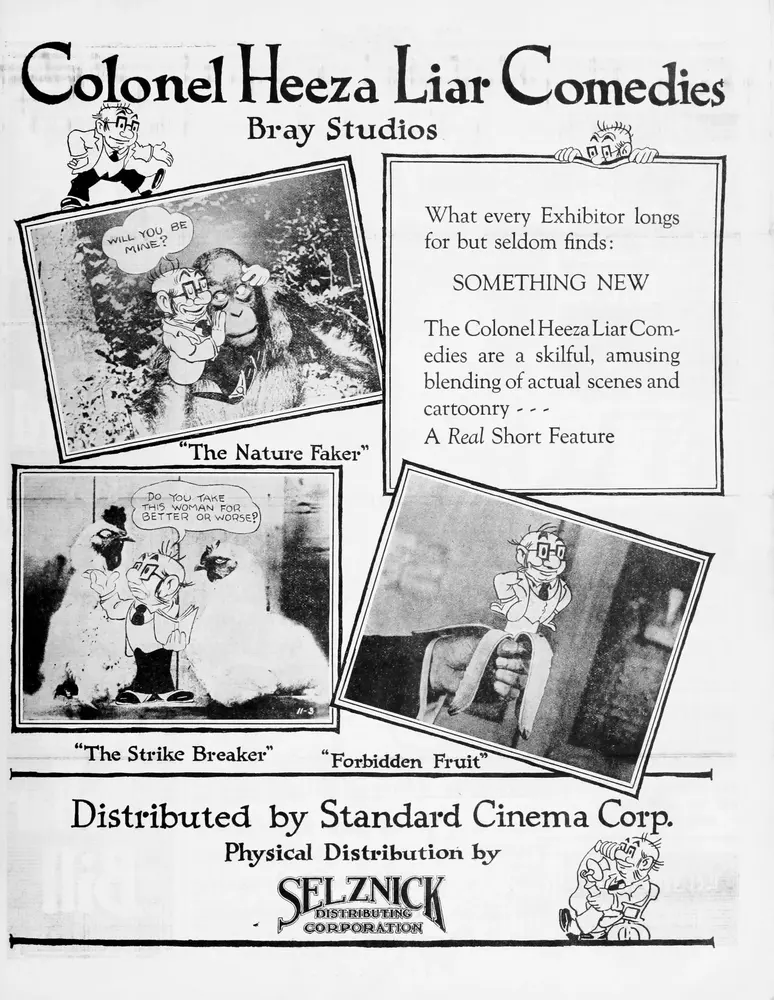
Venturing back to the primordial ooze of cinematic art, 'Colonel Heeza Liar, Nature Faker' emerges not merely as a relic, but as a vibrant testament to the burgeoning imagination of early animators. This short, helmed by the prolific Vernon Stallings, who also lent his creative pen to its narrative, stands as a fascinating vignette from an era where the very grammar of animation was being invented. It's a journey into the mind of a character whose very name is a portmanteau of his defining trait: a liar, a fabulist, a master of exaggerated reality. The film, rather than merely documenting a plot, offers a character study framed within the nascent, yet potent, capabilities of hand-drawn motion.
Vernon Stallings, a name perhaps not as universally recognized as some of his contemporaries, was nonetheless a crucial architect in the foundational years of American animation. His work on the Colonel Heeza Liar series, starting as early as 1913, predates many of the more famous cartoons that would follow. This particular installment, 'Nature Faker,' showcases the Colonel's quintessential trait: his penchant for grandiloquent, utterly unbelievable tales. The character himself, voiced and brought to life by Stallings, is an archetypal figure, a pre-cursor to countless animated tricksters and tall-tale tellers. He embodies a uniquely human desire to embellish, to transform the mundane into the mythical, not necessarily out of malice, but from an almost artistic impulse to reshape reality.
The very premise of 'Nature Faker' is delightfully simple yet profound. The Colonel ventures into the wilderness, not as a naturalist seeking truth, but as an artist seeking inspiration for his next great lie. A chirping bird becomes a monstrous pterodactyl, a scampering squirrel, a ferocious beast. This isn't just a narrative device; it's a commentary on perception, on the malleability of truth, and on the storyteller's power to conjure worlds. In an age where cinema itself was a new form of illusion, a character who consciously manipulates reality within that illusion is a meta-commentary in itself.
To fully appreciate 'Colonel Heeza Liar, Nature Faker,' one must situate it within its historical context. This was a time when animation was experimental, labor-intensive, and often crude by modern standards. Films like this were pioneers, establishing visual language and narrative conventions that would later become staples. The techniques employed were rudimentary: hand-drawn frames, often with slight variations, creating the illusion of movement. There was no sophisticated cel animation as developed later by Bray (who would eventually produce the Colonel Heeza Liar series) or Disney; rather, it was a painstaking frame-by-frame endeavor, often drawing on paper directly or using very simple overlays.
The visual style, characterized by its fluid lines and often exaggerated character designs, speaks to the vaudeville roots of early animation. Characters were often caricatures, their emotions writ large on their faces and through their physical comedy. While not as overtly slapstick as a live-action short like Buster Keaton's Cops, the humor in 'Colonel Heeza Liar' stems from the absurdity of its protagonist's claims and the visual gags used to illustrate his 'faked' nature encounters. The simplicity of the animation is part of its charm; it forces the viewer to engage with the core idea rather than being overwhelmed by visual spectacle.
Colonel Heeza Liar is more than just a character; he's an embodiment of a particular human folly and fascination. His 'nature faking' isn't just about lying about animals; it's about the human desire to control and interpret the world around us, often through the lens of our own biases and imaginations. He's a comedic parallel to the 'nature fakers' controversy of the early 20th century, where prominent naturalists and writers were accused of anthropomorphizing animals and fabricating events for dramatic effect. The film playfully lampoons this idea, taking it to its logical, absurd extreme.
“The essence of the Colonel's appeal lies in his unwavering commitment to his own delusions, creating a fantastical world where the mundane is always ripe for monstrous transformation.”
His adventures, though brief, are a masterclass in comedic escalation. A small fish in a pond becomes a leviathan; a bird's nest, a dizzying precipice. The film doesn't rely on complex plot twists, but on the simple, effective humor of incongruity. This approach, focusing on character-driven comedy through exaggeration, can be seen as a precursor to the character-centric animation that would dominate much of the 20th century, from Popeye to Bugs Bunny. While not as overtly romantic or dramatic as something like I Love You, its emotional core is the joy of storytelling itself, however fabricated.
The visual rhetoric of 'Colonel Heeza Liar, Nature Faker' is deceptively sophisticated for its time. Stallings uses simple visual cues to convey the Colonel's internal world. The sudden transformations of animals, often depicted with a few quick lines or a change in scale, are effective shorthand for the Colonel's imaginative distortions. This economy of motion and drawing was a necessity given the production constraints, but it also fostered a unique aesthetic. It's a testament to the power of suggestion, where the audience is invited to fill in the gaps, much like the Colonel expects his unseen audience to believe his tales.
The pacing of these early shorts is often brisk, reflecting their origins as novelties or curtain-raisers in cinemas. There's no time for lengthy exposition; the character's motivation and the film's premise are established almost immediately. This directness, a characteristic shared with many early silent films, ensures that the comedic beats land quickly and effectively. It’s a stark contrast to the more intricate narrative structures that would evolve in later decades, mirroring the directness of early dramas like The Faithful Heart, albeit in a comedic register.
'Colonel Heeza Liar, Nature Faker' might not possess the dramatic gravitas of a feature film, nor the intricate animation of later Disney or Fleischer productions, but its historical significance is undeniable. It represents a crucial step in the evolution of animation, solidifying the idea of recurring characters and establishing a comedic archetype. The series proved popular enough to warrant numerous installments, indicating that audiences were captivated by the Colonel's antics and his unique brand of humor.
The film's simple narrative about a man who distorts reality for entertainment resonates even today. In an age saturated with curated social media feeds and carefully constructed personal brands, the 'nature faker' archetype feels surprisingly contemporary. The Colonel, in his own charmingly anachronistic way, was perhaps one of the first animated influencers, crafting a compelling (if false) narrative about his life for public consumption. His adventures, though set in a seemingly idyllic wilderness, are fundamentally about the performance of self.
The Colonel Heeza Liar series, and 'Nature Faker' specifically, helped cement the idea of the animated character as a vehicle for specific, identifiable traits and recurring gags. This wasn't just a series of disconnected gags; it was a developing personality. While other early films, like those featuring Winsor McCay's Gertie the Dinosaur, showcased animation's technical marvels, the Colonel brought a more narrative-driven, character-focused comedy to the forefront. This focus on character would become a cornerstone of animation's success, allowing audiences to form attachments and anticipate specific types of humor from their animated heroes and villains.
Looking at other films of the era, one can see a diversity of approaches. While The Invisible Ray might have explored the thrilling potential of science fiction, and Het geheim van het slot arco (The Secret of Arco Castle) delved into mystery, 'Colonel Heeza Liar' carved out its niche in pure, unadulterated comedic fantasy. It wasn't trying to scare or mystify; it aimed simply to amuse and delight through the sheer audacity of its protagonist's fabrications. The film is a lighthearted romp, a stark contrast to the darker themes explored in contemporary live-action dramas such as Die Bestie im Menschen (The Human Beast).
The appeal of the tall tale is timeless, and 'Colonel Heeza Liar, Nature Faker' taps directly into this primal enjoyment. There's a certain thrill in witnessing a character confidently spin an outrageous yarn, especially when the audience is in on the joke. The film invites us to be complicit in the Colonel's deception, to revel in the sheer imaginative power required to turn a mundane afternoon into an epic struggle against impossible odds. This shared understanding between the storyteller (the film) and the audience creates a bond, making the experience more engaging than a simple depiction of reality would be.
The film's ability to transcend its rudimentary technical aspects and deliver genuine humor and character engagement is its true strength. It reminds us that even with limited resources, a strong concept and a memorable character can create lasting impact. While modern animation boasts hyper-realistic visuals and complex narratives, there's an undeniable charm in the raw, unpolished energy of films like 'Colonel Heeza Liar,' a sincerity in its simple ambition to entertain. It's a foundational text, a delightful peek into the origins of an art form that continues to evolve and captivate, proving that sometimes, the most enduring stories are the ones that are entirely made up.
In an era where cinema was still finding its voice, 'Colonel Heeza Liar, Nature Faker' contributed significantly to the evolving lexicon of visual storytelling. It was not just a series of moving pictures, but a carefully constructed comedic performance, delivered through the then-revolutionary medium of animation. Its influence, though subtle, can be traced through the lineage of animated characters who entertain through their flaws, their exaggerations, and their sheer, unadulterated zest for life – or at least, for a dramatically improved version of it. It stands as a charming, if brief, monument to the imaginative spirit of early cinema, a spirit that continues to inspire and inform the animated wonders of today.
IMDb —
1929
Community
Log in to comment.