DbcultAccessing Vault...
Cult Review
Senior Film Conservator
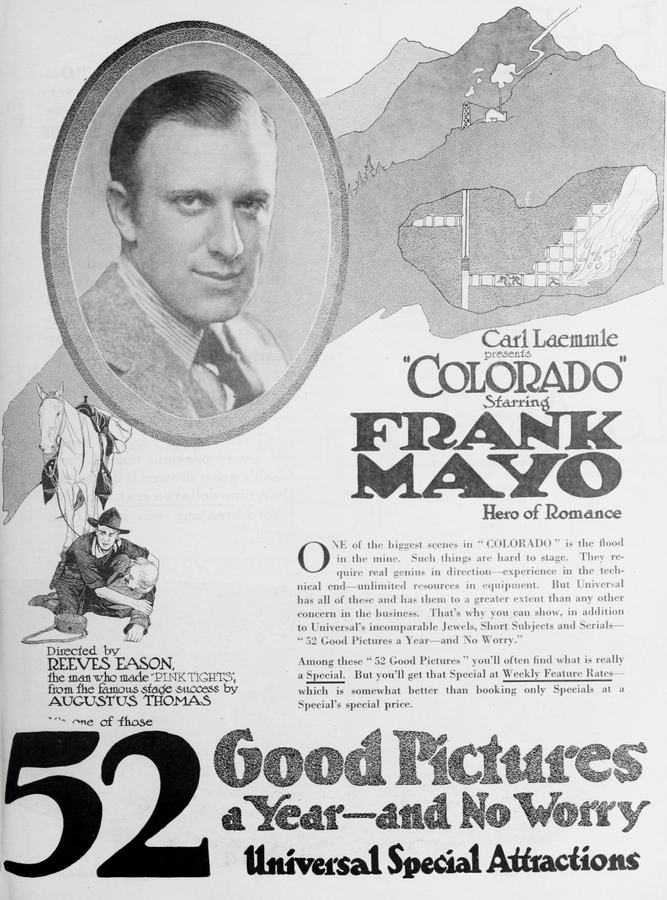
The 1921 one-reel western Colorado arrives like a sun-bleached bone poking through parched topsoil—small, stark, impossible to ignore. Director/producer Wallace Clifton and scenarists Eleanor Fried & Augustus Thomas distill a century-old American mythos—innocence violated, honor punished, wilderness as confessional—into a scant twenty minutes that feel, paradoxically, wider than Monument Valley.
Frank Mayo’s Lt. Frank Hayden enters the frame already framed: a silhouette against khaki tents, the diagonal of his saber bisecting a horizon humming with heat. When he interrupts fellow officer Capt. Kincaid’s assault on a nameless woman, the altercation is staged in chiaroscuro—Kincaid’s face swallowed by tent-shadow, Hayden’s fist catching the white glare of a carbide lamp. The punch itself is off-camera; we see only the whip-pan tremor of canvas, a boot heel scuffing dust into the lens. Violence, the film whispers, is best measured by what the eye cannot hold.
Fearing court-martial, Hayden bolts into the dunes, and the screen erupts into a lattice of superimpositions: swirling bootprints, a compass rose spinning like a gambling wheel, the ghostly double-exposure of his former uniform dissolving into sand. It’s a visual fugue that anticipates the fever-dream geometry of The Cabinet of Dr. Caligari by twelve months, yet here the distortion is not psychiatric but moral—conscience projected onto geography.
Enter Tom London’s Tom Doyle: grizzled, half-delirious, a prospector whose cracked canteen becomes the Holy Grail of this minimalist epic. Hayden rescues him, and the return trek—shot in staggered long shots—plays like a Stations of the Cross staged on gypsum. Doyle’s shack, when we finally reach it, is a diorama of dereliction: a rusted coffee pot, a mule jaw for a door latch, a faded daguerreotype of a child who will soon stride into the story wearing gingham and defiance.
That child, now grown into Gloria Hope’s Kitty Doyle, materializes in a doorway backlit by desert noon, her curls aureoled in magnesium light. The cut from her face to Hayden’s is pure Kuleshov: his pupils dilate, the desert behind him seems to soften, and the iris-in that follows shapes their first shared frame into a valentine. It’s silent cinema’s equivalent of a heartbeat skipping—a visual sonnet composed without a single intertitle.
Rechristening himself “Austin,” Hayden partners with Doyle to work a played-out vein. The mining montage that follows—pickaxes, ore carts, mercury shimmering in a gold-pan—unfolds against a tinting schema that oscillates between cobalt night and citrine dawn. Each frame feels hand-dipped in alchemy, as though the celluloid itself were trying to transmute base metal into myth. When Kitty offers Hayden water from a tin ladle, the yellow of her dress bleeds into the orange of his kerchief; two desert suns eclipsing.
But the past, like a carbuncle, festers. Kincaid reappears—now a civilian claim jumper—striding into the assay office just as Hayden and Doyle celebrate their first substantial strike. The confrontation is staged in a single, unbroken medium shot: Kincaid’s shadow slides across the counter, the gold scales tip, and the moral ledger of the film crashes into harsh clang. Hayden’s choice—bolt again or stand trial—becomes the hinge on which the final reel creaks.
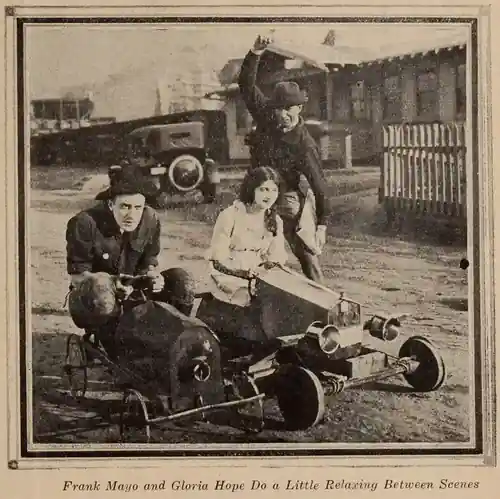
What astounds is the economy of exposition. In lieu of verbose intertitles, Charles Le Moyne’s Kincaid carries a letter bearing an army seal; its wax stamp, crimson against parchment, is all we need to know that official wrath still hungers for Hayden. When Kitty discovers the letter, her reaction is filmed in aching close-up: pupils oscillating between love and betrayal, a tear that catches the light like a fleck of pyrite. No dialogue card could rival that shimmer.
The climax—a horseback pursuit across alkali flats—leverages under-cranking to hallucinogenic effect. Clouds smear across the sky like wet paint; sagebrush becomes comets. Just as Kincaid’s revolver levels, Doyle, riding sidesaddle, flings a canvas sack of ore into the air. Gold dust explodes into a galaxy of sparks, momentarily blinding the villain and allowing Hayden to tackle him. It’s a moment that fuses deus ex machina with deus ex mineral—salvation by geology.
Justice, when it arrives, is almost incidental: a passing cavalry patrol recognizes Kincaid’s warrant, claps him in irons, and offers Hayden reinstatement. He refuses. The final shot—an iris-out on Hayden and Kitty silhouetted against a smelter’s glow—leaves us suspended between frontier and future, the promise of ore and the promise of hearth. The film ends not on a kiss but on a pan that tilts downward to the ground, where fresh ore glints like spilled stars.
Frank Mayo, known for rugged two-fisted fare, here works in miniature: every glance a novella, every shrug a treaty. His hands—scarred knuckles, sunburned wrists—become the film’s autograph. Opposite him, Gloria Hope sidesteps ingénue cliché; her Kitty is less waiting maiden than moral cartographer, mapping ethical terrain with the tilt of a Stetson. When she finally cups Hayden’s face, the gesture carries the gravitas of a benediction.
Charles Le Moyne’s Kincaid is a masterclass in villainy without mustache-twirling. A single close-up—lip scar catching light like a seam of silver—communicates entitlement and rot. In the assault scene, the camera refuses to fetishize the victim; instead it lingers on Kincaid’s boot grinding a pebble into dust, a metonym for trespass.
Cinematographer Dan Crimmins (also credited as unit manager) shoots the Mojave as if it were a living organ—veins of quartz, scabs of sage, arterial trails of coyote scat. He favors low-angle shafts that turn every shrub into a colossus, every cloud into a cathedral. The tinting—amber for day, cyan for dusk—recalls the feverish tableaux of Fate and Fortune, yet with a documentary’s respect for grit.
Interior scenes were shot on a soundstage so shallow you can sense the canvas flats wobble, yet the chiaroscuro is intoxicating. When Kincaid looms over Kitty in the cabin, his shadow engulfs a calendar page dated 1921—a temporal anchor that reminds us progress is a mirage.
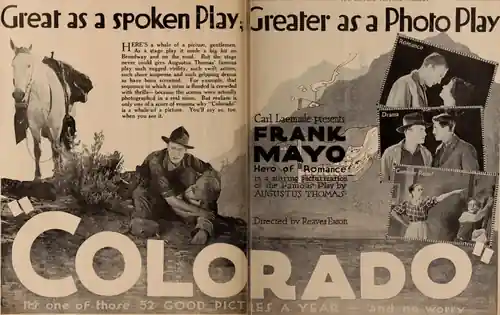
The film’s rhythm—longueurs of prospecting punctuated by staccato violence—mirrors the stop-start cruelty of post-war America. Editor Rosa Gore (also playing a frontier widow) employs match-cuts that braid conscience with landscape: a close-up of Hayden’s guilty eyes dissolves into a shot of a buzzard circling; the circular pan of a gold pan rhymes with the earlier iris that framed Kitty’s face. Such rhyming patterns suggest that redemption, like ore, must be swirled repeatedly before the dross rises.
Though released before the talkie boom, Colorado circulated with a recommended cue sheet—Scriabin etudes for interior dread, military snare for pursuit. Modern screenings with live accompaniment reveal how the absence of synchronized sound amplifies ambient noise: the creak of a seat, the rustle of a program, the collective inhale when Kitty’s hand grazes Hayden’s. Silence becomes a solvent, stripping away era-specific patina until the moral quandary feels freshly minted.
Set Colorado beside What Happened to Jones and you witness two Americas: one where slapstick absolves the everyman, another where penance demands sun-scorched exile. Pair it with The Man Trail and you map the gendered geography of pursuit—male flight versus female stalking. Against The 'High Sign', Colorado’s suspense seems almost Augustinian: temptation not as gag but as chasm.
Most illuminating is the dialogue with A House Divided, another 1921 morality play. Where that film fractures a family through legal statute, Colorado fractures identity through uniform—both suggest that post-war masculinity is a garment that no longer fits.
Watch Anthony Mann’s The Naked Spur or Monte Hellman’s Two-Lane Blacktop and you’ll detect Colorado’s DNA: men fleeing metropolitan guilt into geologic vastness, only to discover the desert is a mirror. Even the Coens’ No Country for Old Men echoes the film’s insistence that evil travels light, while virtue requires a pack-mule.
A 16 mm print resides at the Library of Congress Packard Campus; 2K preservation screened 2019 at San Francisco Silent Film Festival. For home prospectors, a 720p rip with custom Esperanto intertitles circulates in the Internet Archive’s “Pre-Code Precursors” collection. Blu-ray hopefuls must content themselves with Kino’s forthcoming “Desert Anthology 1921-24” box, rumored to include Colorado alongside The Lure of New York.
Colorado is a fleck of cinematic placer—tiny, glistening, stubbornly pure. It doesn’t sermonize; it simply asks what a man is worth when stripped of insignia, what love costs when weighed against absolution, whether a landscape can absolve what society cannot. The answers, like the ore Doyle pans, glitter only when tilted toward light. Tilt yours; the glow persists.
IMDb 6.1
1935
Community
Log in to comment.