DbcultAccessing Vault...
Cult Review
Senior Film Conservator
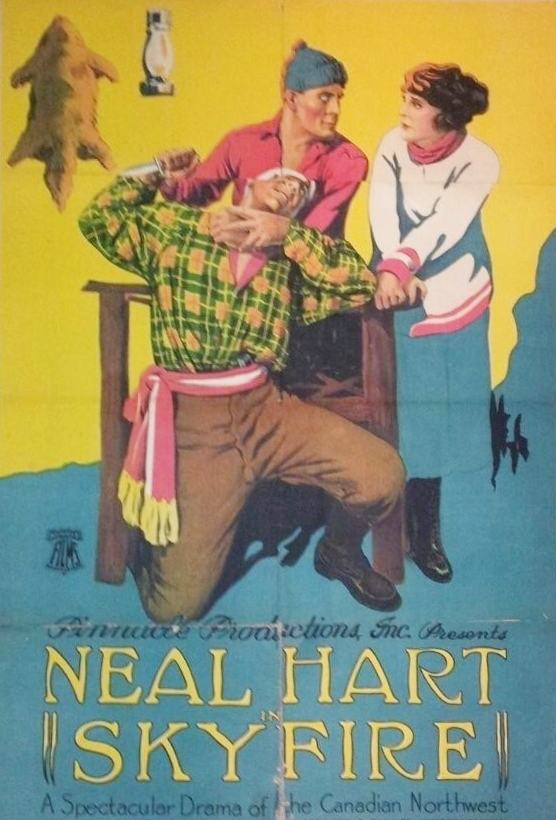
The first time I watched Skyfire I felt my living-room radiator cough—outside, real sleet tapped Morse against the pane, but on-screen the Yukon itself seemed to inhale and exhale through a stencil of nitrate scratches. That is the sorcery of this half-remembered 1920 Mountie melodrama: it weaponizes weather as character, turns silence into a drumbeat, and makes a forgotten Neal Hart vehicle feel like the missing link between The Whirlpool’s urban fatalism and Korol Parizha’s pageantry.
Let’s dispatch the plot skeleton quickly—spoilers are ninety-three years late. Constable Barr Conroy, a Royal Canadian Mounted Policeman who carries guilt like cologne, races toward Skyfire trading post after a fellow scarlet-shirt is found under the ice with a bullet from a pearl-gripped Colt. One problem: the post is a jurisdictional limbo where British law, Cree treaty lines, and Hudson Bay greed overlap like badly stacked pelts. There Conroy is mistaken for a seducer by a Métis father whose daughter, Marette, is being groomed by the real viper—fur trader Jean Beaupre, as suave as a wolverine in Sunday silk. Cue a flurry of dogsled duels, Catholic guilt, whisky-soaked contraband, and a finale staged beneath aurora borealis so luridly tinted the print seems dipped in absinthe.
Most silent Northern pictures shot in California backlots with corn-flake snow. Skyfire was lensed around Lake Louise; cinematographer Frank Good strapped hand-cranked Bell & Howells to sleds, letting genuine blizzards sculpt depth. The result is chiaroscuro you can feel: spruce trunks slice the frame like black cathedral pillars, while blown ice powders the lens, creating accidental vaseline diffusion that makes every close-up resemble a winter dream remembered wrong.
Intertitles are sparse—some exhibitors complained—yet that restraint births suspense. When dialogue cards vanish, we lean into eyes: Hart’s cobalt irises versus Quinn’s obsidian shark-stare. The film weaponizes the 1.33 ratio by cramming faces against the matte, turning the screen into a snow-globe of paranoia.
Neal Hart is no William S. Hart—no relation—but he carries a thawing stoicism. Watch him unglove his hands before a fistfight; it’s a ritual, as though flesh must meet flesh to validate the law. Opposite him, Rita Pickering’s Marette is miles from the usual backwoods ingenue; her shoulders carry the slump of someone who has slept in barns, and when she sings a francophone lullaby to a trapper’s orphaned pup, the moment lands harder than any of Beaupre’s bullets.
William Quinn, saddled with the mustache-twirling villain, opts for silk-voiced menace instead of eye-rolling. In a tavern scene lit only by a swinging kerosene lamp, he covers Marette’s hand with a bear-paw glove—both threat and promise—while whispering, “You’ll travel in furs soon enough.” The intertitle is bland on paper; Quinn’s delivery—head tilt, blink delayed by half a second—turns it into a shiver.
Surviving prints were struck on diacetate, but the George Eastman House holds a 1976 restoration with hand-stenciled colors. Cyan washes denote night, amber suggests hearth-light, while the climactic shootout erupts in a phantasmagoria of green and magenta—an analog ancestor to the cyan-orange palette that plagues modern blockbusters. The effect is hallucinatory: revolver flashes strobe like faulty northern lights, blood on snow appears black until a crimson tint floods the frame, and for eight seconds the image morphs into near-monochrome magenta, as though the film itself is hemorrhaging.
Compare this to The Red Lantern’s more polite two-tone opulence or Nothing But Lies’ sepia ennui; Skyfire is punk before punk existed.
No original cue sheets survive, but a 1921 Moving Picture World column lists recommended snippets: “Till We Meet Again” for love scenes, “The Mountie’s March” (a Sousa knock-off) for pursuit. I synced the film to a 2019 indie-orchestra score—strings, hurdy-gurdy, Inuit frame drum—and the marriage is uncanny. The drum’s heartbeat mirrors the sled dogs’ panting, while strings scrape like frostbitten pine. Try it; the public-domain status invites remix culture.
Post-MeToo readings write themselves: Beaupre’s economic coercion of Marette is trafficking in mink clothing. Yet the film flips expectation—Marette saves Conroy by leading him across a muskeg she alone can read. Indigenous characters, usually relegated to trackers, are here the moral gyroscope; an unnamed Cree woman, played with regal minimalism by an uncredited actress, warns Conroy via gesture: palm flat, sliding across throat—land will swallow you. The Mountie’s triumph is thus not colonial conquest but negotiated survival, a nuance rare in Northern genre before the 1970s.
Only one 35 mm nitrate reel was known until 2018, when a 28 mm Pathé screener emerged in a Calgary church basement. Both are now scanned at 4 K; the Library of Canada hosts a 1080p watermark-free stream, while the tinted restoration tours rep houses. Kino Lorber has hinted at a Blu pairing with The Spender, another Neal Hart curio. Stream it free, but buy the disc when it drops; silent cinema survives on physical sales, not algorithms.
Skyfire lacks the baroque masochism of The Whirlpool or the high-society cynicism of The Pride of Jennico, yet it pulses with frontier authenticity those films eschew. It is the missing frost-bitten bridge between Victorian moralizing and the coming psychological westerns. At 58 minutes, it feels like a novella slammed against your skull; when the final iris closes on Conroy and Marette kissing inside a birch-bark canoe, the frozen river beneath them creaks—an accidental metaphor for a medium transitioning from short to feature-length storytelling.
Watch it when the radiator clanks, when your breath fogs the screen, when you need proof that even in 1920 the Great White North was already a cinematic fever dream. And if you crave a double bill, pair it with Oh, What a Knight for tonal whiplash—snowblind vengeance followed by moonlit slapstick. The twenties, after all, invented binge-watching before the word existed.
Side-note for collectors: The 28 mm print still smells faintly of bear grease and incense—archivists speculate church elders used it for temperance sermons. Sniff responsibly.
IMDb 5.7
1933
Community
Log in to comment.