DbcultAccessing Vault...
7.6/10
Senior Film Conservator
A definitive 7.6/10 rating for a film that redefined the boundaries of cult cinema. Cops remains a cornerstone of transgressive art.
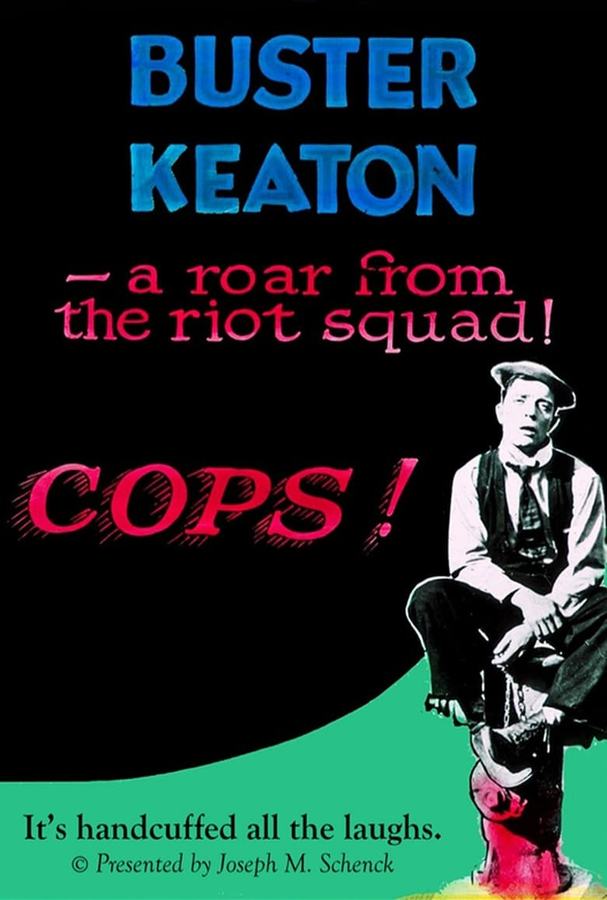
Eighteen minutes. That’s all Buster Keaton needs to stage a municipal apocalypse and still leave room for a punch-line that stings like aftershave on a razor nick. In Cops, the 1922 one-reel wonder he co-wrote and co-directed with Eddie Cline, Keaton distills the DNA of every chase film that would thunder down the century’s corridors. Yet calling it a “chase short” feels like calling Chartres a stone shack; this is a kinetic poem whose stanzas are pratfalls, whose caesuras are the split-seconds when Keaton’s Great Stone Face registers the cosmic injustice of being perpetually in the wrong place at the wrong uniform.
The plot, if we must leash it to language, is a Möbius strip of misapprehension. A penniless young drifter (Keaton) attempts to purchase a horse-cart load of furniture to impress a girl (Virginia Fox), but a carnival of errors lands him inside a police parade where every baton interprets his presence as assault. From here the metropolis metastasizes into a single, many-headed nemesis. Streets elongate like taffy; fences telegraph coded warnings; even the sunlight seems to tattle. Keaton’s only crime is existing while the city is in a mood, and the resulting pursuit is less narrative than physics problem: how many collisions can one body endure without surrendering grace?
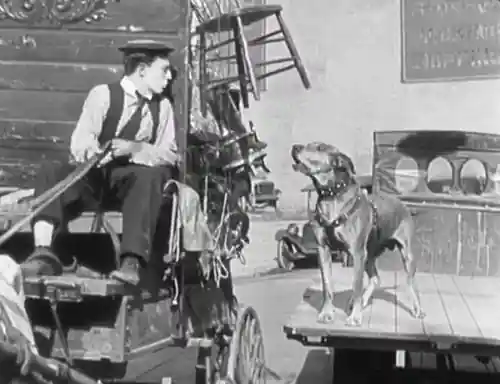
Watch how the film weaponizes depth of field. In the opening gag, Keaton’s cart sits foreground while a marching column of policemen advances in extreme background, their synchronized legs ticking like a metronome. The spatial irony—he’s oblivious, they’re inevitable—compresses comedy and dread into one breath. Later, when he scales a ladder to escape a swarm, Cline cuts to a high-angle shot: the ladder becomes a hypotenuse bisecting the frame, officers pooling at its base like mercury. Geometry turns predator; Pythagoras would have flinched.
Compare this to the pastoral absurdity of A Dolovai nábob leánya or the operatic bombast of Graf Sylvains Rache—both contemporaries busy corseting melodrama into tuxedos. Keaton instead strips cinema to its loincloth: movement versus obstacle, inertia versus whim. Every plank, doorway, and abandoned dressmaker’s dummy is a potential traitor. When he absconds with a massive wooden box labeled “Beware—Explosives,” the lettering might as well read “Beware—Metaphor.”
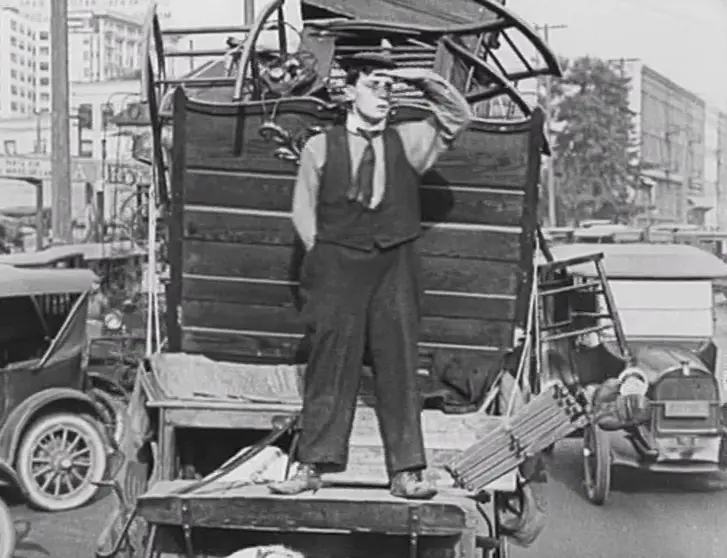
Keaton’s body is a Rube Goldberg contraption governed by Newton’s lesser-known fourth law: dignity equals mass times bewilderment. Note the moment he side-mounts a motorcycle’s handlebars, legs dangling like a scarecrow’s, only to discover the driver has disembarked. The bike putters forward at idle speed; he remains frozen in a posture of fraudulent authority, a makeshift figurehead on a vessel that obeys no helm. The joke escalates not through acceleration but through duration—every extra second of survival amplifies the absurdity. We laugh because physics itself seems to collude in deferring catastrophe.
Contrast this with the more polite domestic fender-benders of Assigned to His Wife or the drawing-room histrionics of When Love Is Blind. Those films treat collision as social faux pas; Keaton treats it as ontological condition.
Steve Murphy and Joe Roberts, playing detectives of varying incompetence, supply the fulcrum. Roberts—towering, walrus-mustached, a human exclamation point—embodies the establishment’s comic menace. His 6'4" frame dwarfs Keaton’s 5'5", yet the camera equalizes them through asymmetrical framing: Roberts fills the vertical axis, Keaton the horizontal, a living exclamation mark sparring with a question mark. Meanwhile, Virginia Fox’s ingenue is no mere handkerchief to be retrieved; her curtsey at the curtain call feels like a conspiratorial wink, as though she too recognizes the charade of authority.
The average shot length here rivals modern MTV montage, yet each cut obeys a spatial integrity that would make today’s continuity supervisors weep into their digital tablets. When Keaton vaults through a wedding procession, absconds with a pair of horses, then vaults back out, the axis of action remains legible despite the mayhem. Cline’s invisible splice work—hidden behind passing vehicles or swinging doors—creates the illusion of unbroken pandemonium. The result is a staccato ballet: punch-pause-punch-pause, a rhythm that anticipates both Eisensteinian montage and the Looney Tunes cadence.
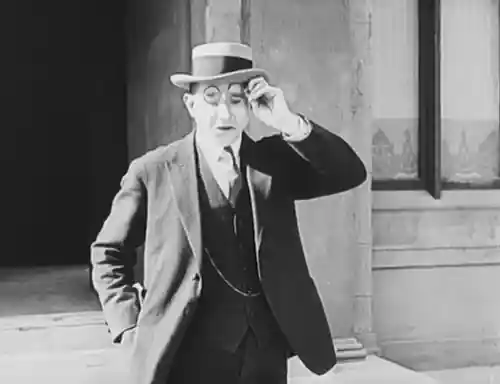
Stack this against the languid pictorialism of Rytterstatuen or the sermonizing tableaux of Kämpfende Gewalten oder Welt ohne Krieg, and you’ll appreciate how radical Cops feels even now.
Released during the Red Scare’s hangover, the film flirts with subversion: an army of civil servants mobilized to neutralize one unarmed civilian whose sole provocation is proximity. The image of a lone man sprinting ahead of a phalanx of uniforms has aged into accidental prophecy—every decade rewrites the allegiance. In 1922 the gag played as establishment farce; in 2023 it loops on social media as protest meme. Yet Keaton, ever the artisan of neutrality, refuses polemic. His camera doesn’t vilify the cops; it revels in the absurdity of mass mobilization itself. The target is not authority but automatism—how easily humans become cogs when handed a badge and a playbook.
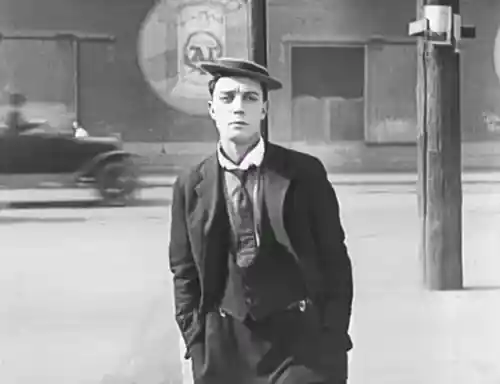
Viewers weaned on talkies often overlook the symphonic sophistication of silent comedy. Cops was shot without a synchronized score, yet the on-screen choreography cues an internal metronome. Notice Keaton’s footfalls during the climactic freight-yard sprint: they land on imaginary downbeats, punctuated by the huffing of real steam locomotives captured live. The ambient noise—locomotive hiss, horse hooves, distant traffic—was etched into the celluloid as ghost frequencies, a proto-sound design that predates cinéma vérité by four decades.
Fast-forward a century and you’ll spot Cops’s DNA spliced into Jackie Chan’s Police Story mall melee, into Spielberg’s 1941 tank-chase, into the kinetic parkour of Casino Royale’s Madagascar pursuit. Even Pixar’s Toy Story nods when Buzz and Woody dash beneath traffic cones—pure Keaton topology. Yet few descendants match the original’s ruthless economy. Where modern spectacles inflate runtime to justify budgets, Keaton’s 18 minutes feel inexhaustible; each viewing reveals a new micro-gag—a background cop tripping over a cat, a shadow puppet mouthing expletives, a storefront sign whose lettering foreshadows the next collision.
By the time Keaton’s rickety boxcar disintegrates beneath him and he’s left sprawled on the tracks, the iris closes not on defeat but on a sly grin. The joke, we realize, was never about escape; it was about the elasticity of the human frame under the hammer of institutional panic. In that grin resides the quintessence of silent comedy: the refusal to concede dignity even when the universe has issued a warrant for your soul.
So, is Cops a quaint relic? Hardly. It’s a hand-cranked prophecy, a reminder that speed is not a matter of horsepower but of wit, that the shortest distance between two points is a pratfall. Stream it at 2 a.m. with headphones off and city lights flickering against your blinds; you’ll hear the echo of a thousand footfalls chasing you still.
IMDb 5.7
1929
Community
Log in to comment.