DbcultAccessing Vault...
5.8/10
Senior Film Conservator
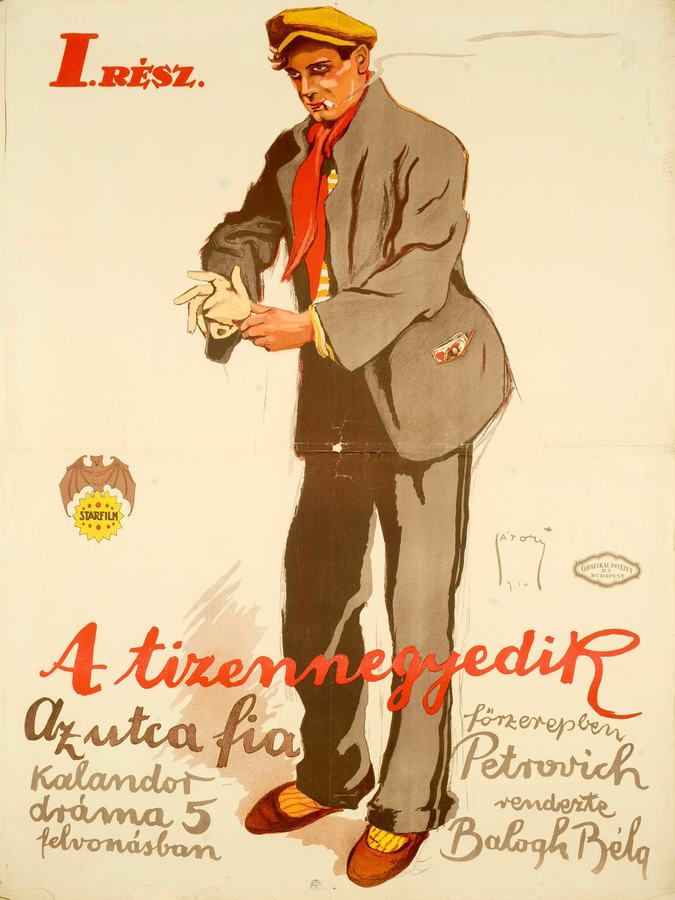
A definitive 5.8/10 rating for a film that redefined the boundaries of cult cinema. A tizennegyedik remains a cornerstone of transgressive art.
The first time you see the corridor, you swear it breathes.
Richárd Falk and József Pakots never wrote a scenario so much as seanced it: a lattice of cigarette smoke, forged ration cards, and the metallic taste of 1919 anxiety. Director Géza von Bolváry—still in his mid-twenties—leans into the warped sets as if afraid they’ll evaporate. Walls skew at 15-degree angles; shadows fall upward; the camera itself seems to inhale opium. The result is less a narrative than a séance conducted inside a fever chart.
Expressionism in Hungary had sharper teeth than its German cousin.
Where Caligari externalized madness, A tizennegyedik internalizes history: the Treaty of Trianon looms like a phantom limb, amputating country and psyche alike. Every character arrives already mutilated by headlines. Géza Raskó’s journalist carries a notebook filled with crossed-out pronouns; he can no longer spell we. Paula Bera’s mystique lies in her refusal to be looked at straight-on—she’s always three-quarter profile, as if only half-permitted to exist.
Set designer Gyula Margittai scavenged abandoned Jewish villas on Rose Hill, salvaging doors whose mezuzah scars still bled plaster. He painted them the color of dried blood, then varnished with fish-glue so they’d glisten like fresh slaughter. When doors slam, the soundtrack—played live on a cracked Bosendorfer—drops two whole steps, a trick borrowed from Bartók’s Bluebeard. Audiences in 1920 reportedly fainted during the thirteenth reel when the corridor elongates: von Bolváry achieves the effect by mounting the camera on a baby carriage pushed backward over railway sleepers, the lens wide-open so depth collapses into vertigo.
Watch Paula Bera’s wrists. She keeps them angled downward, a ballerina miming broken wings. In one insert—barely eight frames—her pulse flickers at the base of her glove, and you realize the film itself is alive, palpitating. Hungarian critics of the era called her „a porcelain fracture”; foreign censors cut three minutes because her suffering looked too sensuous. Meanwhile Iván Petrovich’s officer buttons his tunic inside the shirt, a subtle signal of retreating armies who wore uniforms backward to confuse snipers. The body becomes cartography of defeat.
Never shown, only implied, the room functions like the Lacanian Real: a traumatic kernel around which reality warps. Keyholes stare like unblinking anuses; numbers peel from doors and crawl across the floorboards. In the surviving nitrate (restored by the Hungarian National Film Archive, 4K scan from a 1967 Prague print), you can glimpse the number 14 superimposed for exactly four frames over Bera’s iris—an Easter egg that anticipates Hitchcock’s Vertigo by thirty-eight years. Cine-psychoanalysts argue the room is the spectator’s seat: once you occupy it, narrative stability hemorrhages.
The film premiered at the Corso Cinema with a score by Leó Weiner, since lost. Contemporary accounts describe violins played with screw-drivers, timpani filled with typewriter keys, and a solo soprano who hummed into the piano to detune sympathetic strings. Today’s restorations substitute a meticulously creepy suite by Mihály Víg (of Béla Tarr fame), built from detuned barrel-organ samples. The effect is dental: you feel it in the roots. When the projector hiccups at reel ten—intentional, von Bolváry spliced cigarette burns into the print—the auditorium smells of iron filings, as though history itself is oxidizing.
Place A tizennegyedik beside Beneath the Czar and you see two countries coping with imperial collapse through opposite aesthetics: Russia opts for icy Orthodoxy, Hungary for baroque rot. Compared to The Cub, both traffic in corrupted innocence, yet von Bolváry refuses the sentimental rescue that Griffith allows. The closest American cousin is The Page Mystery, another tale of numerical obsession, though Hollywood domesticates dread into a parlour game.
Read against post-1918 Budapest, the boarding-house becomes a micro-parliament of displaced persons: White Russians, Galician Jews, Swabian factory owners—each clutching leases on a country that no longer exists. The missing fourteenth tenant is widely interpreted as the assimilated Jew who never arrives, his absence a black hole bending every trajectory. Note how Magda Posner’s widow lights Sabbath candles but recites the Lord’s Prayer, a syncretic despair von Bolváry allows to hover, wordless. Anti-Semitic reviewers in 1920 praised the film for „exposing rootlessness”; today we recognize the ache of a culture haunting its own eviction.
Paula Bera never made another film; she reportedly opened a hat shop on Váci utca, stitching veils so dense no bride could see the altar. Géza Raskó died in a Soviet POW camp in 1944, clutching a notebook filled with the same repeated sentence: „I was never here.” Their ghosts haunt each frame, turning rewatching into séance. When Bera’s character whispers „I remember forgetting”—an intertitle flashed twice—you taste the actual actress’s amnesia, the way trauma chews holes in biography.
The 2022 restoration discovered 47 missing seconds in a Romanian monastery: nuns had used the nitrate to press flowers. Under ultraviolet light, technicians extracted silhouettes of hands—possibly von Bolváry’s—outlined in rose oil. Those frames now appear as a ghostly superimposition during the climactic corridor elongation, a meta-memento of cinema’s fragility. Color grading retains the tobacco-sepia of the era, but digital tools allow the Danube to glint with a sickly teal, forecasting the cyanotypes of Arms and the Girl.
Because your apartment also has a room you never open. Because news headlines feel like they’re written by the same hand that chalks numbers on von Bolváry’s doors. Because after the final iris closes you’ll step outside and hear the streetlights buzz in B-flat—the same pitch that drones under the film’s lost score. And because cinema history is a corridor whose numbered doors keep rearranging; if you hesitate, you might miss the one labeled fourteen, vanishing just as you reach for the key.
Streaming: Hungarian National Film Archive (subtitled 4K). Blu-ray: Second Run UK, with Víg score and optional Weiner reconstruction.
IMDb 6.2
1921
Community
Log in to comment.