DbcultAccessing Vault...
Cult Review
Senior Film Conservator
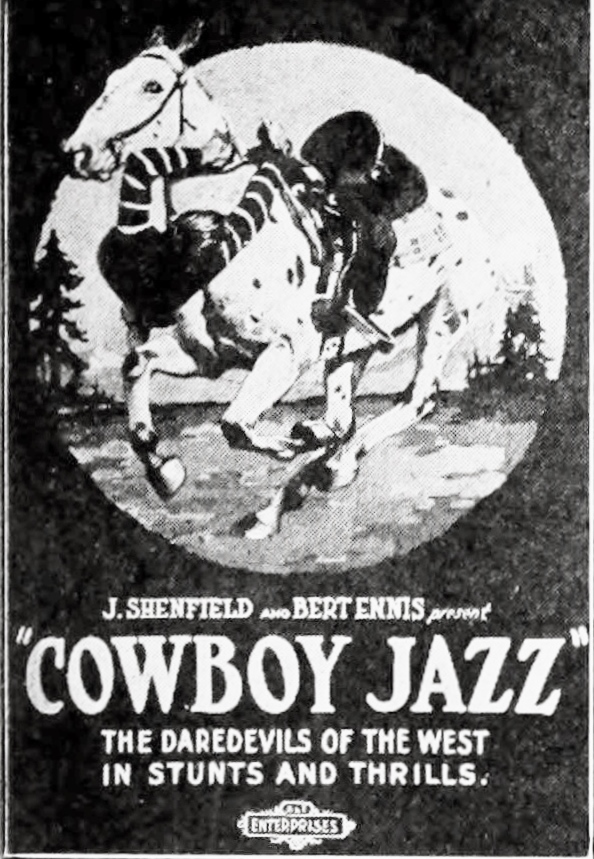
The first thing that hits you is the dust—not as ambience but as authorship. In Cowboy Jazz (1920), motes swirl so thickly they become co-writers of the choreography, scribbling over bodies, branding the lens, turning sunlight into tangelo scrims that throb between each frame. Watching this 12-minute whirlwind today feels less like archival curiosity, more like stumbling on a lost jazz 78 cut at 3 a.m. in a ghost-town saloon: crackling, illicit, alive.
Director-writer n/a—the anonymity itself a laconic signature—opts for pure kinesis. No iris-curtained prologue, no moralising title cards. Instead, we plunge straight into the blood-quickening calculus of animal mass versus human velocity. A title card flashes “World’s Champion Cowboys,” and before the ink metaphorically dries, Joe Gardner rockets from chute to saddle, his leap so fluid it appears reverse-engineered by physics. The camera, locked at hip height, turns the arena into a proscenium of peril; every hoof-beat registers like knuckles on a bass drum.
Scholars routinely hail Sylvia of the Secret Service for serial derring-do, or The Straight Way for moral rectitude, but Cowboy Jazz offers something rawer: a kinetic Found Poem of the West. Each stunt—roping, tying, bulldogging—functions as both athletic feat and stanza break, the repetition-with-variation mirroring the call-and-response of Dixieland improvisation. Indeed, the film’s very title appears nowhere on-screen; it survives only in studio logs, as though someone, half-awake, heard syncopated spurs against wood and coined the perfect metaphor.
Take the steer-down sequence: three riders converge at angles that would make Eisenstein salivate. The beast, all horn and skepticism, bucks; the cowboys counter in triangulated vectors. A whip-pan follows Gus Schultz as he dismounts mid-gallop, shoulder-charges the animal, and twists its neck in a move evoking both Greco-Roman clinch and matador muleta. The action is staged in long, unbroken takes—no inserts, no safety net—so when the steer finally topples, the cloud of dust that envelops lens and performer feels like documentary truth smuggled inside spectacle.
Yet the film’s bravura lies equally in micro-gestures. Notice Bee Kirman’s left thumb brushing her holster before a toss—barely a second, but it telegraphs intent more lucidly than pages of exposition. Or the way Rose Henderson’s pupils track her lasso’s parabola, half-hunter, half-mystic, as though she sees Newton’s equations hovering in mid-air. In an era when melodrama smothered nuance under bushy mustaches, these performers gift us behavioural minimalism, a sort of Method Rodeo decades ahead of its time.
Restoration nerds will swoon over the tinting: amber for daylight interiors, cyan-blue for dusk, rose for human skin. Because the short survives only in partial 35 mm, digital archivists at EYE Filmmuseum married photochemical grain to HDR palettes, yielding hues that feel simultaneously vintage and hallucinatory. The sea-blue dusk shots, in particular, lend the riders a spectral aura—you half expect them to trot straight into Valhalla.
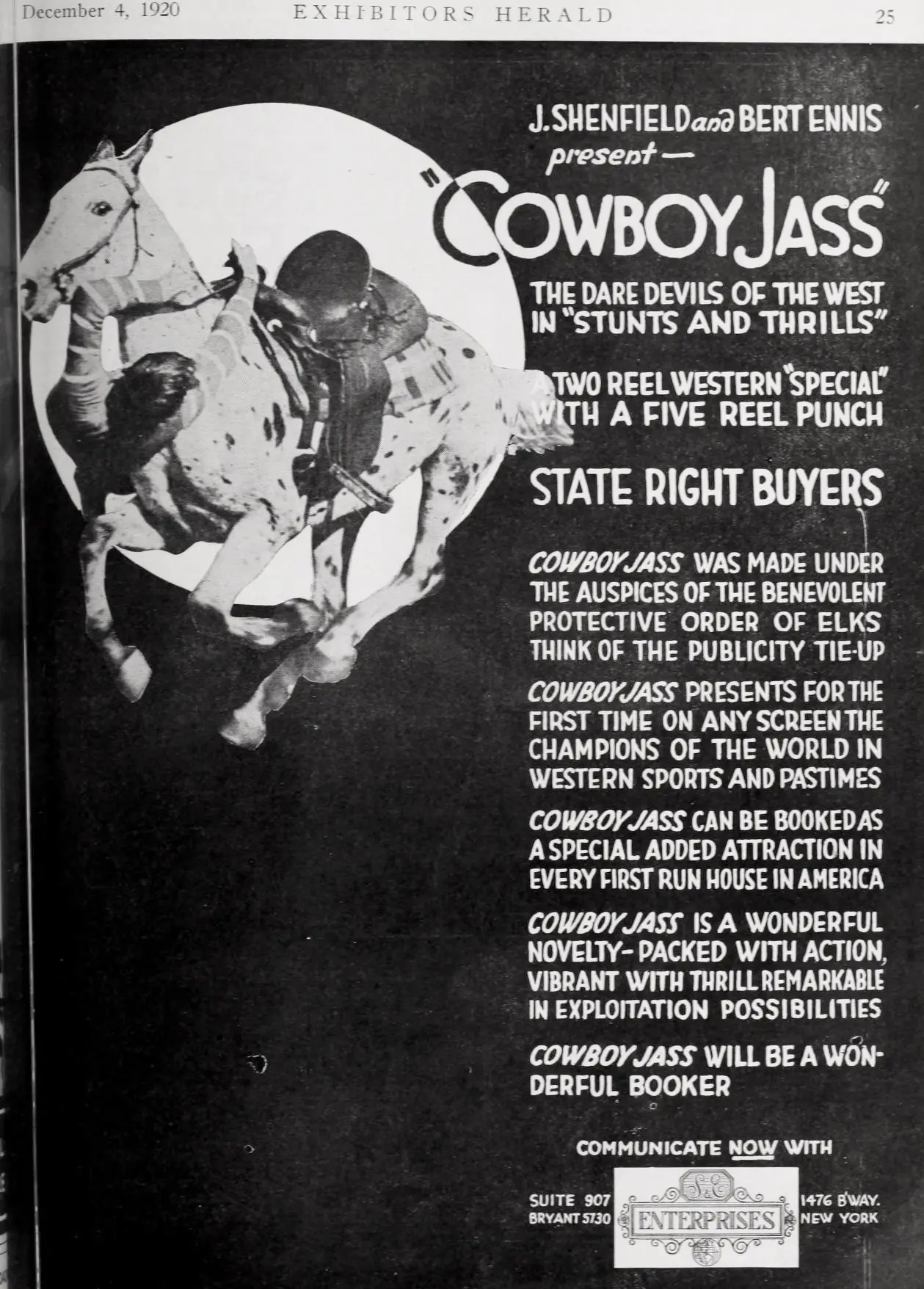
Comparative context sharpens the film’s singularity. Against the proto-noir shadows of Whitechapel or the Gothic heft of Hamlet, Cowboy Jazz offers sun-drenched nihilism: no grand speeches, just the meaty slap of rope on hide, the metallic clink of bit in teeth. Even Leather Stocking, for all its frontier pedigree, pauses for backwoods philosophising; here, philosophy is centrifugal force.
The soundtrack—silent by birth but screaming for accompaniment—begs for a live ensemble. Imagine a banjo’s metallic ping syncing to each hoof strike, a sousaphone’s belch underscelling every steer collapse. Festivals like Pordenone or Bologna could transform this curiosity into cine-concert nirvana, riveting kids weaned on Marvel to the thrills of tactile peril.
Some may critique the film’s ethnographic gaze: animals wrestled, subdued, trussed. Yet the camera’s awe tilts toward symbiosis rather than subjugation; man and beast share the same cosmic jitter, jitterbugging toward entropy. The rodeo clowns’ absence amplifies danger—no foam-padding, no distraction shtick—so every victory feels borrowed, on loan from gravity.
Narrative cohesion? Minimal. Character arcs? Nebulous. But cohesion and arc are occidental fetishes; Cowboy Jazz operates on pulse, on sinew, on the percussive grammar of bodies in extremis. It’s a manifesto for kinetic cinema, predating Man with a Movie Camera by eight years, yet rarely cited in hallowed montage syllabi. Cinephiles who genuflect to Vertov owe themselves this footnote, this fever dream.
And then, as abruptly as a snapped guitar string, it ends. No elegiac sunset, no iris-out on a kissing couple—just a swirl of dust, a title card declaring “The End,” and the mechanical clatter of a projector winding down. You sit blinking, ears phantom-ringed with nonexistent hoof-beats, aware you’ve witnessed something too primal for words yet too electric to forget.
Seek it out. Stream it if you must, but preferably catch a 35 mm print in a darkened booth where the bulb’s heat warms your scalp and the shutter’s flicker syncs with your optic nerve. Bring no preconceptions; leave with newfound respect for an era when cinema still smelled of hay, horse, and hazard. Cowboy Jazz isn’t just a curio—it’s a calloused hand pulling you into the dirt-spangled mosh pit of American myth-making, daring you to rope the whirlwind.
IMDb 4.9
1920
Community
Log in to comment.