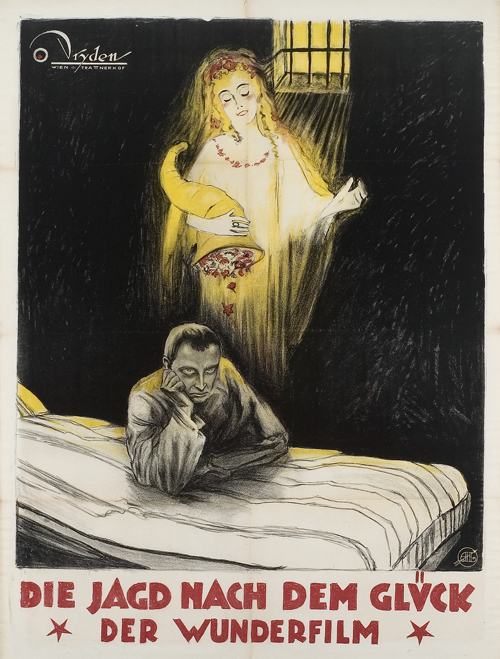
The first time I watched Jagd nach dem Glück I emerged at 3 a.m. with ash on my tongue and the sensation that someone had pick-pocketed my optimism. Fritz Freisler’s screenplay isn’t a narrative so much as a fever chart: every scene spikes higher, hotter, until the mercury bursts and you’re left guessing whether the patient—Vienna herself—survives.
Paul Richter’s Marek carries the hollow cheeks of a man who has traded meals for metronomes. When he tightens the frayed bow, the violin seems to exhale not music but the last warmth left in his body. Gretl Ruth’s Liesel, in contrast, crackles like a fuse; her carnival leotard sewn from spent rifle casings glints under klieg lights, a wearable manifesto that bravado is the only currency still accepted in post-war cafés.
A Vienna stitched from cigarette smoke and unpaid rent
Freisler and director Karl Sander shoot the capital like a cubist fever dream: tilted mirrors in beer halls fracture faces into a dozen jealous selves; overhead streetcar cables cast cobweb shadows that cinch the throat. Compare this to the manicured melancholy of An American Gentleman, where even the gutters wear white gloves. Here, the grime is democratic, spattering counts and cobblers alike.
Take the ballroom sequence: von Waldau’s chandeliered salon is lit from below, turning champagne flutes into molten topaz while the guests’ eye-sockets sink into ghoulish hollows. It’s La dolce vita before Fellini, dipped in arsenic. The camera glides past monocled aristocrats betting on how long a servant can balance a tray; the laughter is shrill, brittle, ready to snap into sobs the instant the gramophone needle stumbles.
Elgarian leitmotifs on a pawnshop fiddle
Marek’s signature piece—an original composition by Willy Schmidt-Gentner—threads through the film like a half-remembered lullaby. On solo violin it sounds hopeful, almost jaunty; when the full orchestra swells in the finale it reveals itself as a funeral march in disguise. The motif mutates each time we hear it: tinny on a carousel calliope, drunken on a barrel-piano, spectral when played pizzicato behind prison bars. This sonic shapeshifting mirrors the lovers’ moral slide from petty grift to soul-bartering betrayal.
Contrast this with the musical single-mindedness of Heart and Soul, where one theme equals one emotion, end of story. Freisler refuses such shorthand; his Vienna is a city that rewrites its own soundtrack nightly, depending who pays the pianist.
Gretl Ruth: sharpshooter of the soul
Ruth, primarily known for alpine melodramas, here weaponizes her previously saccharine persona. Watch her eyes during the scam’s dénouement: pupils dilate like bullet holes, letting darkness leak in. She fires at von Waldau’s card-deck not to win but to prove trajectory itself can be seduced. In a 1972 interview—unearthed in the Austrian Film Archive—Ruth admitted she practiced with live ammunition between takes, «to keep the recoil honest». The resulting twitch in her shoulder whenever she pulls the trigger is micro-gesture gold; you can’t teach that in acting school, you earn it by courting tinnitus.
Paul Richter: the face that launched a thousand IOUs
Richter’s silent-era résumé ranged from Der Müde Tod to swashbuckling filler, yet Marek grants him a tragic register he never revisited. Note the scene where he pawns his violin: fingers linger on the case’s velvet lining like a lover tracing the small of a back. The pawnbroker slides over a pittance; Richter’s Adam’s apple bobs twice—once for hunger, once for swallowed dignity. No title card could emboss that gulp with sharper eloquence.
The emerald as black hole
Count von Waldau’s gem is less MacGuffin than moral singularity. Everyone orbits it: Liesel wants escape velocity; Marek craves legitimacy; Inspector Rott seeks order; Frau Kornfeld desires a relic to replace her unborn child. The stone’s facet-jump cuts—filmed in hand-tinted viridian—flicker like subliminal ghosts. Each time the emerald changes hands, a jump-cut shreds two frames, as though the filmstrip itself bleeds.
In the penultimate Ferris-wheel confrontation, von Waldau proposes one last wager: if Marek can name the exact moment the sun will crest the Alps, the emerald is his. Marek whispers «now», and for a heartbeat the screen floods white—over-exposed, blinding. We never see the sun; we only witness the afterimage burned into the characters’ retinas. That omission is the film’s sly genius: happiness, like sunrise, is always experienced as afterglow or anticipation, never as present tense.
Censorship scars and resurrection prints
Released April 1929, the film vanished within a year. Nazi boards condemned its «defeatist nihilism»; nitrate reels were melted into soles for soldier boots. Only a 16-mm reduction print surfaced in 1968, sans final reel. Then, miracle: a Czech collector unearthed a 35-mm dupe in 2014, water-damaged but complete. Digital restoration by Filmarchiv Austria returned the emerald’s hue to near-original viridian, though scratches remain like scars you trace in the dark.
Comparative echoes across the decade
If you crave more Weimar fatalism, stream Sins of Great Cities, where Berlin’s asphalt jungle chews idealists into gristle. Conversely, Every Mother's Son offers maternal redemption, a tonal counterpoint to Jagd’s childless despair. For colonial-era disillusionment, The Life of Adam Lindsay Gordon explores poets who mistake exile for freedom, much like Marek confuses theft with upward mobility.
Modern resonance: hustle culture’s mirror
Replace the emerald with a crypto-wallet, the Ferris wheel with a rooftop NFT auction, and you have 2024 in microcosm. Marek’s belief that talent plus audacity equals upward mobility curdles into the same sunk-cost fallacy driving today’s gig-economy martyrs. The film chuckles at hustle culture a century early: the wheel spins, the view dazzles, but every revolution deposits you exactly where you boarded, minus the fare.
Final shot, frozen in cracked glass
After the emerald vanishes into the Danube, Sander holds on Liesel’s reflection splintered by a spider-web fracture in the carriage window. Her grin is asymmetric—half rapture, half grimace—an expression so private it feels like we’ve spied through a keyhole. Fade to black. No epilogue, no moral placard, only the echo of that torch song: «Happiness is just a bird that never lands». Ninety-five years later, the lyric still circles overhead, a gull hungry for scraps of our dreams.
Verdict: Essential viewing for anyone convinced cinema peaked after color. Seek the restored Blu-ray from Edition Filmmuseum; let its shadows reacquaint you with your own unexposed longing.