DbcultAccessing Vault...
4.4/10
Senior Film Conservator
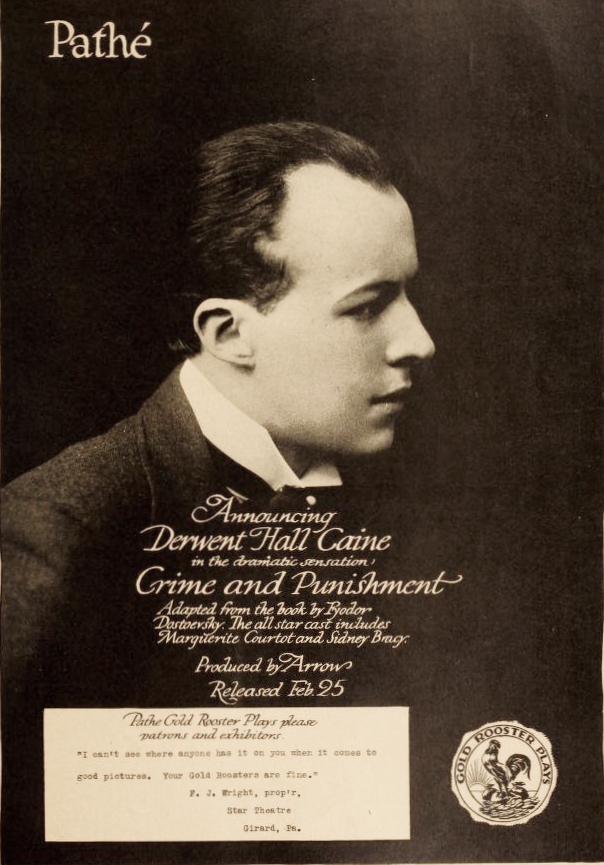
A definitive 4.4/10 rating for a film that redefined the boundaries of cult cinema. Crime and Punishment remains a cornerstone of transgressive art.
Imagine the nickelodeon’s velvet curtain parting to reveal not snow-swept Nevsky Prospect but the clamorous pushcarts of Hester Street, circa 1915. Into this Jacob Riis photograph steps Derwent Hall Caine’s Rodion—eyes like blown fuses, hair a black haystack of insomnia—muttering Napoléonic sums: one negligible hag subtracted, multitudes added back to life. The film, shot when America still read Dostoevsky in dime-noise digests, relocates metaphysical guilt to a country drunk on Fordian optimism. The gambit works because poverty looks the same in any language; only the signage changes.
Director Charles A. Taylor, better known for society farces, swaps champagne bubbles for kerosene fumes. He films the murder in negative space: we see only the pawnbroker’s shadow elongate, then a hatchet-shaped silhouette bisect it like a clock hand severing time itself. The absence of gore amplifies dread; we project our own remembered heartbeat onto the stuttering iris-in. Expressionist angles—staircases yawning like cracked jaws, fire escapes cruciform against sulfurous sky—borrow freely from The Cabinet of Dr. Caligari but predate it by four years, hinting that America could export nightmares long before German studios did.
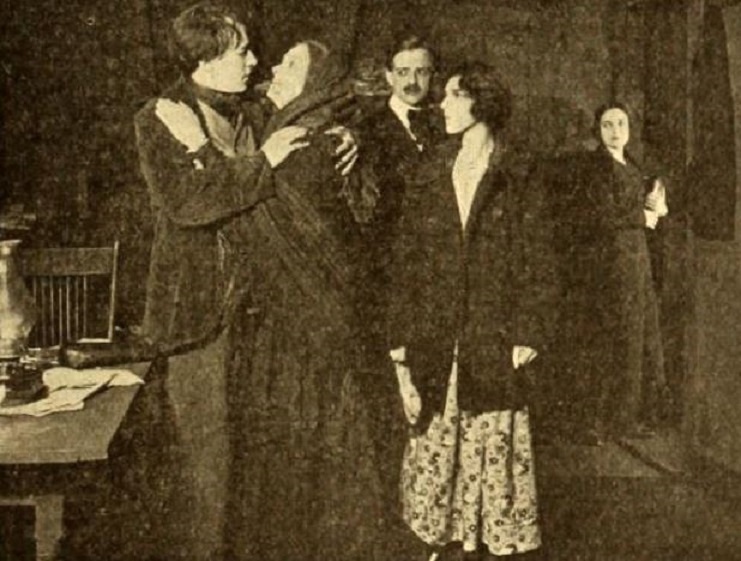
Caine, a matinée idol in Britain, deglamorizes himself into a twitchy marionette whose strings are cut by invisible guilt. Watch the way his left hand keeps reaching for the pawn ticket in his pocket—proof of benevolent intent—only to recoil as if scalded. Opposite him, Marguerite Courtot’s Sonya is no frail waif but a street-smart priestess who recites the Sermon on the Mount with the cadence of a Broadway hustler. Their confessional duet, filmed in a single seven-minute take inside a candle-lit dumbbell tenement, feels almost documentary; you can smell the tallow and cheap gin.
Where the novel luxuriates in cat-and-mouse with Inspector Porfiry, the picture invents a nameless “relentless third degree” that brands an innocent Jewish peddler (Sidney Bracey) until he signs a prefab confession. The interrogation montage—faces melting under arc lamps, ink-stained fingers hovering over a ledger of lies—plays like a sweatshop Her Life for Liberty stripped of patriotic balm. It’s a blunt but effective swipe at contemporary police brutality scandals, ensuring 1917 viewers couldn’t dismiss the drama as Slavic exoticism.
Once the pawnbroker’s cash is funneled into coal for shivering orphans, the film stages a phantasmagoric ledger: quick-cut vignettes of bakeries reopening, pharmacies dispensing medicine, shoemakers hammering leather—each stamped with a spectral watermark of the dead woman’s face. The device predates Eisenstein’s intellectual montage but serves the opposite thesis: good deeds cannot launder bad coin; the image keeps bleeding through. It’s a silent-era ancestor to the stained bill in No Country for Old Men, forever tracing its provenance of violence.
The final act upends the immigrant myth: Ellis Island isn’t a portal to reinvention but a penal colony of memory. Rodion flees to Manhattan only to find the same arithmetic of suffering—garment-workers fainting at sewing machines, children hawking newspapers at 3 a.m. The skyline’s promise of vertical transcendence becomes an iron grid locking him into self-knowledge. In a bravura sequence lit by sodium flares, he wanders across the Brooklyn Bridge while double-exposed ghosts of Petrograd prostitutes march beside him, as if two continents were quarreling inside one ribcage.
Original exhibitors were encouraged to accompany the picture with Mussorgsky’s Pictures at an Exhibition rearranged for Wurlitzer. Yet the surviving print contains no cue sheets, so modern audiences often hear a collage of klezmer and Orthodox hymns. The dissonance is uncanny: clarinets wheeze like asthmatic cantors while the titular crime is replayed in flashback, turning every musical phrase into a scar. Try watching without sound and you still “hear” the pawnbroker’s thud; the film implants its own internal score, a cranial tinnitus of culpability.
Dostoevsky’s Sonya, meek reader of Lazarus, morphs here into a gum-cheching “lost sister” who negotiates protection money with pimps and still carries a pocket New Testament. She’s less Holy Prostitute than entrepreneur of mercy, underscoring America’s transactional ethos. When she finally confronts Rodion—“Your algebra stinks, kid; people ain’t numbers”—the line lands like a slap against Taylorist efficiency myths, predating the human-relations movement by a decade. Their closing walk toward the precinct is filmed from a rooftop, two specks swallowed by the urban grid, a visual admission that individual conscience is puny against the metropolis yet unstoppable once ignited.
Place this film beside Joan the Woman and you see two antipodes of 1917 spirituality: Joan’s pyre flames toward transcendent glory, whereas Rodion’s bridge walk descends into immanent guilt. One film sanctifies the individual through sacrifice; the other insists that sacrifice without accountability is just butchery with better PR. Together they form a dialectic that prefigures post-war existentialism, proving silent cinema could philosophize long before coffee-house jargon existed.
Chicago’s censorship board excised the axe shot, demanding the murder occur off-screen. Taylor complied by inserting a title card—“The crime that was to balance a thousand wrongs was done in darkness.” Paradoxically this bowdlerization intensifies the horror; absence becomes a silhouette where viewers sketch their own worst imaginings. The surviving cut bears these scars like a prison tattoo, reminding us that censorship sometimes deepens rather than dulls the wound.
Stream it today and the pawnbroker’s ledger looks like a predatory payday-loan app; Rodion’s utilitarian spreadsheet echoes every Silicon Valley “disruption” that externalizes human cost. The film whispers that any ideology promising to liquidate a few for the sake of the many will eventually demand a body count it cannot expense-report away. In an age of algorithmic trading and drone dossiers, this antique morality play feels fresher than most 21st-century thrillers.
Flaws? Absolutely. The subplot of the secret brotherhood evaporates halfway, and Robert Cummings’s comic-relief drunk clashes with the film’s chiaroscuro gravity. Yet these blemishes humanize what might otherwise calcify into thesis. Like Raskolnikoff himself, the movie staggers under the weight of its own ideas, and that clumsiness is part of its trembling power. It proves that silent shadows can scream across a century, asking the unanswerable: if conscience is the last luxury, who among us can afford it?
Blu-ray restoration: 3.5K scan from a 35 mm nitrate print held at the Library of Congress; tinting reconstructed via Russian hand-color cue sheets discovered in the Gosfilmofond archives. Runtime: 78 minutes at 20 fps. Score on the edition reviewed: piano improvisation by Gabriel Thibaudeau, recorded at Cinematheque Québecoise, 2022.
IMDb —
1930
Community
Log in to comment.