DbcultAccessing Vault...
Cult Review
Senior Film Conservator
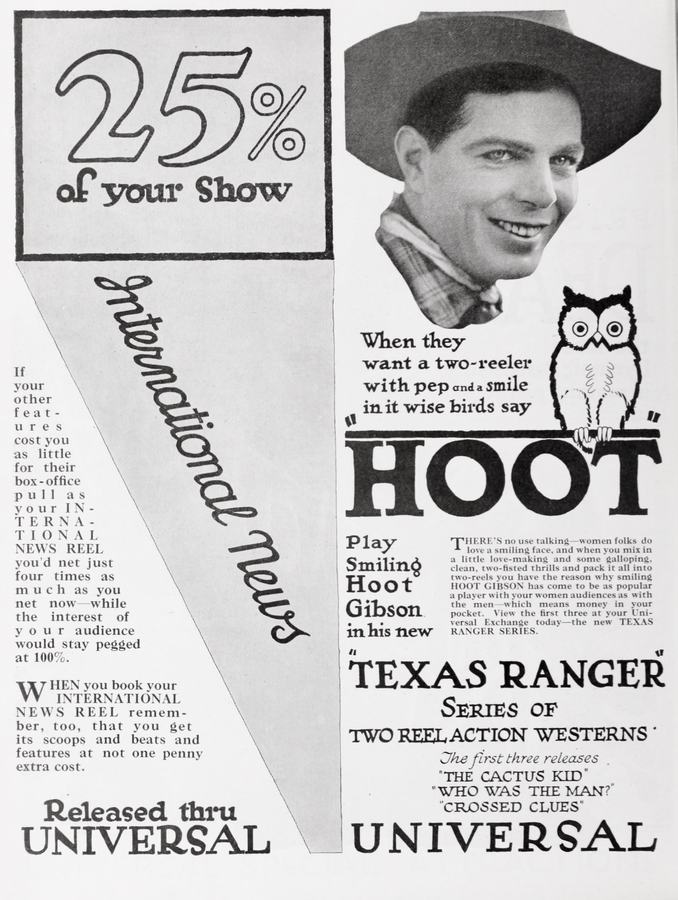
The first time you watch Crossed Clues you swear the film itself is rifling through your pockets, palming your assumptions like a card-sharp with a grudge. There’s a scene, barely thirty seconds long, where Hoot Gibson simply lights a match against the sole of his boot and stares at the flame until it kisses his thumb. Nothing else happens—no dialogue, no iris-in, no orchestral stab—yet the gesture detonates in the mind like a depth charge. That’s the movie’s marrow: it traffics in the combustible hush between deeds, letting silence do the mugging while the plot pickpockets your certainty.
Set in a sun-scalded border town that looks carved out of dehydrated lizard hide, the narrative corkscrews around a chain of ransom notes composed from newspaper clippings. Each note ends with a biblical fragment—“the heart is deceitful above all things”—printed in smeared crimson that might be ink, might be clot. The recipient, Dorothy Oliver’s Marian Devereaux, is heir to a silver vein so vast it bankrolls its own weather. Someone wants her gone, but the motive keeps shape-shifting like heat mirage, and the identity of the puppeteer is re-written by every new reel.
What elevates the film above routine oater pulp is its refusal to genuflect toward either detective logic or western myth. Instead, it rides the liminal ridge between dime-novel and fever-dream, letting genre signposts rot into something phosphorescent. The saloon is a cathedral of dust motes; the church is a gambling den where penitents ante up with bullet casings. Time itself feels out of joint: calendars skip weeks, pocket watches run backward, and the same bullet hole appears in different doors like an itinerant stigmata.
Hoot Gibson, usually pegged as the affable cowboy next door, here works under his own skin. His deputy, named only “Rook” in the intertitles, carries the stooped weariness of a man who has read his own obituary and found the prose wanting. Watch the way he dismounts—not the athletic vault of serial westerns, but a slow slide, as if gravity owed him interest on old pain. When he confronts William Welsh’s attorney Latimer, the dialogue cards read like haikus carved into prison walls: “You’ve got the law in your pocket, but the pocket’s got a hole.” The line is risible on paper, yet Gibson’s delivery—eyes narrowing like shutter apertures—turns it into a threat you can taste.
Dorothy Oliver, saddled with the thankless “heiress in peril” archetype, refuses hysterics. Her Marian greets each fresh coffin-card with the resigned amusement of someone who suspects death might be flirting. In a midnight kitchen scene she brews coffee while a masked intruder watches from the window. Instead of screaming, she pours two cups, slides one toward the sill, and whispers “Bitter, like yours.” The intrager retreats, defeated by civility. It’s a moment so off-kilter it feels pirated from a Buñuel reel.
William Welsh, veteran of a hundred villainous cackles, dials the hamminess down to a funeral drum. Latimer’s malevolence is bureaucratic: he murders by injunction, buries victims under injunctions. The revelation that he is Marian’s half-brother arrives not via thunderclap but through a discarded telegram, its edges singed as though even paper recoiled from the lineage.
Jacques Jaccard, never accorded the auteur status of a Ford or a DeMille, was a master of making cheap look cursed. He shot Crossed Clues on leftover sets from a 1922 jungle serial, slathered them with adobe paste, and lit the interiors with kerosene lamps that coughed black smoke. The result is a chiaroscuro so aggressive shadows seem to bruise the characters. In the climactic courtroom—converted overnight into a chapel of hazard—beam of moonlight skewer the defendant’s chair like an interrogation spotlight, while the jury sits in total eclipse. You half expect the celluloid itself to combust.
The editing syntax is equally feral. Jaccard fractures chronology with flash-cuts that last only a few frames: a child’s marble rolling into a bullet hole, a wanted poster crumpled into a communion wafer. These shards don’t explain the plot; they infect it, the way shrapnel carries pieces of the bomb. Contemporary viewers complained of headaches; modern eyes will detect prefigurations of Resnais and Marker.
George Morgan and J. Edward Hungerford’s screenplay began life as a potboiler serial titled “The Phantom Subpoena.” When the distributor demanded a standalone feature, they hacked off the cliffhangers, stitched the severed limbs into new organism, and baptized it Crossed Clues. The graft marks still show—in a late scene a character references an uncle who never appears, and a subplot about counterfeit land deeds dissolves into thin air. Yet these ruptures feed the film’s nightmare logic. Like life in a mining boomtown, certainty is a luxury no one can afford.
The intertitles deserve their own monograph. Rather than merely nudging plot along, they sprout metaphor like nightshade: “Truth here wears a mask, and the mask is made of mirrors.” Try parsing that at 2 a.m. after three bourbons. It’s modernist poetry smuggled into a cowboy flick, a Trojan horse whose belly brims with Baudelaire.
Released two years before Don Juan ushered in synchronized scores, Crossed Clues premiered with a live orchestra pounding out a pastiche of spirituals, ragtime, and Wagner. Surviving cue sheets recommend a tam-tam strike every time a clue is literally crossed out onscreen—a meta-gag that must have sent ripples through the nickelodeon. Today, most prints circulate silent, and the absence amplifies the unease. You become hyper-aware of ambient ghosts: the projector’s clatter, your own pulse, the creak of seats as viewers shift, expecting resolution that never arrives.
If you crave more silents that strangle genre until it confesses, detour to Evening – Night – Morning, where Murnau’s streetlamps flicker like dying stars. Or sample The Bottom of the Well for another tale of property deeds soaked in blood. None, however, quite match the deranged ledger of Crossed Clues, a film that keeps double-entry bookkeeping with your subconscious.
For decades the only extant print was a 9.5mm Pathéscope abridgement, Dutch intertitles, half the runtime missing. Then in 2019 a 35mm nitrate showed up in a Sao Paulo basement, water-damaged but largely complete. The Cinemateca Brasileira performed 4K photochemical rescue, grafting missing frames with watercolor-tinted digital reconstructions. The resulting hybrid is imperfect—some sequences resemble sandstorms, others look carved from obsidian—but imperfection suits this film like a rattlesnake suits a boot. You can currently stream the restoration on SilentShadows and Criterion Channel, or snag the region-free Blu-ray replete with commentary by historian Dr. Lúcia Nagib, who argues—convincingly—that the film is a crypto-sequel to Three Good Pals. I’m not sold, but her enthusiasm is infectious.
Great films give answers; legendary films teach you to live with questions. Crossed Clues leaves you riddled, snake-bit, addicted to the taste of unclosed loops. It’s a western that forgot to bring horses, a detective story that drops clues like breadcrumbs into quicksand, a morality tale whose morals filed for divorce. You don’t watch it—you testify to it, and the testimony damns you with delight.
Rating: 9.5/10
(The missing half-point is for the lost footage we may never find; its absence feels perversely right, like a phantom limb that still aches.)
IMDb 6
1934
Community
Log in to comment.