DbcultAccessing Vault...
Cult Review
Senior Film Conservator
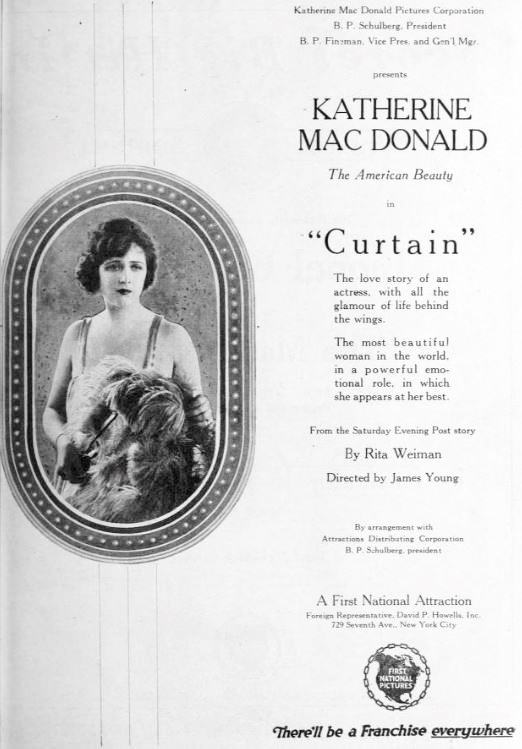
Broadway neon flickers against Fifth Avenue chandeliers; somewhere between the two, Nancy Bradshaw’s heartbeat syncopates with the city’s roar. Curtain—James Young’s 1920 jewel-box of a melodrama—opens on that pulse, then dares to ask what happens when a woman trades the adrenaline of ovation for the hush of a silk-lined boudoir.
The answer arrives stitched in irony: marital marble soon feels like mausoleum alabaster. Katherine MacDonald, statuesque yet mercurial, plays Nancy with a regal tremor behind the eyes; every close-up is a battlefield where ambition duels resignation. Her concession to Dick Cunningham (Charles Richman, equal parts oil-slick charm and predatory possessiveness) is filmed not as romantic capitulation but as surgical amputation—Young’s camera lingers on her hand relinquishing the stage-door key, fingers uncurling like petals bruised by frost.
Time, that stealthy scenarist, jump-cuts through domestic tableaux: a bassinet appears, teacups accumulate, and Nancy’s once-fiery mane is now knotted in maternal primness. Meanwhile, Dick’s gaze wanders to Lila Grant—Florence Deshon’s feline ingénue—whose slink across the parquet promises novelty without the burden of genius. Their sojourn to sun-scorched Mexico becomes a Cinemascope of clandestine embraces, the intertitles coyly euphemistic yet searingly legible.
Enter the crux: with husband abroad, Nancy slips back into the theatre like a revenant reclaiming holy ground. The backstage montage—gelled in nocturnal blues, dust motes swirling like displaced starlight—renders her resurrection less coup than sacrament. When Dick returns, tanned and unrepentant, he finds his wife transfigured: the same mouth that once cooed lullabies now delivers blistering couplets. Accusation ricochets; marriage vows, once granite, fracture into shale.
What ensues is no mere spat but a gladiatorial duet of moral arithmetic. Nancy brandishes Dick’s philandering like a newly sharpened stiletto; he counters with the letter of her promise to forsake greasepaint. Yet the film sides with the spirit: a woman’s right to self-invention eclipses any parchment contract inked under duress of romance. The divorce decree, signed in chiaroscuro half-light, feels less like failure than liberation—a passport stamped for two, child and artist alike.
Visually, Curtain luxuriates in chiaroscuro: shafts of sodium streetlight slice through Venetian blinds, pooling across Persian rugs like spilled champagne. Young, tutored under D.W. Griffith’s epochal eye, orchestrates parallel action—Nancy’s curtain-call bow cross-cut with Dick’s tête-à-tête in a cantina—so that applause south of the Rio Grande becomes tinny, hollow, a ghost of authentic triumph. The film stock itself, grainy and silver-etched, evokes a daguerreotype fever dream.
Compare it to contemporaneous morality plays—say, When Men Desire or Modern Love—and Curtain emerges startlingly progressive. Those titles often punished wayward wives with consumption, poverty, or worse. Here, the errant husband is the one left amid echoing corridors, while the heroine exits arm-in-arm with progeny and profession, a proto-feminist triumph camouflaged in Jazz-Age satin.
Yet the film is no blunt polemic. Its emotional calculus aches with nuance: note the dissolve where Nancy, having tucked her toddler beneath lace coverlets, hesitates at the nursery threshold—half-turned toward the camera, yearning and resolve braided within a single breath. MacDonald, often dismissed as mere “beauty,” conveys that ambivalence with the precision of a surgeon’s stitch.
Rita Weiman’s scenario, adapted from her own serialized novel, crackles with epigrammatic intertitles: “A promise wrung beneath chandeliers may wilt under daylight.” Such aphorisms, far from stilted, function like a Greek chorus—laconic, wry, devastatingly on point. They also slyly wink at the audience, acknowledging that the theatre of marriage is as performative as any Broadway revue.
Earl Whitlock’s cinematography deserves enshrinement. He lenses a simple close-up of Deshon’s Lila through a pane of rain-streaked glass; the droplets warp her smile into something predatory, a foreshadow that needs no verbal underlining. Similarly, a traveling shot follows Nancy as she strides down an alley of hanging costumes—each gown a discarded skin—until she emerges in a blood-red rehearsal dress, reborn. The camera moves, but the metaphor lingers: identity is wardrobe, and wardrobe is choice.
The film’s most radical gambit arrives in its refusal to punish sexuality—male or female. While Dick’s tryst is hardly valorized, neither is it condemned with the scarlet-letter ferocity customary to the era. Instead, the narrative’s ire targets the double standard itself. When Nancy finally confronts her husband, the intertitle burns: “You bartered my art for your vanity—yet covet another’s without shame.” The line lands like a gauntlet, still resonant in a century grappling with wage gaps and unpaid emotional labor.
Some prints suffer from nitrate deterioration—flares bloom like magnesium, eclipsing actors’ eyes—but even these imperfections feel poetic: history gnawing at its own image. Restoration efforts by the Library of Congress have salvaged tints—amber for interiors, viridian for exteriors—that render night scenes phosphorescent, as though Manhattan itself were a bioluminescent organism.
Sound? None, yet the film is symphonic: the rustle of taffeta, imagined; the syncopated clack of typewriter keys as Nancy signs autographs; the hush that falls over auditorium seats when footlights dim. Silent cinema, at its apex, amplifies sensorial memory—viewers supply decibels in the mind’s ear. Curtain weaponizes that phenomenon, forcing us to inhabit Nancy’s subjectivity, to strain for the ovation she’s told she must no longer seek.
Contextually, 1920 was a hinge year: the 19th Amendment freshly ratified, Prohibition just clamped its iron jaw, and Broadway’s playhouses teemed with female playwrights and producers. The film industry, still coastal and freewheeling, mirrored that flux. Hence Curtain stands less as escapism than as cultural barometer—its anxieties about autonomy, motherhood, and creative fulfillment echo in today’s debates over “leaning in.” Swap greasepaint for Silicon Valley stock options and the dilemma stays evergreen.
Performances orbit around MacDonald’s supernova. Richman’s Cunningham exudes monied languor—watch how he fingers a Cuban cigar as though it were a scepter, entitlement ossified into posture. Edwin B. Tilton, as the avuncular playwright who offers Nancy a route back to the stage, supplies balm without condescension, his eyes crinkling like well-loved parchment. Deshon’s Lila, meanwhile, pulses with self-awareness; she knows she’s a placeholder, and that knowledge curdles into spiteful elegance.
The climax—an off-stage dressing-room showdown—unspools in a single, unbroken take (nearly two minutes, a lifetime for 1920). Camera pivots from husband to wife, the mirror between them doubling visages, fracturing identities. When Nancy finally clasps her child and strides into the dawn, streetlights clicking off in sequential salute, the metaphor is unmistakable: the city itself is complicit in her liberation, a vast proscenium arch under which any woman might rehearse her own encore.
Critics of the era, regrettably, fixated on the scandal rather than the subversion. Variety dismissed it as “matinee fodder for the fairer sex,” blind to the seismic ripples beneath its satin surface. Modern reappraisal is overdue. A 2019 MoNA screening reduced a Brooklyn audience to church-mouse silence; gasps greeted the divorce decree, followed by spontaneous applause when Nancy reclaims her dressing-room star. Ninety-nine years had not dulled the blade.
So, is Curtain a feminist screed? Hardly. It is something pricklier, truer: a recognition that love and vocation need not be zero-sum, that motherhood can coexist with muse, that self-abdication is the real tragedy. In an age when #MeToo has toppled titans, the film’s quiet insistence on bodily and creative sovereignty feels both quaint and prescient.
Home-viewing options remain scarce. A bootlegged 480p rip circulates on shadow-stream sites, but hues are wan, intertitles smeared. Criterion, Kino, BFI—take note: a 4K restoration would unveil Whitlock’s gossamer textures, the cobweb lace of Nancy’s peignoir, the bruised-velvet nightlife of Times Square. Until then, seek festival prints, lobby your local cinematheque, or pester Turner Classic Movies. This gem deserves oxygen.
Ultimately, Curtain resonates because it refuses catharsis predicated on suffering. Nancy’s tears are shed, yes, but they irrigate soil from which ambition re-sprouts, greener, sturdier. The final tableau—mother and child ascending a brownstone stoop while a playbill flutters against the railing—offers no swell of violins, only the hush of possibility. That restraint is revolutionary: a woman’s future left deliberately, deliciously unwritten.
Verdict: Seek it, scream for it, screen it. Let its footlights scorch your retinas, let its silence roar in your marrow. For anyone who’s ever been told to choose between heart and hustle, Curtain is both mirror and map—a reminder that the most enduring love story is the one you stage with yourself.
IMDb —
1926
Community
Log in to comment.