DbcultAccessing Vault...
Cult Review
Senior Film Conservator
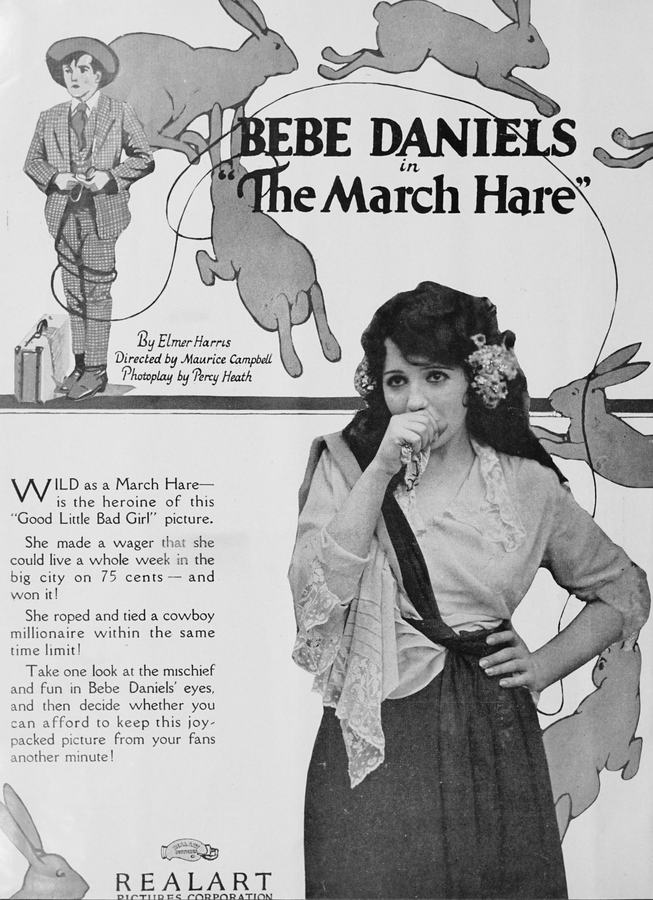
The March Hare, a 1927 silent film, is a glittering confection that masquerades as a simple heist comedy but reveals itself to be a razor-sharp dissection of identity, class, and the performative nature of wealth. Directed by Percy Heath and co-written by Elmer Harris, the film follows Lizbeth Palmer, a Los Angeles heiress who reinvents herself as a penniless flower girl in New York City to prove a point—only to discover that her true self lies somewhere between the two extremes. With a plot that oscillates between high farce and pointed social commentary, the film positions its protagonist as both a trickster and a tragicomedy of manners, navigating a world where trust is as fleeting as the city’s shadows.
Lizbeth’s entrance into New York is anything but humble. Arriving with a chaperone to visit her aunt, she immediately stakes her claim to autonomy by wagering her chaperone she can survive on 75 cents a week. This bet, ostensibly a childish dare, becomes the linchpin of her metamorphosis. Adopting the moniker 'The March Hare'—a nod to her friends’ whimsical nicknaming—she plunges into the role of a streetwise flower girl, a choice that echoes the era’s fascination with 'hobo queens' and flapper resilience. Her transition is as much a performance as it is a revelation; she dons a frayed dress and a wide-brimmed hat, her gilded past reduced to a memory, yet her poise remains unshaken. In this new guise, she captures the attention of Tod Rollins, a young millionaire whose wealth insulates him from the realities of the world outside his penthouse. Their courtship is a dance of mutual deception: Lizbeth hides her identity, while Tod, oblivious to the squalor surrounding him, assumes all women are as carefree as the flowers she sells.
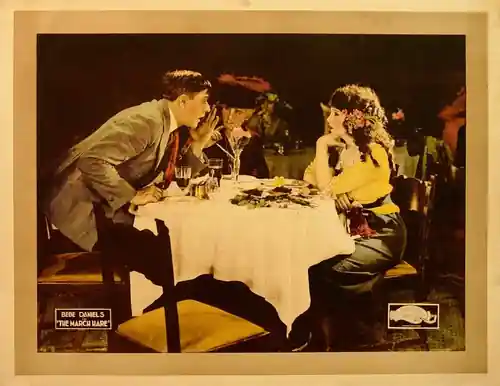
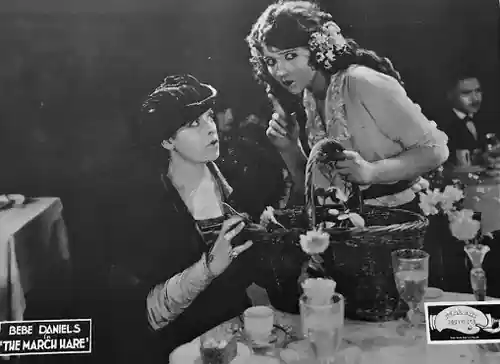
The film’s brilliance lies in its refusal to settle into predictable tropes. Where lesser stories might reduce Lizbeth’s dual life to a mere plot device, The March Hare elevates it into a metaphor for the performative nature of social status. Her aunt’s household becomes a microcosm of class betrayal when the butler, aided by an accomplice, attempts to swindle the elderly woman. Here, Lizbeth’s ingenuity is both a weapon and a salvation. By infiltrating the household under an assumed name, she exposes the fraud, leveraging her street-smart cunning to outwit schemers who underestimate her. The set pieces—particularly the tense final act where she thwarts a jewel heist—are staged with a silent film’s signature theatricality, yet they pulse with the urgency of a modern thriller.
Bebe Daniels, in her role as the chaperone, steals every scene she appears in with a blend of exasperation and reluctant admiration. Her dynamic with Lizbeth is a counterpoint to the film’s central themes: where Lizbeth thrives on chaos, the chaperone embodies the constraints of propriety. This tension is not resolved neatly but lingers like a question mark, suggesting that the chaperone’s rigid adherence to decorum is as fragile as the glass jewels Lizbeth ultimately saves. The supporting cast, including Sidney Bracey as Tod’s more grounded foil and Helen Jerome Eddy as a sly servant, adds texture to the film’s exploration of power and deception.
What elevates The March Hare beyond a mere period piece is its prescient commentary on economic disparity. Lizbeth’s 75-cent survival challenge mirrors the struggles of the working class, yet her ability to navigate both wealth and poverty without losing her agency is a subtle critique of the era’s rigid class structures. The film’s New York is a character in itself—glittering with opportunity yet rife with exploitation. The juxtaposition of Tod’s gilded apartment and Lizbeth’s cramped tenement room is not just visual but symbolic: wealth, the film suggests, is as much a costume as poverty.
Visually, the film is a feast. The use of shadow in Tod’s mansion scenes contrasts sharply with the bright, bustling flower market, a visual motif that underscores the duality of Lizbeth’s existence. The editing, though brisk for the era, maintains a rhythm that feels almost modern, particularly in the heist sequence, where cross-cutting between Lizbeth’s preparations and the butler’s growing paranoia builds tension with Hitchcockian flair. While the lack of synchronized dialogue might seem limiting, the film compensates with expressive acting and clever use of intertitles that double as philosophical musings.
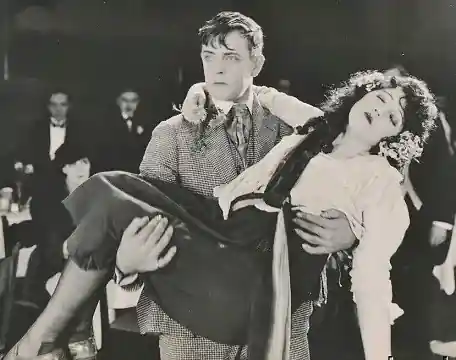
Comparisons to contemporaries like A Law Unto Herself and Wild Waves and Women are inevitable, but The March Hare distinguishes itself through its gender politics. While many films of the era framed women as either victims or vixens, Lizbeth occupies a rare space: she is both the architect of her own destiny and a product of the societal forces that shape her. Her marriage to Tod is not a surrender but a calculated choice, a union that allows her to maintain her independence while securing the resources to protect her aunt. This nuanced approach to agency is as refreshing today as it was in 1927.
The film’s climax—where Lizbeth exposes the butler’s fraud and reclaims the jewels—is less a triumphant finale than a quiet assertion of self. There are no fireworks, no grand speeches; instead, the camera lingers on her face as she exchanges a knowing glance with Tod, the unspoken agreement between them more telling than any dialogue. This restraint is its greatest strength. In an era obsessed with spectacle, The March Hare reminds us that the most compelling stories are those that leave room for interpretation.
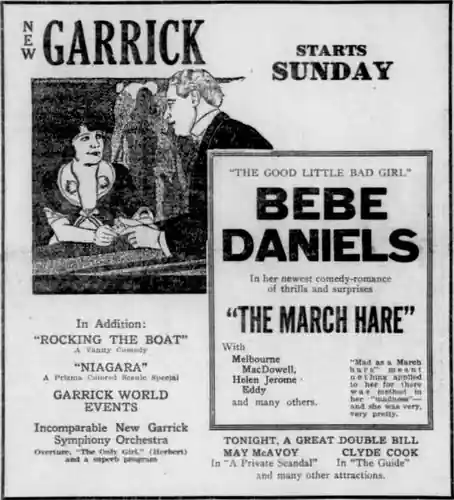
For modern audiences, the film is a gateway to understanding the silent era’s experimental storytelling. The absence of sound is not a barrier but an invitation to focus on gesture, expression, and composition. The performances are so physical, so deeply rooted in the visual language of the time, that they transcend the limitations of the medium. Bebe Daniels’ exaggerated but believable reactions, for instance, anchor the film’s humor without veering into slapstick, while Helen Jerome Eddy’s subtle glances convey volumes about the power dynamics at play.
In the context of 1920s cinema, The March Hare is a bridge between the slapstick comedies of the previous decade and the more socially conscious films of the 1930s. Its themes of identity and deception would find echoes in later works like Her Fighting Chance and The Pointing Finger, yet it remains unique in its balance of wit and gravitas. The film’s enduring relevance lies in its refusal to offer easy answers about class or gender—it instead invites viewers to question the masks we all wear.
Technically, the film is a marvel of its time. The set designs of New York’s contrasting neighborhoods—decaying tenements juxtaposed with Art Deco opulence—speak to the era’s visual ambition. The use of mirrors in Lizbeth’s scenes is particularly striking, reflecting not just her dual identities but the fractured nature of selfhood in a rapidly modernizing world. The score, though lost to time, would have likely mirrored the film’s tonal shifts, blending whimsy with undercurrents of suspense.
Ultimately, The March Hare is a film that rewards patience. Its narrative may seem straightforward, but its layers unfold with the richness of a well-constructed puzzle. For those seeking pure escapism, it delivers. For those inclined to dissect its social commentary, it offers a goldmine of insights. And for cinephiles, it is a rare gem that captures the silent film era at its most inventive—a time when cinema was not just entertainment, but an art form still discovering its own potential.
IMDb 6.1
1930
Community
Log in to comment.