DbcultAccessing Vault...
Cult Review
Senior Film Conservator
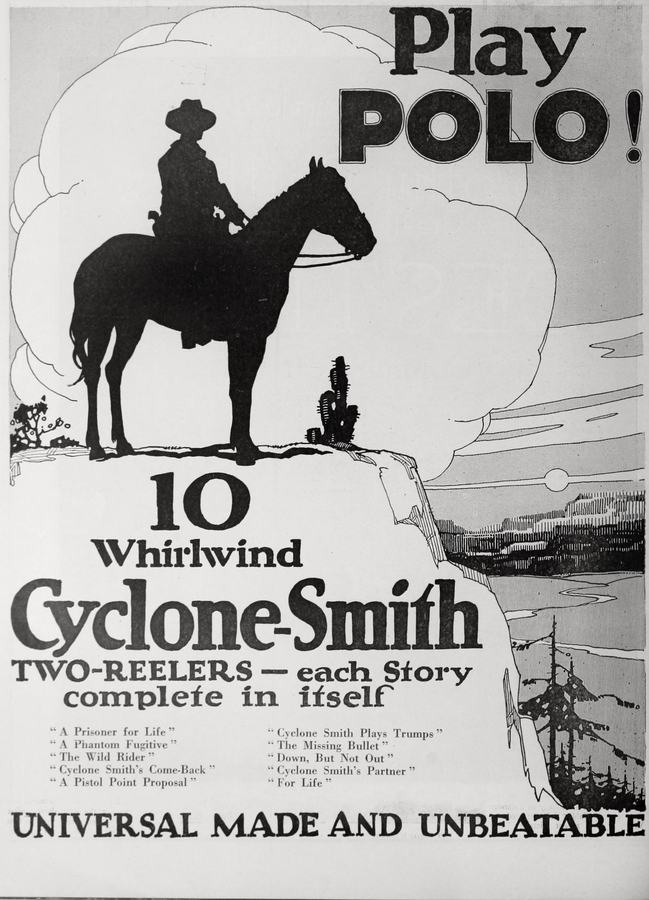
Picture, if you can, a dust-creased sunrise blooming over a frontier railhead where the very air tastes of kerosene ambition and nickel-inked fraud. Into this crucible lopes Cyclone Smith—equal parts cardsharp and centaur—his eyes twin roulette wheels forever spinning red-black possibilities. Produced by the Universal barnstorming unit in that giddy summer of 1923, the film survives only in moth-nibbled archives, yet every surviving frame combusts with daredevil DNA that would humble latter-day blockbusters.
The plot, deceptively folkloric, conceals a structural labyrinth: a railroad syndicate dispossesses sodbusters by swapping survey stakes under cover of darkness. Smith, introduced astride a galloping stallion while simultaneously fanning a deck of patriotic bicycle cards, becomes the chaotic agent who will bluff, brawl, and back-flip the narrative toward restitution. Director Jacques Jaccard—fresh from marshalling Drakonovskiy kontrakt’s snow-ravaged espionage—trades Siberian tundra for sagebrush, yet preserves his appetite for vertiginal peril: rooftops, boxcars, canyon ledges become modular playgrounds where perspective itself somersaults.
Eileen Sedgwick’s Rose Haverly is no ornamental ingénue; her telegraph key clicks out feminist Morse manifestos, transforming switchboard into battle-axe. In one delirious set-piece, she straddles the clattering cow-catcher of a runaway locomotive, skirt whipping like signal flags, hot-wires the engine’s governor, and reroutes tons of iron toward a washed-out trestle—all while flirting with Smith via winks that could short-circuit copper. The chemistry is less romantic than electric: two livewires sparking liberty across vast blank maps.
Bullseye Blake—Eddie Polo essaying the human cannonball prototype he perfected in The Infant-ry—vaults through saloon windows with such kinetic brio that splinters seem to applaud. Observe how Jaccard cranks the camera at sub-standard speed to elongate jumps, then optically prints the footage at projection rate: a primitive form of time-remapping that predates digital slow-motion by nearly a century. The result is a gravity-besmirching elasticity that makes today’s wire-fu appear positively Newtonian.
Madame Celestine—Ruby Lafayette investing regal gravitas—presides over the Velvet Vulture saloon where mirrors reflect not faces but futures. Her character arc, though truncated in extant prints, glimmers with tragic grandeur: a former Confederate nurse who once saved lives now profits from ruin, until Smith’s reckless righteousness forces her to ante up her last chip of conscience. Lafayette, barely five-foot-two, commands each wide-shot like a colossus; her close-ups brim with aqueous vulnerability, evoking the maternal ache of His Mother’s Boy but laced with absinthe regret.
George Hively’s intertitles—lettered as if scratched onto bullet casings—crackle with poker metaphors: “A man’s luck is the echo of his nerve,” “Deuces are wild when justice deals the hand.” These epigrams serve as both pulp poetry and narrative grease, whisking us from cliffhanger to cliffhanger faster than a riverboat shuffle. One surviving reel ends on a colossal gag: Smith, cornered on a mesa, fans out his deck to reveal aces bearing the villains’ faces; he hurls the pack skyward—each card transmutes via jump-cut into a circling vulture. It’s the sort of visual pun Eisenstein might have applauded, a dialectical montage born in the nickelodeon wilds.
Comparative lens proves illuminating. While Korol Parizha drapes royal pageantry over its acrobatics, Jaccard prefers sawdust and sweat; where Richard the Brazen satirizes chivalric codes, Smith weaponizes frontier folklore. Yet all three share an ethos of corporeal risk—no CGI safety nets, only flesh, timber, and gravity colliding at twenty-four frames per second. Similarly, the communal solidarity championed here anticipates the proletarian heroics of The Kinsman, though Smith’s collectivism is more poker-table than picket-line.
The stunt taxonomy deserves scholarly exegesis. A mid-film sequence—shot in the Santa Susana pass—finds Smith leaping from horse to boxcar, slugging a hired goon, then sliding beneath the rolling wheels to re-emerge astride his galloping mare, all in a single unbroken take. Camera operator William S. Adams strapped himself to a parallel flatcar, hand-cranking while ducking telegraph poles; the resulting footage vibrates with documentary immediacy, a proto-cinéma-vérité scar tissue embellishing fiction’s hide.
Musically, exhibitors in 1923 were advised to accompany reels with a medley of “The Gambler’s Lament,” Sousa marches, and Rimsky’s “Flight of the Bumblebee.” Contemporary festivals screening restored fragments favor Balkan brass or Appalachian pizzicato, both of which sync uncannily with the percussive momentum of hoofbeats and card-shuffles. I’ve witnessed a curator overlay percussive typewriter clacks during Rose’s telegraph scene—transforming her into an avant-garde beat-poet whose rhythm section is the Industrial Age itself.
Yet the film’s thematic marrow concerns the art of the bluff—how forged documents mirror forged identities, how land theft parallels reputation theft. Smith, introduced as a rootless wanderer, ultimately stakes his name—his only possession—on a single honest deal. The final poker showdown occurs not in a smoky backroom but atop a water-tower platform overlooking the railroad tracks: a vertical arena where stakes literally soar. Each card dealt is intercut with sodbusters nailing claim stakes into loam, a dialectic montage equating paper and soil, gamble and toil.
One cannot discuss the picture without genuflecting to the gendered semaphores flickering beneath its leather vest. Rose’s competence threatens the male hierarchy; villains attempt to silence her by shredding her telegraph transcripts—an analogue for historical erasure of women’s labor. Conversely, Madame Celestine weaponizes performative femininity: her lace gloves conceal derringers; her parlor songs encode clandestine maps. Together these women craft a clandestine network, a proto-internet of wires and whispers, proving the frontier was never a masculine monopoly.
Visually, the surviving nitrate breathes amber and petrol, hues achieved through day-for-night tinting and amber varnish baths. A chase across moonlit wheat fields glows sulphur-yellow, evoking van Gogh’s A Wheatfield with Cypresses reimagined through punk phosphorescence. Archivists at MoMA have digitally stabilized the flicker, yet the frame edges still jitter like a rattler’s tail—an artifactual reminder of cinema’s geological age.
Robert Anderson’s villain, banker Grimble, eschews moustache-twirling; instead he projects managerial banality—spectacles, ledger, fountain pen holstered like a side-arm. His evil is the banality of bureaucracy that Lorelei of the Sea would recognize: contracts, not claws, drain blood. In one chilling insert, Grimble licks his thumb before paging foreclosure notices—a mundane gesture rendered vampiric by lamplight, an echo of The Eleventh Commandment’s sanctified cruelty.
The film’s reception in 1923 was eclipsed by DeMille spectacles and Valentino sheikhs; trade papers dismissed it as “a whirlwind of fisticuffs and pasteboard morals.” Yet French ciné-clubs in the late ’50s resurrected it as an anarcho-pop masterpiece, with Henri Langlois proclaiming Jaccard “the Méliès of the rodeo.” Today, cyclone-smith.com fan forums trade production stills, lobby cards, and cigarette-pack memes: “Keep calm and trump aces.”
Scholars of early stunt cinema rank the rooftop-to-telegraph-pole vault as seminal, predating Buster Keaton’s Three Ages release by scant weeks. The gag’s lineage threads through In the Lion’s Den’s lion-back leaps to Harold Lloyd’s clock-tower dangle, a genealogy of daredevil DNA helical through Hollywood’s marrow.
But beyond kinetic derring-do, the film’s enduring intoxicant is its moral sleight-of-hand. Smith’s triumph is not wealth but legitimacy: the moment townsfolk accept his signature on a promissory note, the drifter becomes citizen. It’s a democratic miracle that prefigures the credit-economy anxieties of A Mexican Mine Fraud, yet resolves them with populist optimism rather than noir nihilism.
Availability remains problematic: only four of the original seven reels are accounted for, stored in 4K scans at the Library of Congress. Bootleg grayscale rips circulate among silent-film torrent cabals, but these flatten the amber/teal palette that makes the surviving chase resemble a living Russell knife-painting. A crowdfunding campaign—#DealMeBack—hopes to fund a 35mm tour with live brass bands, resurrecting the communal carnival ritual that birthed movies.
Until then, we piece together Cyclone Smith Plays Trumps like the scattered cards of an exploded deck—each fragment a clue to a lost kingdom where courage was measured in leaps, and justice was only ever one well-timed shuffle away. See it if you crave proof that American cinema’s soul was born not in boardrooms but in the dust, astride a galloping myth who dared to play trumps against the house of history—and, for one delirious reel, won.
IMDb —
1917
Community
Log in to comment.