DbcultAccessing Vault...
Cult Review
Senior Film Conservator
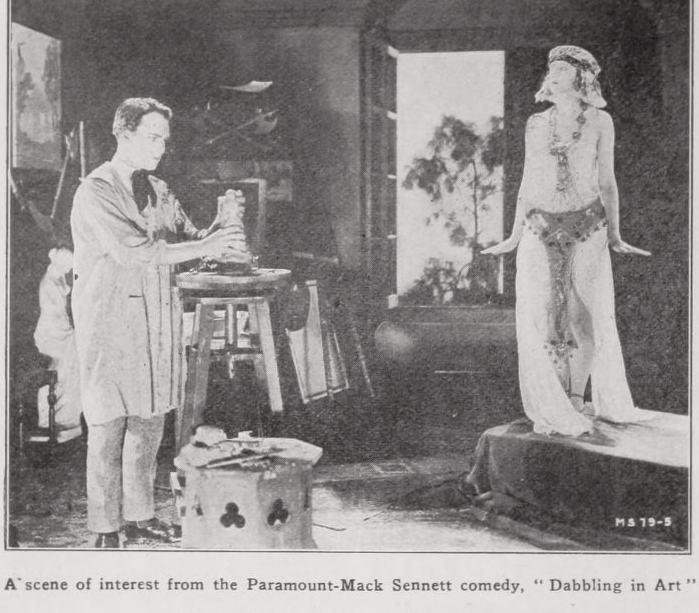
Dabbling in Art
is a film that crackles with the tension of a society in transition. Released in an era when silent cinema was both a spectacle and a sermon, it dissects the myth of the "starving artist" with surgical precision. Marie Prevost, in a role that feels like a precursor to Monroe’s screen persona, embodies a character whose charm is as performative as the art she peddles. Her ascent is less a triumph and more a masquerade, a performance art piece where the audience—both on and offscreen—is complicit in the illusion. The film’s visual grammar is its most subversive tool: quick cuts juxtapose the protagonist’s brushstrokes with close-ups of coin clinking in a ledger, a silent duet between creation and exploitation.
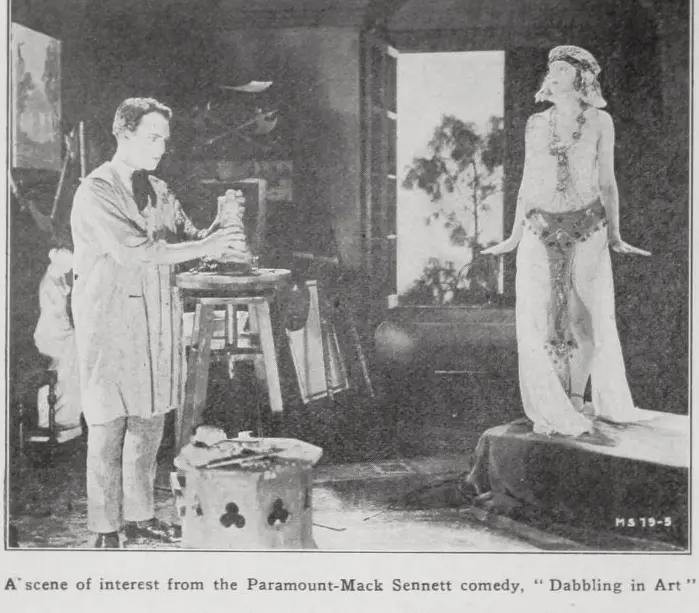
The film’s central conflict is not between good and evil but between authenticity and artifice. Joseph Belmont’s art dealer is a study in contrasts—his tailored suits are neat, his smile disarming, yet his fingers twitch with the energy of a man perpetually calculating. In one standout scene, he arranges a portrait session for Prevost’s character, instructing her on how to "look" like a bohemian. The camera lingers on her discomfort, the tension between her true self and the persona he sells. This scene, shot in a studio where the walls are painted with trompe l’oeil frescoes, becomes a metaphor for the entire narrative: a painted lie selling itself as truth.
Comparisons to The Pursuing Shadow are inevitable, as both films interrogate the performative nature of success. Yet Dabbling in Art
goes further, using its silent format to amplify what words might dilute. The absence of dialogue forces the viewer to focus on the protagonist’s body language—a nervous tic, a hesitant hand—revealing a soul at war with itself. When she finally breaks down in a gallery, the sound of shattering glass (the only sound effect in the film) punctuates her unraveling identity.
Visually, the film is a masterclass in using light as a narrative device. Scenes set in the protagonist’s attic studio are bathed in warm, golden hues, while the art dealer’s office is cold and blue-lit, a visual metaphor for the transactional nature of his world. A pivotal sequence, where Prevost’s character paints a self-portrait, is shot in such a way that the canvas is always off-center, a subtle nod to her fractured sense of self. The editing here is frenetic, the brushstrokes on film mirroring the chaotic energy of her psyche.
Contrast this with the scenes of the art world’s elite, where the lighting is flat and unflattering, reducing the characters to two-dimensional figures. It’s as if the film itself is commenting on the art establishment—reducing vibrant creativity to a commodity. This visual strategy pays off in the third act, where the protagonist’s forgery is revealed not with a dramatic flourish but a slow zoom on the painting’s corner, where the signature is a crude forgery. The audience, like the characters, is complicit in the deception.
Beneath the surface, the film is a sharp satire of postwar consumerism. The art dealer’s schemes mirror the speculative economy of the time, where anything could be sold if the right story was crafted. This theme resonates with The Toilers, which similarly critiques the exploitation of labor. Yet Dabbling in Art
is more personal, focusing on the individual’s complicity in systemic issues. The character of Eddie Fitzgerald’s critic is particularly telling—his disdain for the art world is genuine, but his reviews are still crafted for public consumption, a reminder that even dissent can be commodified.
The film’s use of supporting characters is equally telling. Billy Bevan’s prodigy, for instance, is a vehicle for the film’s exploration of authenticity. His art is raw and unpolished, a stark contrast to the protagonist’s polished, marketable work. Yet when he is co-opted by the art world, his final piece becomes a pastiche of what he once despised. This arc, while brief, is a microcosm of the film’s central thesis: that the system corrupts not through force but through seduction.
Decades later, Dabbling in Art
remains a prescient commentary on the art world’s perpetual tension between innovation and commercialization. Its themes echo in modern narratives like Leave It to Susan, which also grapples with the commodification of talent. Yet this film’s silent format gives it a timeless quality; the lack of dialogue allows the visuals to speak louder, a technique that feels oddly modern in its emphasis on image over text.
The film’s technical achievements are also noteworthy. The use of shadows and light to convey emotion predates German Expressionism but shares its aesthetic DNA. A scene where the protagonist walks through a rain-soaked city, her silhouette merging with the reflections on the wet pavement, is a masterclass in silent storytelling. It’s a moment that needs no intertitles—just the sound of her footsteps and the viewer’s imagination.
In conclusion, Dabbling in Art
is more than a period piece; it’s a mirror held up to the eternal struggle between art and commerce. Its critique is as sharp today as it was in its time, a testament to its creators’ foresight. For cinephiles and historians alike, it’s a film that demands repeated viewings, each one revealing new layers beneath its painted surface.
IMDb —
1928
Community
Log in to comment.