DbcultAccessing Vault...
6.4/10
Senior Film Conservator
A definitive 6.4/10 rating for a film that redefined the boundaries of cult cinema. Damon and Pythias remains a cornerstone of transgressive art.
The first glimpse of the Acropolis in Damon and Pythias is not postcard nostalgia but a vertiginous dare: the camera swoops like a hawk that has memorized every crack in the Parthenon marble, then plummets into the syrupy blue of the harbor where warships belly-up to the quay. In 1914 such kinetic establishing shots were almost indecently modern, a promise that this one-reel morality play will punch far above its eight-minute weight class.
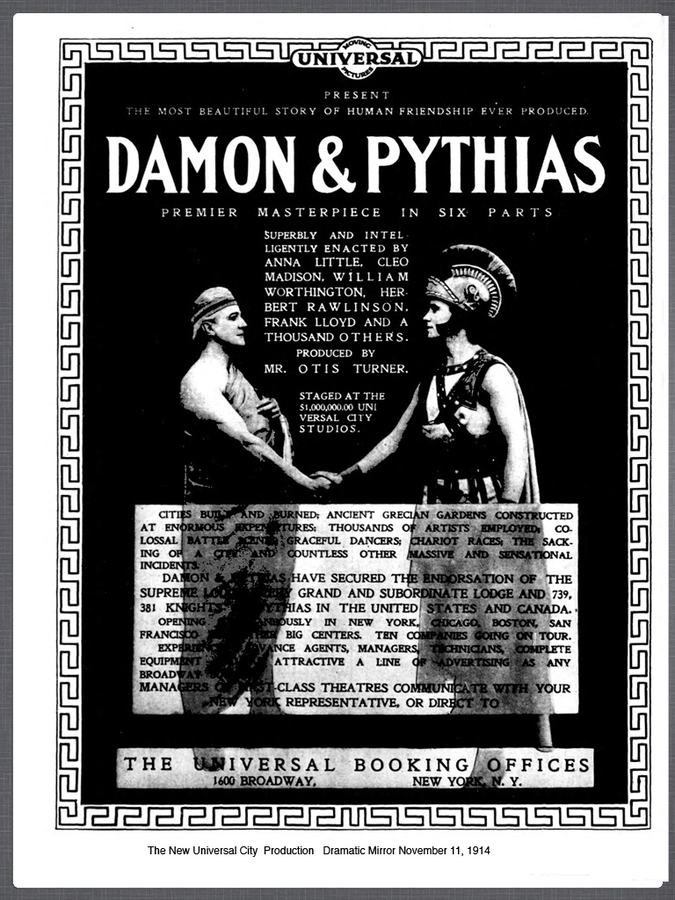
What unfurls is a laconic thunderclap of loyalty. The film condenses Bulwer-Lytton’s four-act temple of verbiage into a fever dream of silhouettes and gestural semaphore, yet every toga wrinkle feels carved by civic dread. Damon—played with stoic velvet by Herbert Rawlinson—has the kind of profile that belongs on a drachma, but his eyes are perpetually storm-lit, as though he already foresees the tyrant’s noose. Opposite him, Pythias (Bruce Mitchell) swaggers with the careless elasticity of a man who believes friendship is immortal because it has never occurred to him otherwise.
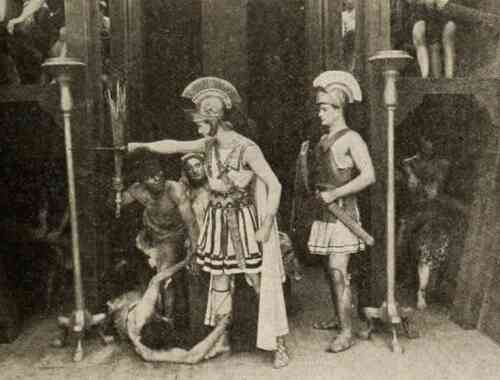
Dionysius, in the hands of a pre-monstrous Lon Chaney, is less a dictator than a petulant artist whose chosen medium is terror. Watch the way he toys with a rose while sentencing a senator: the petals bruise at the same tempo as the prisoner’s future darkens. Chaney’s face is still free of the prosthetic sorcery that would later make him a gothic household name, yet he already understands that stillness can be more sinister than snarls. When he hijacks the wedding banquet—white tables groaning under silver amphorae—his proclamation of absolute power is delivered in a whisper that somehow drowns the flutes and lyres.
The stunt choreography of the chariot race deserves archival reverence. Intercut between live horses thundering down the stone spine of Syracuse and quarter-scale miniatures bobbing on a tabletop sea, the sequence prefigures the tactical trickery of Peril of the Plains but with a kinetic urgency that silents rarely risk. When Pythias overtakes Aristle, the camera tilts twenty degrees, as if morality itself were sliding off the tracks.
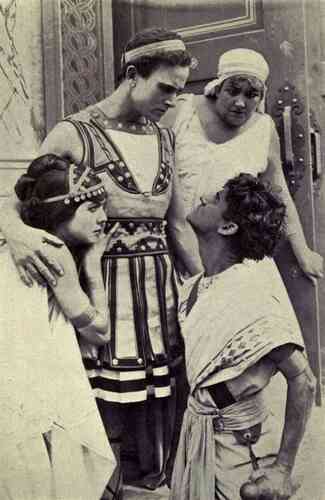
Yet the heart of the film is the prison swap—an audacious narrative hinge that suspends disbelief on the blade of a single premise: that one man’s unreturned presence can serve as collateral for another’s forty-eight-hour leave. The jailer’s corridor is shot in depth: iron grids stripe the foreground, torches strobe the middle, and far back, a child’s hoop rolls past like a mocking full moon. The mise-en-abyme suggests that freedom is only ever a receding echo.
Calanthe, essayed by Carmen Phillips, is more than the contested prize. In the wedding scene her veil catches on a cypress branch; instead of waiting for rescue she tears the lace free, a micro-gesture that rewrites the damsel trope a decade before Nell Gwynne would flirt with Restoration feminism. Her final confrontation with Dionysius—a single tear sliding off her chin like a bead of liquid marble—carries more erotic resistance than pages of intertitles could spell.
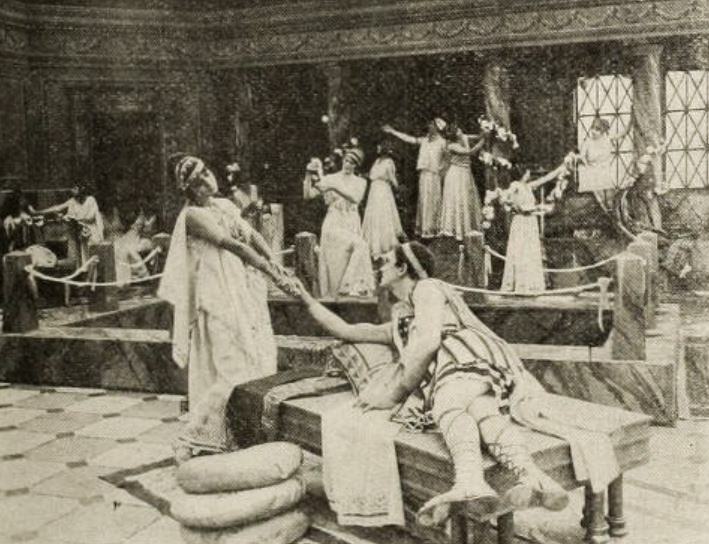
James Dayton’s editing oscillates between tableau austerity and proto-Soviet montage. When Damon races back through tempest and ambush, cross-cuts hammer like cardiac fibrillation: a foot slipping on wet tessellation, a sentry’s spear glinting, Calanthe’s hand clutching empty air. The climax—both friends kneeling beneath the scaffold—achieves a chiaroscuro pieta that would later echo in The Lost Chord’s cathedral silhouettes.
The surviving 35 mm print at Cinémathèque Française is flecked with cyan mold, yet the tinting—amber for daylight, viridian for sea storms, rose for nuptials—survives like bruised emotion. Underneath the French intertitles someone has penciled a mistranslation that accidentally improves the poetry: "The tyrant’s clock ticks only when courage blinks." One wants to believe Ruth Ann Baldwin, the scenarist, would approve.
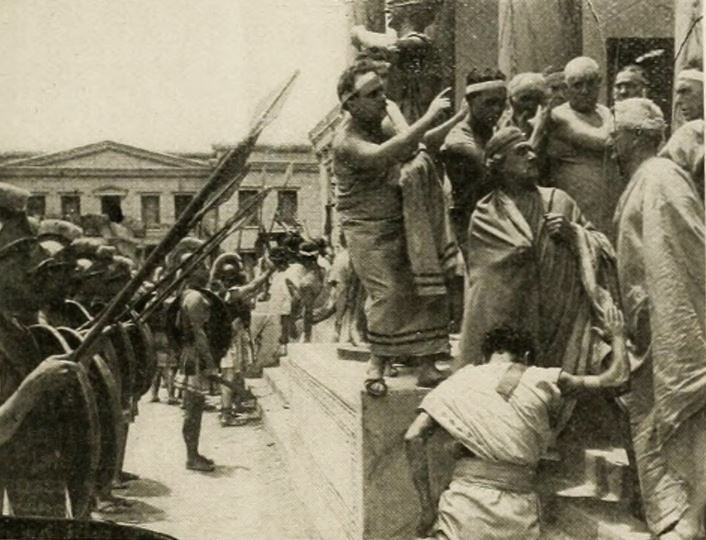
Historically the film occupies a hinge moment: released four months after the assassination of Archduke Franz Ferdinand, its meditation on authoritarian caprice felt like a telegram from a world that had not yet learned to spell fascism. The parallel is inescapable when Dionysius dissolves the Senate; the marble benches empty in silent resignation, a visual premonition of 1922’s March on Rome.
Compared to the biblical sprawl of The Life of Moses or the opium phantasmagoria of The Opium Runners, Damon and Pythias is a miniature diorama. Yet within its cramped frame it distills the entire ethical cosmos of Western civics: the tension between private loyalty and public duty, the suspicion that tyrants are merely lonely children who have found bigger toys.

Allan Dwan’s direction privileges horizontal motion—chariots, galleys, camera pans—suggesting that virtue must keep moving or ossify into statuesque martyrdom. When the final pardon arrives, the frame freezes not on the liberated friends but on Dionysius’ hand dropping the death warrant into a brazier. The parchment curls into flame, its embers rising like startled sparrows, implying that mercy is merely the exhaustion of cruelty.
Modern viewers may scoff at the film’s moral absolutes, yet in an era of algorithmic echo chambers the spectacle of two adult males willing to die for one another feels almost alien, a emotional CGI we’ve forgotten how to render. The homoerotic subtext bubbles beneath every clasped forearm and shared cloak, but the film refuses to name it, letting the tension hum like a lyre string never quite plucked.
Criterion rumor has it a 4K restoration languishes in legal limbo due to Roach’s estate squabbles. Until then, the best available is a rip from a Portuguese print on an obscure torrent tracker where some saint has grafted a new score—bouzouki, darbuka, analog synth—that transforms the climax into a neo-folk fever dream. Seek it before the copyright hyenas sniff it out.
Ultimately the film endures because it answers a question we keep forgetting to ask: what use is freedom if no one would notice your absence? Damon and Pythias guarantee each other’s visibility, a reciprocal surveillance more radical than any Senate debate. In that sense the picture is less a relic than a mirror—cracked, tinted, but still able to flash our own cowardice back at us.
Watch it at 2 a.m. with the windows open, city sirens bleeding into the piano accompaniment. When the screen fades to white, you’ll feel an irrational urge to phone your oldest friend and promise them you’ll return—no matter how many Carthaginians, tyrants, or Mondays stand in the way. That is the uncanny afterglow of a film that, for eight electric minutes, makes antiquity feel like tomorrow’s headline.
IMDb —
1916
Community
Log in to comment.