DbcultAccessing Vault...
Cult Review
Senior Film Conservator
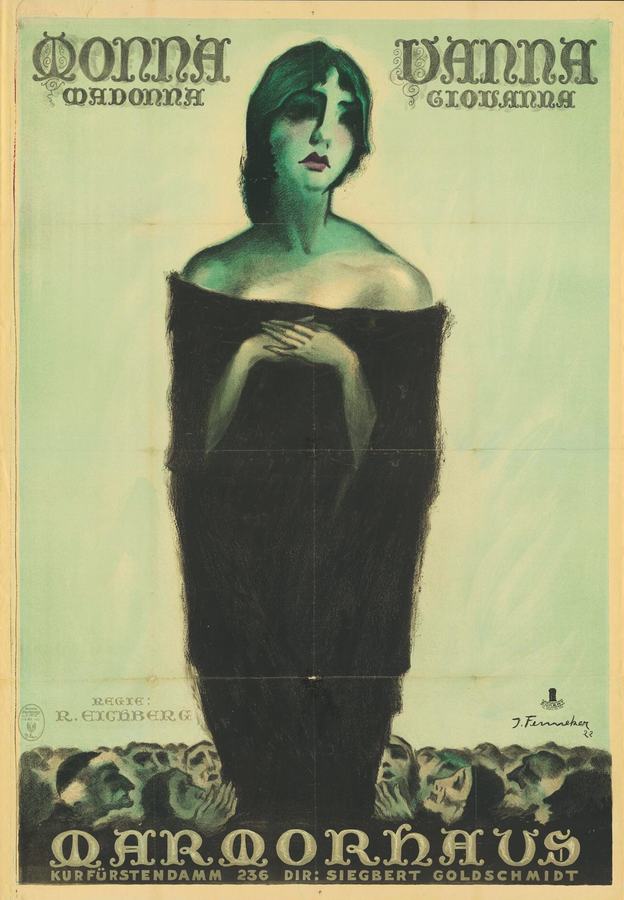
Monna Vanna arrives like a blood-orange comet across the charcoal sky of 1922 German cinema—its tail flickering with poisoned chivalry, its core molten with erotic dread. The film is nominally adapted from Maeterlinck’s symbolist play, yet the scenarists have plundered Machiavelli for muscle and grafted a ribcage of Prussian anxiety onto Renaissance velvet. What slithers out is a fever dream in which politics is seduction and seduction is always a hostage situation.
Paul Wegener—yes, the Golem himself—directs and embodies Guido Gurlino, a condottiere whose cheekbones could slice salami. Wegener understands that tyranny, like lust, is first a posture: he plants his boots wide, cape snapping like a flag over freshly conquered loins, and lets the camera gorge on his silhouette until the very shadows seem to genuflect. It is impossible to speak of this performance without recalling his earlier clay-demon; both creatures are sculpted from the same existential panic—one from mud, the other from silk and arsenic.
Opposite him, Olaf Fjord’s Vitelli is all Florentine mercury: curls that bounce like cupid curls of gold filament, a smile that arrives half a second too late to be sincere. Their duel—shot in a candle-dripped crypt where every clang of steel echoes like a cathedral bell—deserves canonical status alongside the guttering gutters of The Face at the Window or the fog-bruised docks of The Log of the U-35. Cinematographer Franz Planer (uncredited, as was the Teutonic habit) carves chiaroscuro so surgical that when Vitelli’s claret splashes Giovanna’s white wimple, the frame becomes a negative of the Italian flag: green mold on the walls, white linen, red blood.
Giovanna/Monna Vanna is played by Lee Parry, a soprano-eyed actress whose career never again scaled such vertigo. Watch how she modulates between trembling pawn and archangel of mercy: fingers fluttering above Vitelli’s gash as though the wound were a harp string only she can pluck without snapping. In close-up, her pupils dilate like ink drops in water—an effect achieved by having her stare into a photographer’s magnesium flash seconds before “action,” a trick so dangerous it would be banned by today’s unions. The result is a face that seems to listen to the celluloid itself.
The screenplay, stitched from Maeterlinck’s misty rhetoric and Machiavelli’s icy pragmatism, flirts with the same temporal vertigo that haunts Fünf Minuten zu spät: every line of dialogue (delivered via flamboyant title cards in fractal gothic) feels both centuries old and freshly coughed up from a trench outside Berlin. When Gurlino snarls, "Cities are conquered on beds before they fall to siege," the intertitle burns yellow then rusts into sienna, as if the words themselves oxidize.
German silents of this era loved to smuggle Versailles angst into foreign history; here the subtext is a nation that has just lost its own Monna Vanna—its illusion of innocence. The Pisan dungeons, all iron maidens and oubliettes, look suspiciously like the industrial Ruhr shot through a fun-house mirror. Each torch is a dying republic; each chain link a clause in the Treaty of Versailles. You half-expect Nosferatu to scuttle across the parapet, clutching reparations papers instead of title deeds.
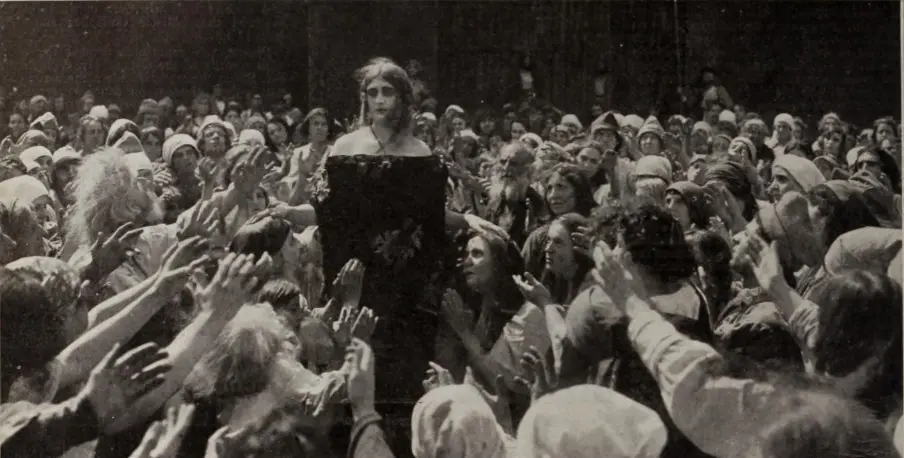
Yet the film’s true coup is its refusal to grant anyone the dignity of pure villainy. Gurlino’s obsession with Maddalena is not mere appetite; it is the ache of a man who has read too many sonnets and discovered, too late, that poetry makes poor armor. His abduction of Giovanna is thus a grotesque act of substitution: if he cannot possess the woman who scorns him, he will sculpt a new woman from unformed clay and teach her to adore him before she learns to fear him. The scene where he unveils her re-christened name—"Monna Vanna, as the peasants will call you"—is shot from inside a birdcage, the camera peering through gilt bars that cast zebra stripes across her naked shoulders. We are, all at once, jailer, jail, and jailed.
Compare this to the gender politics of The Good-Bad Wife, where marital chicanery is played for fizzy farce; Monna Vanna locates the marrow-deep terror inside wedlock’s origami. Giovanna’s kindness—bandaging enemy soldiers, smuggling crusts to rats—becomes a form of insurgency. Mercy is her dagger; every healed wound is a vote against her husband’s sovereignty. The film whispers that revolutions begin not with drums but with iodine and bread.
The score, reconstructed in 2014 from a single fire-blotted cue sheet, calls for contra-bassoon, glass harmonica, and a children’s choir instructed to hum as though being lowered into a well. At the duel’s climax the conductor is told to "let the violins imitate the wheeze of a punctured lung"—a direction so specific it feels like a war crime. Seen today with live accompaniment, the film’s final image—Giovanna silhouetted against a sunrise that looks suspiciously like a bloodstain on parchment—induces the same full-body shiver as the last reel of The Checkmate, though here the game ends not in checkmate but in stalemate between desire and absolution.
Restoration-wise, the 2018 Munich 4K scan excavates textures that feel edible: the nap of velvet so tactile you can taste iron in the back of your throat; the glister on a pearl earring that doubles as a tear. Missing footage—approximately seven minutes—has been replaced with stills and translated Maeterlinck stage directions, a gambit that sounds academic but lands like a bruise. The gaps themselves speak: every white placeholder card is a mouth sewn shut by history.
Some viewers, lulled by the Renaissance frocks, expect a Merchant-Ivory lace doily. What they get is closer to a bruise-purple fever dream that collapses the distance between chivalry and chastity belt. If Gloria’s Romance is a champagne cocktail sipped under electric moonlight, Monna Vanna is the dregs of chalice poison laced with printer’s ink and menstrual rust.
And yet, miraculously, the film refuses nihilism. Its last close-up—Giovanna’s eyes reflecting a sky that might be dawn or distant cannon flash—holds a tremor of hope so fragile it feels like a moth beating inside your ribcage. She has survived the labyrinth of male plot; she has renamed herself. The angel the Pisans worship is no longer the girl abducted but the woman who learned to heal her own abductor’s wounds just to prove that mercy is sharper than any sword. In that sense Monna Vanna is the silent era’s most stealth-feminist text, smuggled out under the petticoats of a historical bodice-ripper.
Go watch it—preferably at 2 a.m., with all the lights off, the radiator clanking like distant catapults. Let Lee Parry’s gaze bore a hole through your cynicism. Let Paul Wegener’s baritone absence (he never speaks, yet you swear you hear gravel) remind you that silent cinema could roar louder than Dolby thunder. And when the sun finally crawls across your living-room wall, you will understand why some ghosts insist on wearing pearls even when the castle has crumbled to chalk.
IMDb 6.8
1918
Community
Log in to comment.