DbcultAccessing Vault...
Cult Review
Senior Film Conservator
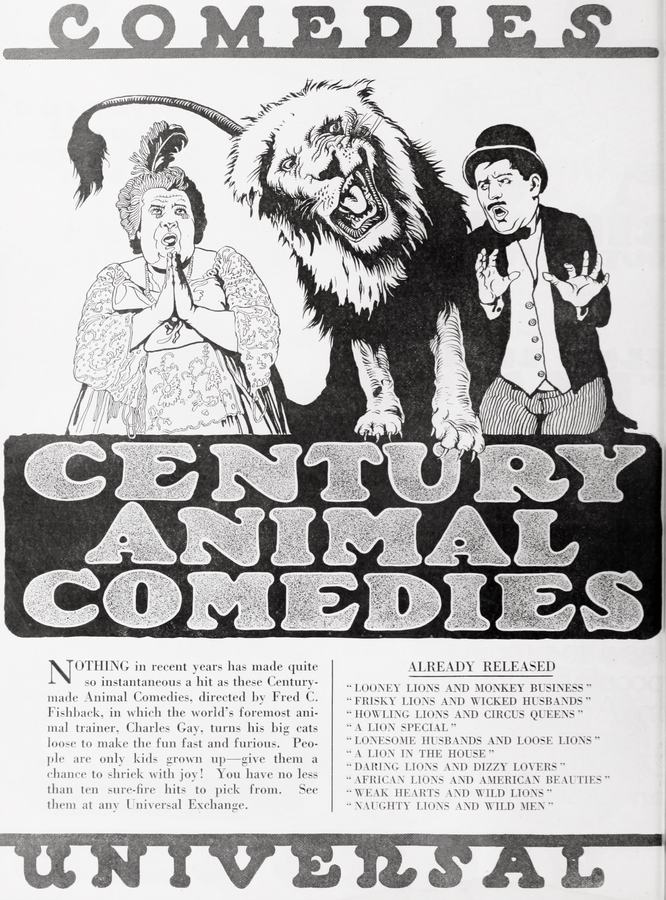
To witness Daring Lions and Dizzy Lovers is to step into a bygone era of cinematic recklessness that modern safety protocols have rendered extinct. Produced during the zenith of the short-subject comedy boom, this film stands as a harrowing yet hilarious testament to the lengths filmmakers would go for a laugh. Unlike the polished, almost mathematical precision found in Pretty Smooth, Watson’s work here feels uncontained, a sprawling mess of fur, teeth, and frantic human movement that defies the standard narrative logic of the 1920s.
The premise is deceptively simple, yet its execution is fraught with a tension that modern viewers might find genuinely distressing. We are introduced to the dizzy lovers—played with a manic commitment by Bud Jamison and Merta Sterling—whose attempts at courtship are interrupted by the literal presence of lions. These are not the lethargic, drugged animals of later Hollywood spectacles; these are the Century Lions, a troupe of predators that became a brand in their own right. Their inclusion transforms a standard domestic farce into something far more primal, reminiscent of the atmospheric dread found in The Rescue, albeit played for gasps rather than tears.
Bud Jamison, a veteran of the Essanay comedies and a frequent foil for Chaplin, here takes center stage with a performance that is nothing short of athletic. His physicality is the glue that holds the disparate parts of the film together. While performers in films like Triumph relied on a certain stoic grace, Jamison embraces a total loss of dignity. His reactions to the lions are not merely performed; they feel like the genuine survival instincts of a man who realizes he is inches away from a mauling. This blurring of the line between actor and character is what gives the film its lasting power.
Jamison’s timing is impeccable, particularly in the sequences where he must navigate a room filled with roaming beasts while maintaining the pretense of a romantic pursuit. It is a masterclass in spatial awareness. He uses his entire body—his trembling hands, his bulging eyes, his frantic gait—to communicate a specific brand of 1920s anxiety. It’s a stark contrast to the more internal struggles depicted in The House Without Children, where the conflict is emotional rather than physical. Here, the conflict is whether or not the protagonist will be eaten before the final curtain.
Merta Sterling, often undervalued in the pantheon of silent comedians, provides a necessary grounding for the film’s more outlandish moments. She does not play the typical damsel in distress; instead, she exhibits a sort of weary resilience that makes her the perfect partner for Jamison’s hysteria. Her comedic sensibilities align more closely with the energetic shifts seen in Betty in Search of a Thrill, where the female lead is an active participant in the chaos rather than a passive observer. Sterling’s ability to maintain her character’s dignity while being chased by a lion is a feat of professional focus that deserves more recognition.
William Watson, a director who understood the pulse of the short-form comedy better than most, utilizes a framing style that emphasizes the proximity of danger. He avoids the static wide shots that were common in early silents, opting instead for medium shots that trap the actors and the lions in the same claustrophobic frame. This technique creates a sense of immediacy that is often missing from contemporary dramas like The Big Sister. Watson isn't interested in the moralizing of the era; he is interested in the reaction—the pure, unadulterated shock of the audience.
The pacing of Daring Lions and Dizzy Lovers is relentless. There are no quiet moments for reflection. Every scene builds upon the previous one in a crescendo of absurdity. This rhythmic approach to filmmaking is what separates Watson from the more methodical directors of the time. He understands that in a film featuring apex predators, the momentum is the only thing keeping the audience from questioning the sheer insanity of the production. It shares a certain DNA with Howling Lions and Circus Queens, another Watson-led foray into the world of animal-based comedy, yet Dizzy Lovers feels more refined in its madness.
Visually, the film is a product of its time, yet it possesses a grit that makes it feel surprisingly modern. The lighting is harsh, the sets are functional, and the costumes are designed for movement. There is no room for the ornate beauty of The Spanish Jade or the gothic undertones of Le diamant noir. Instead, the aesthetic is one of utility. Every prop is something that can be broken, every piece of furniture is a potential shield, and every doorway is a possible escape route. This utilitarian approach to set design heightens the stakes, making the world of the film feel like a literal cage.
The lions themselves are filmed with a reverence that borders on the fetishistic. Their manes, their claws, and their yawning maws are given significant screen time, serving as a constant reminder of the thin line between civilization and the wild. This thematic preoccupation with the 'beast within' or 'beast without' is a common trope in silent cinema, but rarely is it literalized with such reckless abandon. Even in more serious works like The Spreading Evil, the 'evil' is often metaphorical. In Watson’s film, the evil—or at least the danger—is a four-hundred-pound cat that doesn't know it's in a comedy.
Looking back at Daring Lions and Dizzy Lovers, one cannot help but wonder about the ethical implications of such a production. The actors were clearly in harm's way, and the animals were subjected to the chaotic environment of a film set. However, through the lens of history, these concerns are secondary to the sheer cinematic impact of the work. It represents a moment in time when the medium was still exploring its boundaries, when the rules were being written in real-time, and when the price of a laugh was often a near-death experience.
The film’s influence can be seen in the later work of Buster Keaton and even in the high-octane action-comedies of the modern era. The idea of using genuine peril to elicit a comedic response is a tradition that began here, in the dusty backlots of Century Comedies. While it lacks the narrative complexity of The Broken Coin or the social commentary of Marked Men, it succeeds on its own terms as a piece of pure, unadulterated spectacle. It is a film that demands to be watched, not just for its historical value, but for its ability to still provoke a visceral reaction from an audience that has seen everything.
The collaboration between William Watson and Bud Jamison reached a fever pitch in this short. They developed a shorthand for chaos that few other duos could replicate. While Jamison would go on to have a long and storied career—eventually becoming a staple of the Three Stooges shorts—his work here is perhaps his most daring. He wasn't just a comedian; he was a gladiator in a business suit. Similarly, Watson’s direction here is more focused and energetic than in his other works like When Doctors Disagree or the somewhat more conventional Love and Lavallieres.
In the end, Daring Lions and Dizzy Lovers is a reminder of the raw power of the silent image. It doesn't need dialogue to convey the sheer terror of being trapped in a room with a lion, and it doesn't need special effects to make the audience lean forward in their seats. It is a masterclass in tension, a celebration of the absurd, and a fascinating glimpse into a time when the lions were real, the lovers were dizzy, and the cinema was a truly dangerous place to be. It occupies a unique space in film history, standing alongside curiosities like The Beloved Blackmailer as a testament to the diverse and often bizarre output of the early studio system. For any serious student of film, it is an essential piece of the puzzle, a roar from the past that still echoes today.
Review by the Cinephile's Archive – Dedicated to the preservation of silent chaos.
IMDb —
1916
Community
Log in to comment.