DbcultAccessing Vault...
Cult Review
Senior Film Conservator
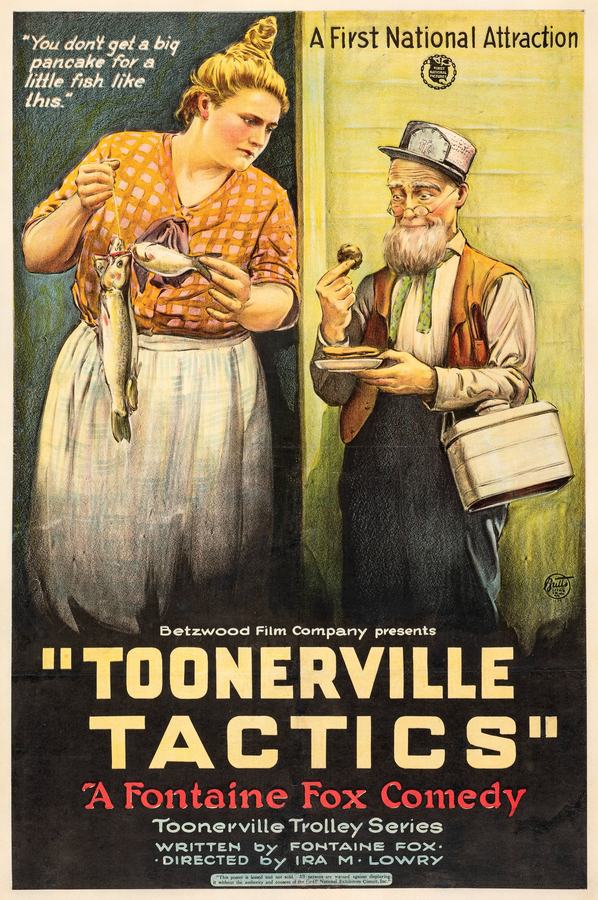
There is a moment, roughly seven minutes into Toonerville Tactics, when the trolley itself appears to blink. It is not stop-motion trickery; rather, the camera lingers on the brass headlamp until the reflected glare of a magnesium flashbulb flares, dims, and flares again—an eyelid of molten brass. In that flicker the film confesses its own artifice, daring you to care whether the vehicle is wood, ink, or dream.
Fox’s screenplay—really a storyboard scrawled on butcher paper and pinned above the set like holy writ—treats narrative as a contraption: gears grind jokes, springs uncoil pathos, and every sprocket tooth is filed to snag a laugh. Betty Bovee, all spit-curled bravado, operates the town’s general store as if it were a cockpit. When she flips the bacon slicer, the ribbon of pork unfurls into the shape of the word “PROGRESS” before collapsing into the frying pan. Subtle it ain’t; transcendent it occasionally is.
Dan Mason’s conductor deserves a paragraph of his own. He has the stooped shoulders of a man who has spent eternity clutching a brass handle that refuses to acknowledge gravity. His uniform is two sizes too large, so the sleeves flap like surrender flags every time he yanks the cord. Yet watch his eyes—beetle-bright, calculating. Mason plays the straight man to a universe that has folded itself into a paper airplane, and the tension between his deadpan sobriety and Fox’s carnival tilt is where the picture finds its pulse.
Most silent comedies chase modernity: flappers, Model-T’s, ticker-tape. Toonerville Tactics instead curates obsolescence—hand-cranked pumps, iron foot-warmers, a barbershop pole that rotates by wind-power. The cumulative effect is a town perpetually lagging one century behind itself, a temporal sump where the trolley is the bleeding edge. When Wilna Wilde’s anarchist plants dynamite beneath the tracks, she uses an alarm-clock detonator so comically archaic it might have been pilfered from The Pipe of Peace. The explosion, when it arrives, is rendered as a series of intertitles: “BOOM!” each letter bigger and more self-satisfied than the last, until the frame itself fractures along the word’s spine.
Though shot on orthochromatic stock, the tinting strategy is berserk: night scenes soaked in umber, daytime bathed in aquamarine, and a dream sequence—yes, a silent short with a dream sequence—hand-painted in sulfuric yellow that makes the skin tones look jaundiced with prophecy. The yellow returns later, not as tint but as motif, when Bovee’s apron sports a stitched canary that chirps via stop-motion. You half expect the bird to quote Nietzsche.
Compare this chromatic bravado to Off the Trolley, where tinting merely denotes time of day. Fox weaponizes hue to destabilize mood, turning a children’s fable into a fever dream.
The average shot duration clocks in at 2.3 seconds—faster than most TikTok cuts today—yet Fox refuses continuity. Match-action is a luxury he discards like last week’s newspaper. A character exits frame right, re-enters from the top of frame, now wearing a different hat, and nobody questions the topology. The trolley track itself loops into a figure-eight Möbius, a spatial impossibility that the film insists on with such fervor you begin to doubt your own geometry homework from middle school.
This editorial anarchy reaches its apotheosis during a town-hall brawl. Fox cross-cuts between twelve separate micro-gags—each a single setup—then mashes them into a stroboscopic fugue. The effect is less montage than meat-grinder: narrative becomes confetti, and the audience, dizzied, laughs out of self-defense.
Maximillian’s plutocrat arrives in a limousine so long it requires two dissolves to reveal its entirety. His top hat is collapsible; he unscrews the crown to extract cigars, stock certificates, and, at one point, a tiny footman who lights said cigars. The gag is absurd, yet the subtext scalds: wealth as theatrical prop, labor as literal miniature. When the trolley workers strike, they do so by removing the town’s horizon—a painted canvas rolled up like a window-shade—leaving the bourgeoisie to stumble into blank white void. Marx would have spilled his coffee laughing.
Curiously, the strike sequence rhymes with Revolutionens datter, though Fox’s insurrection is played for custard-pie catharsis rather than Nordic gloom.
Betty Bovee is no damsel; she engineers the final coup by seducing the braking system itself. In a medium shot that feels like a confession, she whispers into the trolley’s brass bell—its acoustic orifice pixelated by decades of nitrate decay—promising “a future without timetables.” The anthropomorphized tram, smitten, re-routes itself into a lake, thereby dissolving class, gender, and the town’s only source of public transit in one splash. It’s either nihilist feminism or feminist nihilism, take your pick.
The surviving print lacks composer credits; most festivals slap on jaunty Wurlitzer. Resist. Watch it mute, and the absences become percussion: the clatter of sprockets, your own heartbeat, the rustle of strangers stifling giggles. Every intertitle arrives like a ransom note, its font a jittery sans-serif that seems cut from yesterday’s tabloid. When the film ends, the screen stays white for twelve seconds—an eternity—before the projector’s shutter clicks closed. That void is the movie’s final joke: it has derailed narrative so thoroughly it leaves you staring into pure possibility.
Modern viewers may detect DNA strands in everything from Looney Tunes to Michel Gondry, yet Fox remains a footnote. Blame the scarcity of prints—only two 16 mm negatives survive, one in Pordenone, the other in a private collector’s freezer in Boise. Each screening risks further vinegar syndrome; each laugh accelerates decay. Perhaps that fragility is fitting for a film that insists everything—track, town, time itself—can be folded up and pocketed.
If you crave more structured whimsy, consult Hearts United, but expect sentiment where Toonerville offers detonation.
Is it perfect? Hardly. The middle reel sags under the weight of its own contraptions, and a blackface cameo—brief, jarring—reminds you that even anarchists can traffic in cruelty. Yet the film’s willingness to atomize logic, to treat cinema as a toy chest upturned onto the parlor rug, makes it indispensable. Watch it for the gags, re-watch it for the philosophy, then watch it once more to confirm that yes, the trolley really did just wink at you.
Rating: 9 derailed schedules out of 10.
IMDb —
1934
Community
Log in to comment.