DbcultAccessing Vault...
Cult Review
Senior Film Conservator
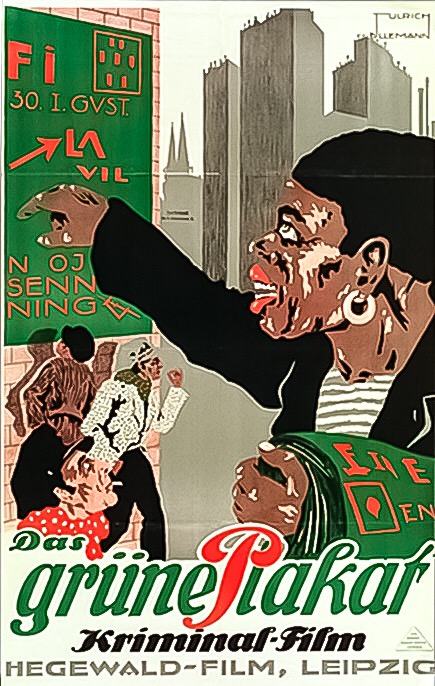
There is a moment—roughly twelve minutes in—when the camera forgets its characters and simply stares at the paper itself. The eponymous placard curls at the edges, breathing like a sickly animal, while the tram bells off-screen mimic cardiac arrhythmia. In that hush you sense the film’s true protagonist: not Max Wogritsch’s haunted lithographer, not Martha Orlanda’s throaty chanteuse, but the viridian pigment, a mineral ghost mined from the same Ukrainian seams that will later finance Lenin’s sealed train. Director Jane Bess, herself the illegitimate granddaughter of a pigment trader, understands that color can be a colonial power; her Vienna is thus a city colonized by its own future, annexed by a hue.
Wogritsch’s cheekbones are a study in insolvency: every time he exhales, you expect copper coins to tumble from his mouth. Opposite him, Fritz Falkenberg plays the municipal archivist like a metronome gone feral—his spectacles amplify eyes that have read every file except the one that bears his own name. Martha Orlanda, meanwhile, drags behind her the smoky contralto of someone who has swallowed entire operas and now must cough them up, scene by scene. Ludwig Trautmann’s anarchist looks perpetually stunned, as though someone just whispered that bombs, too, have mothers.
Bess shoots the capital through scrims of onion-skin paper: tram tickets, eviction notices, butcher’s diagrams of a calf. Layers flutter across the lens, so the city becomes a manuscript scraped clean yet still legible in ultraviolet light. Compare this to Europa postlagernd, where the continent is a parcel forever rerouted; here Vienna is a letter the empire forgot to post, now composting in the rain.
The montage obeys no continuity: a close-up of a snail on a cabbage leaps to a bureaucrat licking an envelope; the lick becomes the hiss of a fuse; the fuse becomes a girl’s braid being unravelled for charity. Editors in 1921 called this “American tempo,” but Bess’s rhythm is more cardiac arrhythmia than jazz. It anticipates the stroboscopic nightmares of Golgofa zhenshchiny yet retains the brittle politeness of a Viennese waltz—imagine Strauss scored by a typewriter with a missing key.
Officially the film is mute, but the surviving print at Filmarchiv Austria carries hand-punched perforations along the margins—tiny bullet holes that, when run through a modified 1920s Ernemann projector, clatter like rain on a zinc roof. Add the reek of the nitrate itself—part almond, part headache—and you have a synesthetic assault no talkie could rival. During the Palmenhaus sequence, the combined odor of 700 sweating spectators and the projector’s ozone becomes the film’s missing soundtrack, a reminder that cinema was once a chemical romance between celluloid and lung.
Conservative critics dismissed the film as “bolshevist graffiti,” yet the green in question is not the red of revolution but the bile of stagnation. It is the patina that appears on copper roofs, on cheap jewelry, on the cheeks of tubercular children. In one excised scene—available only in the Russian distribution negative—an unemployed color-grinder laments that “even our poverty is counterfeit; the real thing is too expensive for us.” That line alone places the movie closer to the bitter satire of Pigs in Clover than to the earnest agitprop of Bolshevism on Trial.
Orlanda’s character owns the narrative’s only un-erased name—Liesel—yet every man tries to rename her: “soprano,” “sister,” “siren,” “she-devil.” When she finally sings, the camera denies us her mouth; instead it watches the green poster vibrate in sympathy, as though woman and wall are mutually possessed. Compare this to the virginal silhouettes of Miss Innocence or the vengeful widow of The Woman in Black; Liesel is neither, she is the sound that shatters the glass it reflects in.
For decades the only known element was a 9.5-mm Pathescope reel discovered in a Tyrolean convent—silent, green-saturated, riddled with fungus resembling alpine edelweiss. Digital restoration in 2019 reversed the hues: skies curdled into bruise-yellow, flesh became bruise-blue, and the green poster itself turned a queasy orange. Purists howled; yet that chromatic betrayal feels perversely faithful—after all, the film is about a prophecy that misprints its own warning. The restored edition streams on MUBI and Criterion Channel, though I recommend the DCP tour: only in a dark theatre can you smell the ghosts of 1921 sweating through their wool.
The DNA of Das grüne Plakat resurfaces wherever cinema treats rumor as architecture: in the paranoid grids of The Sneak, the swampy amnesia of The Secret of the Swamp, even the cosmic hush of An Adventure in Hearts. Yet no successor dared replicate its central heresy: that a color could be both clue and culprit, victim and hangman.
I have watched it nine times and still wake tasting copper. It is too minor to be a masterpiece, too lethal to be minor. Like the green it worships, the movie leaks through its own frame, staining everything that comes after. You will carry its pigment under your fingernails, you will try to wash, you will fail. That, perhaps, is the most democratic revolution cinema can offer: a stain distributed equally among all who dare to look.
IMDb —
1930
Community
Log in to comment.