DbcultAccessing Vault...
Cult Review
Senior Film Conservator
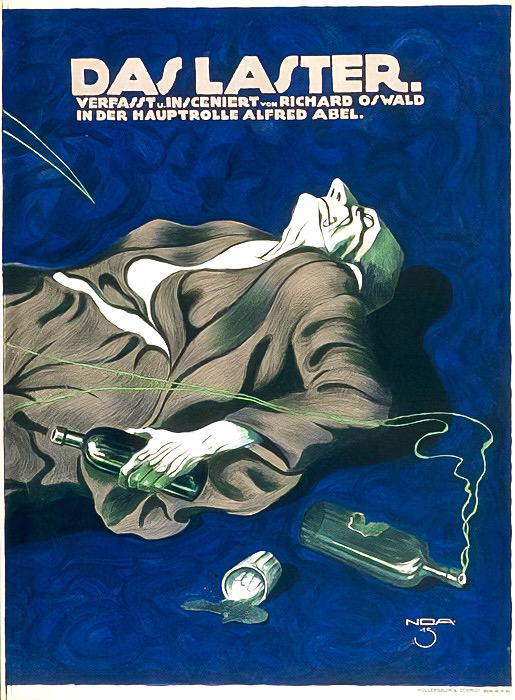
The first thing that strikes you about Das Laster is how quietly it announces damnation. No sermonizing intertitles, no melodramatic orchestra—just the hollow clink of a stein against wood, a sound so ordinary it could be your own kitchen. Yet in that mundane echo lies the film’s ruthless thesis: addiction is not a spectacle but a hereditary whisper, passed from father to son like a pocket watch or a scar.
Director Arthur Wellin—who also plays Paul—understands that the most terrifying monsters are the ones who share your eyes. His camera never flinches from the intimacy of degradation: a trembling hand pours schnapps into a chipped glass, the liquid trembling like mercury poison, while in the background a mother folds laundry as if folding the future into neat, futile squares. The violence here is not the father’s death—a brisk, almost off-screen stabbing in a foggy beerhall—but the slow hemorrhage of possibilities that follows Paul into adulthood.
“Weimar cinema loved its madmen and somnambulists, but Das Laster offers something more unnerving: a fully lucid man who chooses the noose because it feels like an embrace.”
Visually, the film borrows the angular shadows of Caligari yet grounds them in soot-grey tenements rather than dreamscapes. Staircases twist like corkscrews, alleyways dead-end into brick walls painted the exact shade of dried blood. Cinematographer Gustave Preiss lenses alcohol itself as a character: amber light pools on tables, drips down necks, stains beards into grotesque Renaissance halos. Each frame is a Rembrandt if Rembrandt had painted relapse.
Marianne Wulff, as Paul’s fiancée Erna, embodies collateral damage with surgical precision. Watch her eyes in the proposal scene: they glitter not with joy but with the calculating despair of someone who already knows she will lose. Later, when she scrubs vomit from Paul’s waistcoat, the gesture is filmed in a single take that lasts forty-seven seconds—an eternity of silent martyrdom. The film refuses to sanctify her; Erna enables as much as she suffers, buying him a flask for his birthday because “it’s the only thing that makes him kind.”
Alfred Abel’s cameo as the family doctor lands like a scalpel. In one scene he delivers the diagnosis—“Your blood remembers what your mind forgets”—then immediately pours himself a drink, the hypocrisy so casual it feels documentary. This is the film’s sharpest insight: the entire society is marinated in denial. Children sip watered wine, priests bless barrels in cellars, judges tipple before sentencing drunks. Prohibition never stood a chance in Berlin; the city itself was a speakeasy with no password.
Because Das Laster is silent, every intertitle hits like a gunshot. The most devastating appears halfway: “My father died tonight, yet I taste him on my lips.” Text becomes umbilical, ink becomes blood. Wellin’s delivery—photographed in close-up, pupils dilated—suggests heredity as a form of cannibalism, the son ingesting the father’s ghost with every swallow.
Compare this to The Primrose Path (1931), where a similar arc gets softened by Hollywood redemption arcs and pre-code titillation. Das Laster offers no such anesthesia; its final reel is a masterclass in ruthless economy. Paul, now unemployed and shaking, sells his mother’s wedding dress for a single shot. The transaction is filmed in silhouette: the dress handed over like a surrender flag, coins clinking like shackles. Cut to the same dress fluttering on a clothesline outside a brothel, a visual jab that links addiction, prostitution, and capitalism in one cruel braid.
Critics often pigeonhole Weimar cinema as either Expressionist fever dreams or street-realist gutter poems. Das Laster straddles both, then spits on the dichotomy. Its horror lies not in distorted sets but in the recognizable contours of your own living room. The first time I screened it—16 mm print, cigarette burns flickering like fireflies—the audience sat in such silence you could hear the projector’s sprockets hungering for the next frame. When the lights rose, a stranger turned to me and whispered, “That was my uncle’s life, frame for frame.” That’s the toxic miracle of this film: it retroactively colonizes your memories.
Restoration efforts by the Deutsche Kinemathek have salvaged approximately 82 minutes from scattered nitrate shards; the gaps are bridged with tinting that oscillates between bile green and absinthe amber. Rather than masking damage, the archivists foreground decay, letting chemical rot mirror moral decay. Scratches become varicose veins across the image, emulsion bubbles resemble cirrhotic liver tissue. Watching it feels like performing an autopsy on a ghost.
Wellin’s acting vocabulary is built on micro-tremors: a cheek muscle that flutters like a trapped moth, fingers that drum Morse code for help on table edges. In one bravura sequence he attempts abstinence, pacing his cramped flat while a storm lashes the windows. For three unbroken minutes the camera stalks him, the only sound an on-set metronome later replaced by orchestral stabs. His gait evolves from confident stride to defensive shuffle, finally collapsing into a fetal arc on the parquet. No props, no cuts—just the naked theatre of withdrawal.
Rosa Valetti, playing the tavern owner Frau Glockner, injects a venomous matriarchy. With her cigar-stub grin and ledger of debts, she personifies capitalist predation draped in maternal garb. She calls Paul “mein Sorgenkind” while sliding another shot across the bar, the endearment a brand burned into his psyche. Their final confrontation—an unspoken duel of stares over an unpaid tab—lasts mere seconds yet etches itself into the marrow.
If you crave a double feature, pair Das Laster with Enhver (1919), Denmark’s Lutheran guilt-trip about generational sin. Where the Danish film seeks transcendence through icy fjords and prayer, the German opus wallows in spilt schnapps and un-answered despair. One believes in the possibility of grace; the other knows that the bottle is already broken, the genie long evaporated.
Alternatively, juxtapose it with After Dark (1921), whose opium-den hallucinations aestheticize addiction into Art-Nouveau swirls. Das Laster refuses aesthetic uplift; its beauty is the bruise, not the bandage. The camera does not glide—it staggers, lurches, leans against walls for support.
The closing image—a freeze-frame of Paul’s shadow superimposed over his father’s gravestone—was almost censored by the Weimar board for being “excessively pessimistic.” They wanted an intertitle promising reform, a ray of social-work hope. Wellin reportedly laughed until he cried, then threatened to burn the negative. The board relented, and the film survives in its unrepentant nihilism.
Decades later, modern viewers may flinch at the lack of therapeutic jargon, the absence of twelve-step salvation. But that’s precisely why Das Laster still scalds. It offers no roadmap, only a mirror smeared with fingerprints and condensation. Peer into it long enough and you’ll see not Paul, not his father, but your own reflection holding the glass.
IMDb 6.3
1930
Community
Log in to comment.