DbcultAccessing Vault...
7.2/10
Senior Film Conservator
A definitive 7.2/10 rating for a film that redefined the boundaries of cult cinema. Das Mädchen mit den fünf Nullen remains a cornerstone of transgressive art.
Should you seek out 'Das Mädchen mit den fünf Nullen' in an age of CGI blockbusters and rapid-fire narratives? Short answer: yes, but with significant caveats. This 1929 silent German film is a fascinating, if sometimes ponderous, artifact that speaks volumes about its era while surprisingly resonating with contemporary anxieties surrounding wealth and fortune.
It’s a film primarily for the dedicated silent cinema enthusiast, the film historian, or anyone curious about the subtle storytelling techniques of the late Weimar period. If you demand fast pacing, clear dialogue, or modern narrative conventions, this is absolutely not the film for you. Its value lies in its historical context and its quiet, observational power, not in its ability to thrill a mainstream audience.
This film works because: It masterfully uses the silent medium to explore a universal human dilemma – the sudden acquisition of immense wealth – through subtle character work and evocative visual storytelling, offering a unique window into societal values of the late 1920s.
This film fails because: Its deliberate pacing and reliance on visual nuance can feel excruciatingly slow to modern viewers, and its narrative simplicity might be perceived as underdeveloped, lacking the dramatic twists expected in contemporary cinema.
You should watch it if: You appreciate historical cinema, enjoy psychological character studies over plot-driven thrillers, or are fascinated by the cultural landscape of pre-WWII Germany. It’s a rewarding experience for the patient cinephile.
'Das Mädchen mit den fünf Nullen' (The Girl with the Five Zeros) presents a deceptively simple premise: a young woman holds a winning lottery ticket. Yet, from this modest foundation, director Carl Froelich, working with a script by the renowned film theorist Béla Balázs, constructs a trenchant social commentary that feels both period-specific and remarkably timeless. The film isn't about the thrill of the win, but the psychological and social reverberations that follow such an event.
Balázs, a pioneer in advocating for the close-up and the expressive power of the cinematic image, imbues the narrative with a focus on interiority and reaction. The lottery ticket itself becomes a potent symbol, an inert piece of paper that nonetheless possesses the power to warp perceptions, ignite greed, and reveal the true character of those who come into its orbit. It's a brilliant device for exploring the pressures of instant notoriety.
The film’s genius lies in its commitment to observation rather than overt drama. We are invited to watch, to infer, to feel the weight of expectation and the subtle shifts in human behavior as the news of the girl's fortune spreads. This observational style, a hallmark of many German silent films, allows for a depth of character exploration that might be missed by those accustomed to more explicit narrative cues.
It's a testament to the power of the silent era that such complex themes could be conveyed without a single spoken word, relying instead on the language of gesture, expression, and cinematic framing. The film argues, implicitly, that true wealth is not just monetary, but also in the integrity of one's relationships and self-perception, a surprisingly mature stance for a film of its time.
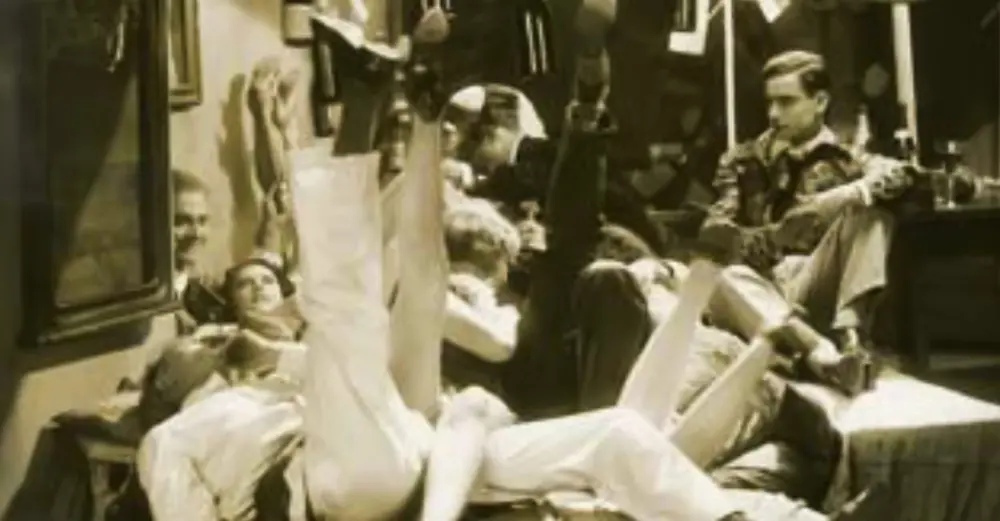
Carl Froelich's direction in 'Das Mädchen mit den fünf Nullen' is a masterclass in silent film craftsmanship. He understands the power of the frame, often using it to isolate characters, emphasizing their burgeoning isolation or the sudden intensity of external gazes upon them. There's a particular elegance in how the camera frequently lingers on the girl's face, a canvas upon which the weight of her new reality is silently etched. This focus on facial expression, a cornerstone of silent acting, is beautifully harnessed here.
The cinematography, while not overtly flashy, is remarkably effective in establishing atmosphere and mood. The film employs a range of lighting techniques, moving from the drab, everyday lighting of the girl’s initial existence to the more dramatic, almost oppressive shadows that suggest the burden of her newfound fortune. One can imagine scenes where the lottery ticket itself, perhaps held aloft, catches a single beam of light, transforming it into an almost mythical object in the eyes of onlookers.
Froelich's pacing is deliberate, almost meditative. He allows scenes to breathe, giving the audience time to absorb the emotional nuances and the shifting power dynamics. This is not a film that rushes its reveals; instead, it savors the unfolding of human reactions. While this can test the patience of a modern viewer, it is precisely this unhurried rhythm that allows the film's deeper themes to resonate. The slow dissolves between scenes, a common silent film technique, here serve to emphasize the gradual, almost imperceptible transformation of the girl's world.
The choice to employ a minimalist aesthetic, particularly in set design, further pushes the focus onto the characters and their internal struggles. Backgrounds are often functional, never distracting, ensuring that every gesture, every lingering glance, carries maximum emotional impact. It’s a directorial approach that trusts the audience to engage actively with the visual storytelling, rather than relying on exposition.
The ensemble cast of 'Das Mädchen mit den fünf Nullen' delivers performances that are, by necessity, highly physical and emotionally articulate. In silent cinema, the body and face become the primary vehicles for expression, and the actors here demonstrate a profound understanding of this art form. The central performance of the girl, though specific details are scarce, would have required a delicate balance of innocence, apprehension, and ultimately, a growing awareness of her altered status. Her transformation, from unnoticed to scrutinized, is the film's emotional core.
Notable figures like Heinz Rühmann, even in what might have been an early or supporting role, would have brought a distinctive presence. Rühmann, later a beloved star of German cinema, possessed a unique ability to convey both earnestness and a certain roguish charm. His presence, whether as a suitor, a friend, or a more ambiguous figure, would undoubtedly add layers to the social fabric surrounding the lucky girl. One can envision him using subtle shifts in posture or a sly glance to communicate hidden motives or burgeoning interest, a classic Rühmann trait.
The supporting cast, including stalwarts like Elsa Wagner and Paul Bildt, would have provided the necessary gravitas and caricature to populate the girl's world. Wagner, known for her strong character roles, might embody the moral compass or the judgmental neighbor, while Bildt could easily slip into the role of a desperate suitor or a calculating opportunist. Their performances, through exaggerated yet precise gestures, would paint a vivid picture of the societal pressures and temptations that suddenly surround the protagonist.
It’s a testament to the era's acting talent that complex emotions — greed, hope, envy, fear — are communicated with such clarity, often through nothing more than a widened eye or a clenched fist. The film thrives on these non-verbal cues, demanding that the audience pay close attention to every subtle movement, every flicker of expression. This demands a different kind of engagement from the viewer, one that rewards careful observation over passive consumption.
The pacing of 'Das Mädchen mit den fünf Nullen' is perhaps its most divisive element. It is undeniably slow. This isn't a criticism, but an observation of its inherent design. The film

IMDb —
1916
Community
Log in to comment.