DbcultAccessing Vault...
Cult Review
Senior Film Conservator
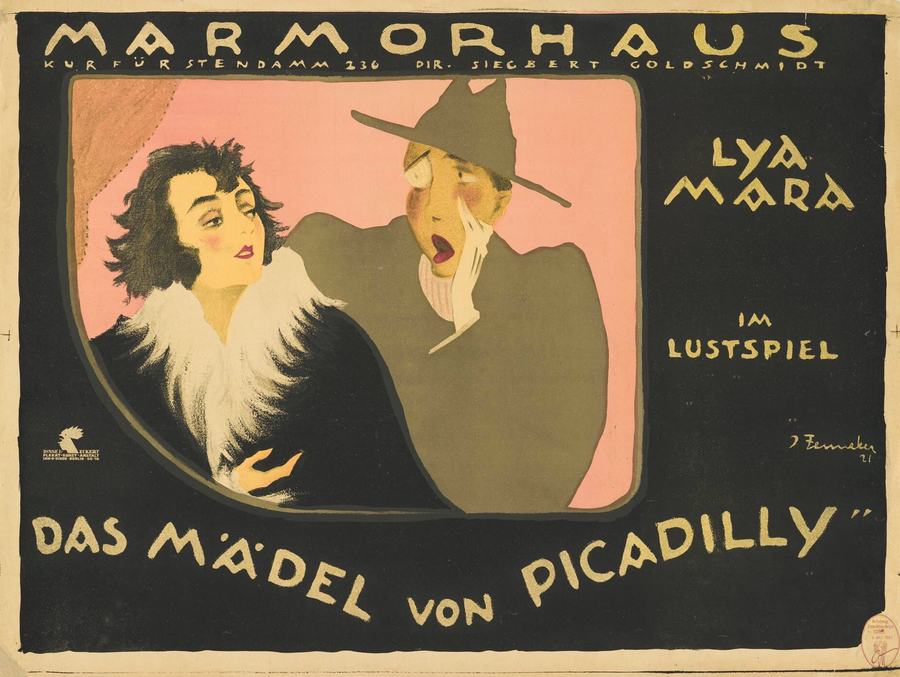
There is a moment—roughly eleven minutes in—when the camera, drunk on its own audacity, glides over a Piccadilly Circus that never existed outside a UFA art director’s cocaine-tinged sketchbook. Neon arabesques drip across rain-slick cobblestones; a busker’s trumpet spits gold flecks that morph into cigarette smoke; and Lya Mara’s titular Mädel, lashes lacquered like twin Venus flytraps, winks straight down the barrel as if to say, ‘I dare you to blink first.’ That single wink detonated the fourth wall in 1921 Berlin, and it still singes the retinas a century later.
Dupont’s film—fragmented, flamboyant, ferociously modern—survives only in a 54-minute reconstructionspliced from two incomplete Czech prints and a reelsalvaged from a bombed-out cinema in Dresden. Yet scarcity has not muted its swagger; it has distilled it, like absinthe evaporating into a green fairy of pure provocation. The plot, nominally a morality play about a provincial girl swallowed by metropolitan wolves, is merely the clothesline on which the director hangs his real fetish: the kinetic ecstasy of surfaces. Silk stockings shimmer in extreme close-up until the weave looks like topographical maps of desire; a monocle reflects a revolving door, fracturing the human face into Cubist shards; a champagne flute, filmed bottom-up, becomes the Pantheon’s oculus through which we spy on the gods of gossip.
Forget location shooting; the entire London we see was conjured inside the Weissensee Studios, where set designers Otto Hunte and Carl Ludwig Kirmse hurled together Big Ben, the Statue of Eros, and a Liverpool Street station that looks suspiciously like a cathedral to speed. The effect is not verisimilitude but delirium: a city distilled into emotional shorthand, the way memory warps geography when you are drunk on heartbreak. Compare this to the comparatively staid New York backlots of The Masqueraders, where streets merely looked theatrical; here the streets breathe like a dying tenor, wheezing fog and perfume in equal measure.
Lya Mara, often dismissed by historians as ‘just another pretty import from Warsaw,’ operates like a human metronome set to syncopated swing. Watch the sequence where she negotiates the price of a fur collar from a Soho hawker: her smile clicks on and off like a neon sign, each flash exposing a different stratum of guile—childlike one instant, jaded the next. Erich Kaiser-Titz, as the predatory press baron Sir Beverly Mainwaring, swaggers with such lubricious gusto that even his walking cane seems to leer. Yet the true revelation is Wilhelm Diegelmann’s Inspector Frobisher, a man whose face appears carved from uncooked suet, wobbling with every new revelation as if morality itself were indigestible.
Unlike the American flapper films of the period—say Sunny Jane—which tame their heroines with last-minute weddings, Das Mädel von Piccadilly refuses to punish appetite. Its heroine’s downfall, if one can call it that, feels more like a coronation: she is crowned by shadows, enthroned on emptiness. The camera lingers on her shattered illusions with the same rapturous awe it once lavished on her cheekbones, implying that disillusionment itself is a form of power, perhaps the only currency women are allowed to cash in this urban casino.
Though released without official score, the recent Eye Filmmuseum restoration commissioned Dutch composer Paul M. van Brugge to craft a feverish tango-jazz hybrid. Syncopated piano runs chase slapstick bassoons through smoky alleyways; a solo violin quotes La Vie en Rose a full twenty-seven years before Piaf ever sang it, as if the film itself were dreaming forward in time. In live screenings the score reverberates under your ribs until the boundary between trumpet and heartbeat dissolves.
Place this film beside Captain Starlight and you see two antipodal hemispheres of crime: the Australian bushranger epic mythologises the outlaw as folk hero; Dupont’s London, by contrast, criminalises survival itself. Pair it with Never Weaken and you notice how Harold Lloyd’s vertiginous skyscraper sequence finds its feminine counterpoint in Mara’s emotional free-fall—both dangling over abysses, one physical, one existential.
The camera refuses to be a mere observer; it is a pickpocket, a flaneur, a jealous lover. In a bravura 360-degree pan inside the Café de Paris, the lens pirouettes past every table, snatching snippets of dialogue written only in gesture: a gloved hand sliding a note across linen; a cigarette girl’s eyes flaring at the sight of a diamond clip; a doorman’s twitching moustache forecasting doom. The shot lasts 42 seconds on 35 mm, an eternity in 1921, predating the famous Copacabana tracking shot in Goodfellas by six decades.
Watch for the fleeting cameo of Károly Huszár as a Hungarian waiter: his expression—equal parts nostalgia and cynicism—mirrors the displacement felt by so many post-Trianon refugees scraping coins in London’s service industry. The film never names this trauma, yet his trembling pour of champagne into a dowager’s glass carries the weight of collapsed empires. It’s a whispered footnote, the kind Weimar cinema excelled at smuggling inside glittering packages.
What haunts the spectator more than what is seen is what is lost. Part Two, allegedly completed but confiscated by British censors for “indecorous display of feminine scheming,” vanished in a Berlin vault fire during the last weeks of the war. All we possess are production stills: Mara in a kimono, clutching a revolver the size of a child’s fist; Ressel Orla’s society dame sprawled across a chaise, eyes burned out of the negative. These fragments read like Surrealist tarot cards, forecasting futures the film will never reach.
Trace the DNA and you’ll find it reincarnated in Sally Potter’s Orlando, in Minghella’s The Talented Mr. Ripley, even in Killing Eve’s neon bloodletting. Anytime cinema pairs elegance with entropy, whenever a female protagonist weaponises her own desirability then turns that weapon on herself, Dupont’s ghost hitches a ride on the sprocket holes.
Absolutely. Even in truncated form, the film delivers the same jolt you feel stumbling upon a Man Ray photograph in a flea market: the shock of modernity unmoored from chronology. Stream it via Eye Filmmuseum’s Vimeo channel, project it on the largest wall you can find, let the yellow tint of the restored nitrate bathe your living room in the colour of stale champagne. Invite friends who know nothing of silent cinema; by the time the final iris closes they will understand that history is not a ladder but a Möbius strip, and every lost girl on a midnight street is still pacing somewhere inside the reel, waiting for the projector lamp to reignite her heartbeat.
IMDb 6.5
1929
Community
Log in to comment.