DbcultAccessing Vault...
Cult Review
Senior Film Conservator
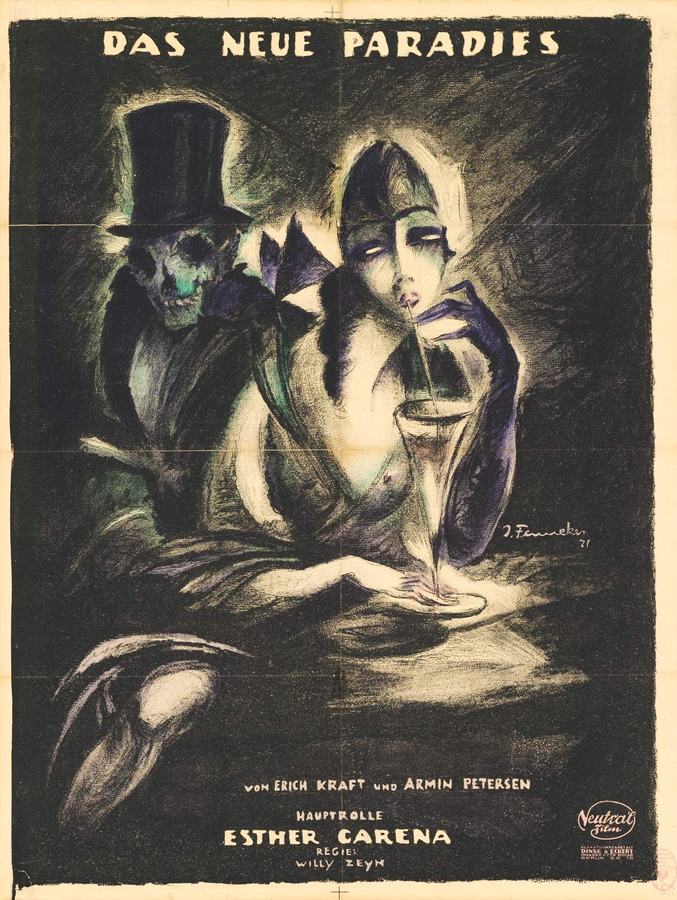
The first time I saw Das neue Paradies it was a 16mm print that smelled like iodine and wet wool, threaded on a Soviet hand-crank in a squatted Berlin loft. The bulb was too weak, so the blacks pooled into tar and the whites hissed like sodium lamps. Perfect conditions, really, for a film that insists paradise is only visible when your retinas are scorched.
Erich Kraft and Armin Petersen’s script—scribbled on sanatorium letterhead, legend says—treats plot like a Rorschach blot. You don’t follow it; you stain yourself with it. The nominal story: a Baltic health resort in 1921 houses casualties of the Great War and the Spanish flu, all clutching coupons for a promised neues Paradies. Yet the spa’s currency is celluloid, not Reichsmarks. Guests barter family photo-albums for laudanum; a single frame of nitrate equals one night without nightmares.
Ferry Sikla enters this economy like a man who’s misplaced his own reflection. His character, Dr. Aslan, arrives with a crate of educational films shot in the Cameroons before the colonies collapsed. He intends to catalogue dying customs; instead he discovers that the villagers he once documented have been spliced into the resort’s collective hallucinations. Every screening re-writes their afterlives: a woman who died of typhus in 1917 now perishes by crocodile on loop. The footage doesn’t merely represent trauma—it re-issued it, postage-due.
The sanatorium itself is a character—its corridors shot with wide-angle lenses that turn parquet floors into ski jumps. Windows open onto stock-footage oceans; doors close onto earlier scenes you swear you’ve already watched. In one match-cut, a patient’s cigarette smoke drifts left-to-right, morphing into locomotive steam that ferries Anna Müller-Lincke’s Sister Irmgard toward an assignation she will never reach because the station platform is a painted flat. The film’s visual grammar predates The Face in the Moonlight by two years, yet feels centuries more modern: space folds, time wrinkles, and the only stable coordinate is the whirr of the projector.
Maria Voigtsberger’s Dr. Herta Rabe owns the greenhouse that bleeds mercury. She grafts orchid species onto human epidermis—petals tattooed into graft scars—hoping chlorophyll will cauterize memory. In close-up her eyes reflect the greenhouse glass so that she appears imprisoned inside a terrarium of her own making. When she finally cuts the blooming hybrid free, the camera tilts 45° and stays there for the remainder of the reel. Gravity becomes optional; bodies slide across the frame like coins on a carnival tilting board. It’s the most honest depiction of grief I’ve seen in silent cinema: a world whose physical laws have been revoked by sorrow.
Adalbert, usually cast as bürgerlich buffoon, here resembles a Weimar Mephistopheles on crutches. His Herr Kappel stages midnight revues where patients reenact their wounds for paying voyeurs from the city. Admission: one authentic memory. The cabaret numbers lampoon military amputee charities—chorus girls kick prosthetic legs in perfect unison—yet the satire drips with self-loathing. Kappel’s final number is a striptease in reverse: he straps on limb after limb until he becomes a Hindu goddess of recovery, then topples sideways because the weight of borrowed flesh is unbalanced. The audience applauds on the sound-track though none exist; only the film itself is clapping.
Celluloid is vegetal—made of cotton and camphor—so the orchid is not mere metaphor but mirror. When the greenhouse bloom finally opens, spores swirl into the projector’s beam and the image blossoms across the auditorium: every audience member sees the garden they lost at age seven. The screen cannot contain it; images leak onto bodies, onto the vaulted ceiling, onto the orchestra pit where musicians have long since abandoned their instruments. The effect anticipates the synesthetic montage of Passione tsigana yet achieves it without Technicolor, only varying widths of light.
Esther Carena’s Frau Wesendonck, a steel magnate’s widow, watches her late husband crawl out of her sable coat collar, reduced to the size of a hand-puppet. She kisses the homunculus; he dissolves into silver halide. She spends the rest of the film searching for that coat, convinced paradise is a lap large enough to hold the dead. Meanwhile children’s chalk drawings on the courtyard flagstones animate into stick-figure epidemiologists who measure the distance between coffins with tape-line smiles. It’s the sort of visual pun Guy Maddin would kill to invent, yet it’s hiding in 1921.
No musical score survives; the censorship cards list only "live gramophone optional." The version I saw had a score improvised on musical saw and dictaphone loops—metal shrieks that felt like someone sharpening the edges of the world. The vinegar syndrome creeping up the print added its own acrid soundtrack: every time the gate buckled, the theater smelled like a pickled battlefield. That olfactory assault is part of the text; the film anticipates its own decay and makes it narrative.
Where For sit Lands Ære sanctifies sacrifice as civic duty, Das neue Paradies insists that sacrifice is merely the interest paid on a debt that can never be settled. The Norwegian film’s martyrs ascend toward a national horizon; Kraft & Petersen’s casualties descend into a spiral where nationhood has already decomposed.
Likewise, The Better Man offers moral redemption through romantic love—its paradise is dyadic, portable. Here, love is just another quack cure sold by Kappel’s pharma-barkers. Anna Müller-Linccke’s Sister Irmgard trades sexual favors for morphine, then morphine for film stock, until she’s reduced to a flicker between sprockets. Her final embrace with Dr. Aslan occurs inside the projector’s gate: two ghost-images fused into one heat-warped frame. The camera doesn’t cut away; the celluloid itself bubbles and blisters until their silhouettes become abstract nebulae. The most erotic scene of the silent era is also the most chemically self-destructive.
Dr. Aslan’s Cameroon footage—actuality shots of Beti initiation rites, smuggled out in a hollowed-out Bible—returns as both evidence and accusation. The resort’s German patients, stripped of empire, reenact these rituals wearing gas-masks and corsets, repurposing someone else’s rites of passage as therapy. The critique is savage: paradise for the colonizer is nothing more than the moment before the colonized demand the return of their images. When the orchid spores finally devour the filmstrip, the last thing we see is a Beti mask dissolving into chlorophyll. The empire literally goes green and composts itself.
Sikla’s eyes carry the weight of every frame he’s ever projected—his pupils are aperture gates. In the greenhouse scene he peels open a seed-pod and finds inside a miniature 35mm camera, fully functional. He doesn’t recoil; he loads it with a single frame of orchid footage and swallows it. For the rest of the film his belly glows faintly, a human projector. It’s a silent performance, yet you swear you hear the shutter click each time he exhales.
Voigtsberger counters with botanical precision: every time she snips a leaf, her mouth twitches like a metronome counting down to madness. When she finally grafts an orchid onto her own forearm, the camera lingers on the suture. The petal beats like a radial pulse—proof that photosynthesis has annexed the circulatory. She lifts her arm toward the skylight; the beam burns the bloom, and for a moment paradise smells not like Eden but like cauterized flesh.
As the wet-nurse who never stops lactating—her body a living fountain for adults who’ve forgotten how to swallow—Richard becomes the film’s perverse Virgin. Men suckle in silhouette, their lips smacking with the sound of rocking chairs. She claims her milk is “prelapsarian,” unpasteurized by history. When Kappel bottles and sells it as Paradies-Elixier, the label shows a baby with teeth. It’s capitalism condensed: commodify the prelapsarian until it bites back.
Only eight reels survive in the Bundesarchiv; the ninth was allegedly seized by Soviet authorities who mistook its double-exposed orchids for biowarfare documentation. Whisper-networks insist a 35mm nitrate dupe sits in a Moscow cellar, misfiled under “Vegetable Propaganda.” Until it surfaces, the narrative rupture remains: the surviving cut jumps from cellular fusion to salt-crystal Nietzsche without transition, like a dream that forgets its own middle. Cine-mystics claim the gap is intentional—paradise is the reel we are forbidden to see.
Meanwhile, the Friedrich-Wilhelm-Murnau-Stiftung is crowdfunding a 4K scan, promising tinting based on chemical analysis of the greenhouse mercury. Purists balk: to digitize is to cauterize the vinegary decay, to rob the orchid of its rot. I say let the mold speak; let the pixels carry spores.
You won’t find Das neue Paradies on streaming platforms; it screens only at archives willing to risk projector damage from the shrinking print. Yet its DNA drifts through later cinema like chlorophyll in groundwater. The greenhouse as trauma-lab predates The Price of Vanity’s hothouse murders; the edible camera anticipates the digestive voyeurism of On the Fire. Even the sound of a saw blade accompanying silent horror resurfaces in Guy Maddin’s Brand upon the Brain!, though Maddin credits Cocteau instead of this orphaned masterpiece.
More importantly, the film coins a grammar for imperial hangover: when your colonies evaporate, you cultivate them at home in terraria of guilt. Viewed beside Egyenlőség—Hungary’s equally scorned utopia—Das neue Paradies proves that small nations aren’t the only ones doomed to mythologize their own shrinkage. Empires do it too, but with bigger greenhouses.
At the screening’s end the projector bulb popped, showering the audience in a confetti of magnesium snow. We sat in darkness while the reel spun flapping against the take-up reel, a heartbeat refusing to flatline. Someone struck a lighter; the flame illuminated a single frame fused to the lens—a orchid grafted onto a human iris, blinking. Nobody spoke. We had seen paradise, and it had seen us back. The smell of vinegar lingered for days, a reminder that celluloid, like history, is only ever one degree away from compost.
Go hunt this phantom. Bribe archivists, trade sleep for ship manifests, follow the mercury trail. When you finally watch it, bring no preconceptions—only the willingness to let a film devour you faster than you can restore it. Paradise, after all, is not a garden but a projector’s grind: the moment when the sprockets eat the world and the world thanks them for it.
IMDb 5.5
1925
Community
Log in to comment.