DbcultAccessing Vault...
6.4/10
Senior Film Conservator
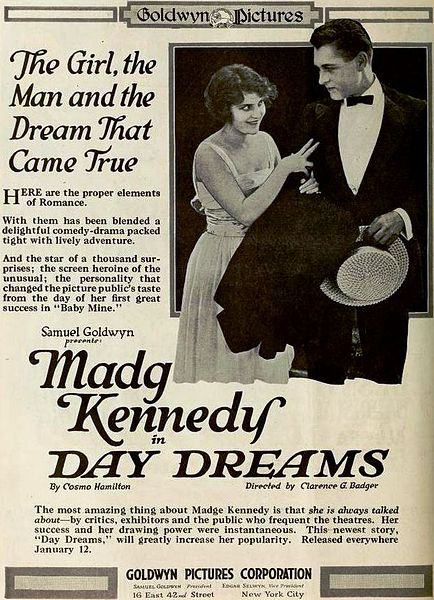
A definitive 6.4/10 rating for a film that redefined the boundaries of cult cinema. Day Dreams remains a cornerstone of transgressive art.
Step into the ethereal glow of early cinema, and you'll often discover narratives that, despite their age, resonate with an astonishing contemporary relevance. Day Dreams, a 1919 silent film, is precisely one such treasure. It’s not a grand epic of historical battles or a sprawling melodrama of societal upheaval, but rather an intimate, exquisitely rendered portrait of a young woman’s soul. This film, penned by the insightful Cosmo Hamilton, delves into the universal human yearning for something more profound than the ordinary, a desire that often finds its crucible within the confines of a quiet, unassuming life.
The core of Day Dreams lies in its protagonist, brought to life with remarkable subtlety by Madge Kennedy. She embodies the quiet despair and vibrant inner life of a young woman whose existence is, by all outward appearances, utterly unremarkable. Her days are a tapestry woven from the threads of routine and expectation, devoid of the thrilling escapades and passionate encounters she devours in the pages of her beloved chivalric romances. These tales of a gallant White Knight are not mere entertainment; they are a lifeline, a mental sanctuary where her spirit soars free from the gravitational pull of her circumstances. The White Knight isn't just a character; he's a potent symbol of rescue, of true love, of a destiny far grander than the one laid out before her. This profound internal conflict, the chasm between her vivid imagination and her drab reality, forms the emotional bedrock of the film, allowing Kennedy to convey a spectrum of emotions through nuanced gesture and expressive gaze, a testament to the power of silent film acting.
The delicate balance between aspiration and practicality is further explored through the introduction of a wealthy industrialist, portrayed with a certain stolid charm by Alec B. Francis. His suit represents a path of material security and societal acceptance, a safe harbor from the uncertainties of life. For many women of the era, such a match would be the culmination of their hopes, a pragmatic solution to a life often fraught with economic precarity. Yet, our protagonist, fueled by the literary ideals that have shaped her inner world, finds herself unable to acquiesce. Her heart, or rather, her deeply ingrained romantic sensibility, rebels against the notion of a life without the transcendent spark she envisions. Her rejection of the industrialist is not merely a refusal of a man; it is a profound declaration of her commitment to an ideal, a silent scream against the suffocating embrace of the conventional. This defiance, subtle as it may be, speaks volumes about the burgeoning sense of self and agency that characterized the turn of the century, a quiet revolution often played out in the private chambers of the heart.
The narrative then introduces a pivotal figure: a young writer, played by John Bowers, who arrives in her sleepy village. His appearance is not heralded by trumpets or bathed in an otherworldly glow, but rather by the subtle shift in the protagonist's perception. Is this the White Knight, disguised in the unassuming garb of an intellectual? The film expertly plays on this ambiguity, allowing the audience to share in her tentative hope, her cautious optimism. Bowers’ portrayal is nuanced, suggesting a depth and sensitivity that contrasts sharply with the industrialist’s more straightforward demeanor. This shift from a purely internal fantasy to the potential manifestation of that fantasy in the real world is where Day Dreams truly shines, offering a poignant commentary on how our ideals often find form in unexpected, perhaps less theatrical, ways. The film doesn't preach; it invites contemplation, allowing the viewer to ponder the delicate dance between what we imagine and what we encounter.
Madge Kennedy’s performance is nothing short of captivating. Without the luxury of spoken dialogue, she conveys the vast emotional landscape of her character through an intricate ballet of facial expressions and body language. Her eyes, in particular, are windows to a soul brimming with longing, disappointment, and nascent hope. When she reads her tales, her gaze becomes distant, lost in the heroic exploits of her fictional saviors. When confronted by the industrialist, her polite but firm rejections are communicated through a slight turning of the head, a subtle stiffening of the posture. And when the writer appears, the hesitant, almost imperceptible softening of her features speaks volumes about the stirrings within her heart. This masterful command of her craft is a powerful reminder of why performers like Kennedy were considered titans of the silent era, capable of eliciting profound empathy and understanding from an audience through purely visual means. Her work here is a masterclass in understated emotional conveyance, making the audience feel every tremor of her character's inner life.
The directorial choices, while not explicitly attributed in the prompt, demonstrate a keen understanding of visual storytelling. The cinematography often juxtaposes the stark reality of the village with the dreamlike sequences, perhaps rendered through soft focus or imaginative framing, that represent the protagonist's inner world. The use of close-ups on Kennedy’s face amplifies her emotional journey, drawing the viewer into her most private thoughts. The pacing is deliberate, allowing moments of quiet reflection to breathe, which is crucial for a film so focused on internal states. The overall aesthetic is one of understated elegance, serving the narrative rather than overshadowing it. This approach allows the thematic richness of Cosmo Hamilton’s writing to fully blossom on screen, proving that a compelling story doesn't always require bombastic spectacle but can thrive on psychological depth and character-driven nuance.
Cosmo Hamilton’s screenplay for Day Dreams is a remarkably insightful piece of writing, especially considering the limitations of the silent medium. He crafts a story that is not just about a woman's choice between two men, but about the profound human need to reconcile idealism with reality. The 'White Knight' is more than a romantic trope; it's an emblem of escape, of meaning, of a life lived fully. Hamilton's genius lies in translating this abstract yearning into concrete, visual scenes and interactions that allow the audience to understand the protagonist's motivations without a single spoken word. His narrative structure, with its clear delineation between the protagonist's inner world and her external circumstances, provides a powerful framework for the emotional arc of the film. It's a testament to his skill that such a nuanced psychological drama could be conveyed so effectively through the nascent cinematic language of the time.
The supporting cast, though perhaps less central to the film’s intimate focus, contributes significantly to the overall texture of the narrative. Grace Henderson and Marcia Harris likely provide the grounding presence of the community, representing the societal norms and expectations that the protagonist navigates. Jere Austin’s role, perhaps as a friend or another suitor, would add further layers to the protagonist’s social milieu. Each actor, in their silent roles, plays a part in building the world around Madge Kennedy’s character, making her journey feel more authentic and her internal struggles more poignant. Their presence, even in brief appearances, helps to solidify the social fabric against which her personal drama unfolds, providing context and contrast to her unique aspirations. The collective efforts of the ensemble ensure that the protagonist's isolation and longing feel all the more palpable.
Comparing Day Dreams to its contemporaries reveals its distinct voice. While films like The Three Musketeers (1916) offered grand adventures and swashbuckling heroes, Day Dreams opted for an internal journey, a quiet heroism of the soul. It shares a thematic kinship with films exploring female agency and societal constraints, though perhaps with a gentler touch than some. One might find echoes of a woman's struggle for self-definition in a new environment, similar to the thematic currents in Her New York, where the protagonist also navigates a world that doesn't quite align with her expectations. The yearning for a life beyond the ordinary, a romantic escape, also subtly connects it to films like The Little Pirate, which might feature a spirited heroine dreaming of adventure. Unlike the overt struggles depicted in a film like Silnyi chelovek, Day Dreams focuses on the more subtle, yet equally powerful, battles waged within the human spirit. Its enduring legacy lies in its ability to tap into a universal human experience: the often-solitary quest for meaning and connection that transcends mere survival or convenience. It speaks to the part of us that believes in the possibility of enchantment, even when life seems determined to offer only the mundane. The film reminds us that dreams, even if they never fully materialize as imagined, are vital for animating our existence.
In essence, Day Dreams is more than just a silent film from a bygone era; it is a timeless meditation on the power of imagination, the allure of idealism, and the quiet courage it takes to hold onto one's dreams in the face of a starker reality. It invites us to consider the profound impact of the stories we tell ourselves, and how those narratives shape our perception of the world and our place within it. Madge Kennedy's performance remains a poignant reminder of the enduring human spirit that seeks not just sustenance, but transcendence. It’s a film that whispers rather than shouts, but its message resonates with an undeniable clarity, proving that some of the most profound human dramas unfold not in grand spectacles, but in the quiet chambers of the heart, where dreams are nurtured and realities are subtly reshaped by the enduring hope for a White Knight, in whatever form he may appear.
IMDb —
1929
Community
Log in to comment.